
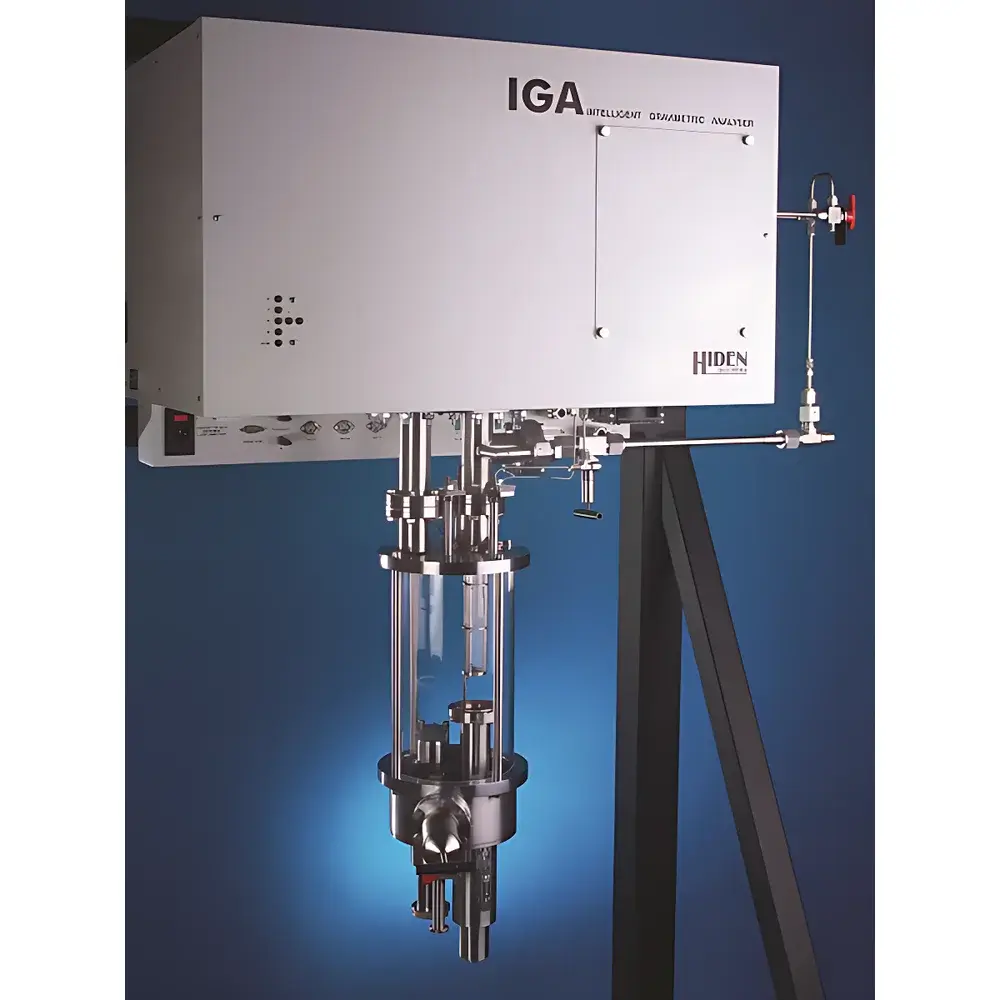
Hiden IGA Intelligent Gravimetric Sorption Analyzer
| Brand | Hiden |
|---|---|
| Origin | United Kingdom |
| Model | IGA |
| Balance Capacity | 1 g (5 g optional) |
| Sample Mass Range | 0–100 mg (0–200 mg with 5 g balance) |
| Mass Resolution | 0.1 µg (0.2 µg with 5 g balance) |
| Mass Stability | ±1 µg (long-term, static), ±0.1 µg (short-term) |
| Vacuum Base Pressure | <1×10⁻⁶ mbar |
| Maximum Operating Pressure | 10 bar (20 bar optional) |
| Pressure Resolution | 1/16,000 of full scale |
| Pressure Accuracy | ±0.02% of full scale |
| Temperature Range | −270 °C to 1000 °C |
| Temperature Resolution/Accuracy | ±1 °C (Type K thermocouple), ±0.01–0.1 °C (PRT) |
| Temperature Response Time | 0.05 s (Type K), 1 s (PRT) |
| Pressure Vessel Certification | ASME Section VIII Div. 1 / BS 5500 Category III |
Overview
The Hiden IGA Intelligent Gravimetric Sorption Analyzer is a high-precision, fully automated gravimetric system engineered for quantitative characterization of gas and vapor sorption behavior across an exceptionally wide operational envelope. At its core, the IGA employs a state-of-the-art microbalance—integrated into a rigorously controlled vacuum and pressure environment—to directly measure mass changes in real time as adsorption or desorption occurs. This fundamental gravimetric principle eliminates assumptions inherent in volumetric methods (e.g., dead volume calibration, gas compressibility corrections), delivering intrinsic accuracy for both equilibrium and kinetic sorption data. Designed without compromise for materials science research, the IGA accommodates diverse sample classes—from ultralow-surface-area metals and MOFs to hygroscopic polymers and high-temperature ceramics—under precisely regulated temperature (−270 °C to 1000 °C) and pressure (10−6 mbar to 10 bar, upgradable to 20 bar) conditions. Its architecture supports both static (equilibrium isotherms) and dynamic (transient uptake, breakthrough, pulse injection) measurement protocols, making it a primary tool for hydrogen storage evaluation, catalytic surface analysis, and advanced porous material development.
Key Features
- Ultra-stable microbalance platform with 0.1 µg resolution (standard 1 g capacity) and long-term stability of ±1 µg under inert, static conditions—critical for low-uptake measurements on high-surface-area materials.
- High-fidelity pressure control system featuring 1/16,000 full-scale resolution and ±0.02% accuracy, enabling precise isobaric and isothermal stepping for rigorous thermodynamic modeling (e.g., virial, Langmuir-Freundlich, D-R).
- Multi-range temperature capability with dual-sensor support: fast-response Type K thermocouples (0.05 s response) for rapid thermal cycling and high-accuracy Platinum Resistance Thermometers (PRTs) for sub-0.1 °C stability in long-duration experiments.
- ASME Section VIII Div. 1 and BS 5500 Category III certified pressure vessel—ensuring mechanical integrity and regulatory compliance for high-pressure gas handling (including H₂, CO₂, NH₃, hydrocarbons).
- Modular configuration options: IGA-001 (single-gas), IGA-002 (vapor), IGA-003 (multi-gas), IGA-100 (dynamic multi-component), IGAsorp (water vapor), and IGAsorp-CT (high-temperature water sorption).
- Integrated purge and pre-treatment sequences—including in situ heating under dynamic vacuum or reactive gas flow—enabling reproducible surface activation prior to sorption analysis.
Sample Compatibility & Compliance
The IGA accepts solid powders, pellets, monoliths, and thin films within a 0–100 mg standard mass range (extendable to 200 mg). Its design accommodates chemically aggressive vapors (e.g., H₂O, NH₃, SO₂, organic solvents) and corrosive gases (Cl₂, HCl) via chemically resistant internal wetted parts (Hastelloy, quartz, Viton-free options available). All models comply with ISO 15901-2 (physisorption), ISO 21360 (vacuum metrology), and ASTM D3663 (catalyst surface area). For regulated environments, the system supports audit-trail-enabled operation per FDA 21 CFR Part 11 when paired with validated software configurations, and meets GLP/GMP documentation requirements for catalyst qualification and battery material certification workflows.
Software & Data Management
Hiden’s proprietary IGA Control & Analysis Suite provides real-time visualization of mass, pressure, temperature, and derived parameters (e.g., uptake rate, differential heat, diffusion coefficient). Raw data are stored in vendor-neutral HDF5 format with embedded metadata (instrument ID, calibration timestamps, operator logs). The software includes built-in modules for BET surface area, t-plot micropore analysis, DFT/NLDFT pore size distribution, and kinetic modeling (e.g., Avrami, Fickian diffusion). Export functions support CSV, Excel, and Origin-compatible formats; API access enables integration with LIMS and ELN systems. Full traceability—including version-controlled method templates and electronic signatures—is maintained throughout experimental execution and post-processing.
Applications
- Hydrogen storage capacity and reversibility assessment on metal hydrides, complex hydrides, and carbon-based sorbents—per ISO 16111 and SAE J2717 protocols.
- Catalyst characterization: metal dispersion (via CO/O₂ chemisorption), active surface area, TPD/TPR/TPO profiling, and coke formation kinetics.
- Porous material development: micropore volume, narrow pore size distribution (<0.7 nm), and framework stability under cyclic vapor exposure (e.g., MOFs, zeolites, COFs).
- Pharmaceutical solid-state analysis: moisture-induced phase transitions, amorphous content quantification, and excipient compatibility screening per ICH Q5C guidelines.
- Energy materials: Li-ion battery electrode hydration, solid electrolyte interfacial (SEI) layer evolution, and gas evolution monitoring during thermal runaway simulation.
- Environmental sorbents: CO₂ capture capacity under flue-gas-relevant conditions (15% CO₂, 85% N₂, 40–80 °C), humidity swing performance, and competitive adsorption selectivity.
FAQ
What distinguishes gravimetric sorption from volumetric (manometric) methods?
Gravimetric measurement directly tracks mass change, eliminating reliance on gas law assumptions, dead volume calibration, and compressibility corrections—yielding higher accuracy for low-uptake systems and non-ideal gases.
Can the IGA perform simultaneous multi-gas or multi-vapor experiments?
Yes—the IGA-100 and IGA-003 configurations support up to four independently controlled gas/vapor lines with sequential or co-flow capability, enabling competitive adsorption and mixture breakthrough studies.
Is the system compatible with mass spectrometry (MS) or FTIR coupling?
All IGA models feature standardized UHV-compatible flanges and real-time analog/digital outputs, enabling seamless integration with residual gas analyzers (RGAs), quadrupole MS, or transmission FTIR cells for evolved gas analysis (EGA).
How is temperature uniformity ensured across the sample zone?
The furnace incorporates multi-zone PID control and calibrated axial thermocouple mapping; optional radial PRT arrays provide spatial temperature verification per ASTM E220 for high-accuracy kinetic studies.
What calibration standards and documentation are provided?
Each system ships with NIST-traceable mass calibration weights, pressure transducer certificates (valid for 12 months), and a full Factory Acceptance Test (FAT) report including balance linearity, vacuum leak rate, and temperature homogeneity validation data.



