
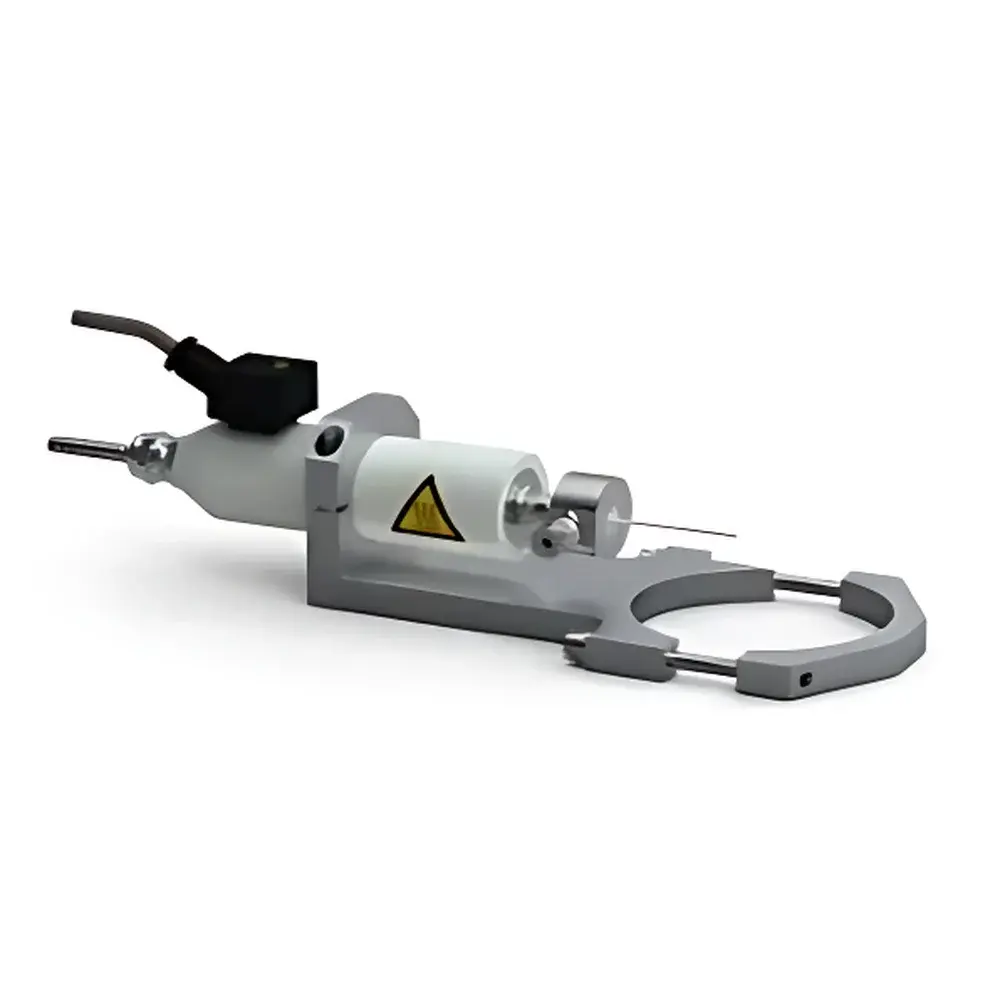
Hiden TGA-MS Thermal Gravimetric Analysis–Mass Spectrometry Coupling System
| Brand | Hiden |
|---|---|
| Origin | Austria |
| Model | TGA-MS |
| Interface Type | Capillary Direct-Coupling Interface |
| Dead Volume | Minimized (< 10 µL) |
| Capillary Temperature Control | Up to 300 °C |
| Material of Construction | Inert (High-Purity Stainless Steel, SilcoNert®-treated Surfaces) |
| Gas Handling | Dual-Channel Mass Flow Controlled (H₂, He, N₂, Ar Compatible) |
| Flow Rate Range | 0.1–50 mL/min (Adjustable to Match TGA Effluent Profile) |
| Compliance | ASTM E2550, ISO 11358, USP <1210> |
Overview
The Hiden TGA-MS Thermal Gravimetric Analysis–Mass Spectrometry Coupling System is an engineered interface solution designed for real-time, quantitative evolved gas analysis (EGA) during thermal decomposition, oxidation, or desorption processes. It integrates a high-sensitivity quadrupole mass spectrometer (QMS) with commercial thermogravimetric analyzers via a heated, low-dead-volume capillary transfer line. The system operates on the principle of coupling thermally induced mass loss (measured gravimetrically as a function of temperature/time) with simultaneous molecular identification and semi-quantitative concentration profiling of gaseous species (m/z 1–300 amu) by electron ionization (70 eV) mass spectrometry. This configuration enables direct correlation between weight change events and chemical speciation—critical for mechanistic studies in materials science, polymer degradation, catalysis, pharmaceutical stability testing, and battery electrode characterization.
Key Features
- Heated fused-silica or stainless-steel capillary interface (temperature-controlled up to 300 °C), eliminating condensation of semi-volatiles and ensuring transmission fidelity for labile species such as H₂O, CO, CO₂, NH₃, SO₂, and organic fragments.
- Ultra-low dead volume (< 10 µL) design minimizes residence time and band broadening, preserving temporal resolution between TGA mass-loss steps and MS signal onset—essential for kinetic deconvolution.
- Entire gas pathway constructed from inert, passivated materials (SilcoNert®-coated stainless steel, VCR fittings, electropolished surfaces) to prevent catalytic surface reactions, adsorption, or memory effects.
- Dual independent mass flow controllers (MFCs) support precise delivery of reactive or inert carrier gases (e.g., H₂, He, N₂, Ar) either for purging, reaction atmosphere control, or calibration gas introduction.
- Real-time synchronization via TTL trigger signals ensures time-aligned acquisition between TGA thermogram (mass vs. temperature/time) and MS transient spectra (intensity vs. m/z vs. time).
- Modular architecture allows integration with major TGA platforms including Netzsch, TA Instruments, Mettler Toledo, and PerkinElmer systems without hardware modification.
Sample Compatibility & Compliance
The TGA-MS system accommodates solid, powdered, or thin-film samples (typically 1–20 mg) across ambient to 1200 °C operating ranges, depending on the host TGA furnace. It supports both dynamic (ramped heating) and isothermal protocols under controlled atmospheres. The interface complies with ASTM E2550 (Standard Test Method for Thermal Stability by Thermogravimetry), ISO 11358 (Plastics — Thermogravimetry of Polymers), and USP (Analytical Instrument Qualification). Data acquisition and reporting meet GLP/GMP documentation requirements, with optional 21 CFR Part 11-compliant software modules available for audit-trail logging, user access control, and electronic signature functionality.
Software & Data Management
Hiden’s QGA (Quantitative Gas Analysis) software provides synchronized visualization of TGA derivative curves (DTG), mass loss %, and time-resolved mass spectra. It includes peak deconvolution tools, library matching (NIST/EPA/NIH spectral databases), isotopic pattern fitting, and relative quantification using pre-calibrated sensitivity factors. Raw data are stored in vendor-neutral ASCII formats (CSV, TXT) and HDF5-compliant binaries for third-party analysis in MATLAB, Python (via h5py), or Thermo Fisher Omnic. All processing steps—including background subtraction, dwell time optimization, and m/z drift correction—are fully traceable and scriptable for method validation.
Applications
- Decomposition mechanism elucidation in metal-organic frameworks (MOFs) and coordination polymers.
- Residual solvent mapping and dehydration kinetics in active pharmaceutical ingredients (APIs).
- Oxidative stability assessment of lithium-ion battery cathode materials (e.g., NMC, LFP) under O₂/N₂ mixtures.
- Catalyst deactivation analysis via coke formation and sulfur poisoning pathways.
- Pyrolysis product profiling from biomass, plastics, or composites for circular economy feedstock evaluation.
- Thermal aging studies of encapsulants and adhesives in photovoltaic module reliability testing.
FAQ
What sample types are compatible with the TGA-MS interface?
Solid powders, granules, thin films, and pressed pellets—provided they generate measurable volatile or gaseous products within the operational temperature range of the host TGA.
Can the system quantify evolved gases absolutely?
Yes—absolute quantification is achievable using calibrated reference gases (e.g., certified CO₂ in N₂) and instrument-specific response factors determined per m/z channel; semi-quantitative trending is standard without calibration.
Is vacuum compatibility maintained during coupling?
Yes—the capillary interface maintains differential pumping integrity: the TGA side operates at near-atmospheric pressure while the QMS chamber sustains ultra-high vacuum (≤1×10⁻⁷ mbar) via turbomolecular pumping.
How is synchronization between TGA and MS achieved?
Hardware-level TTL pulse triggering from the TGA controller initiates MS acquisition cycles, ensuring sub-second temporal alignment between mass loss events and ion signal transients.
Does the system support reactive gas environments like H₂ or CO?
Yes—dual MFCs enable stable, programmable delivery of reducing or oxidizing atmospheres, with full compatibility for in situ reduction studies or catalytic reaction monitoring.
Related Products





