
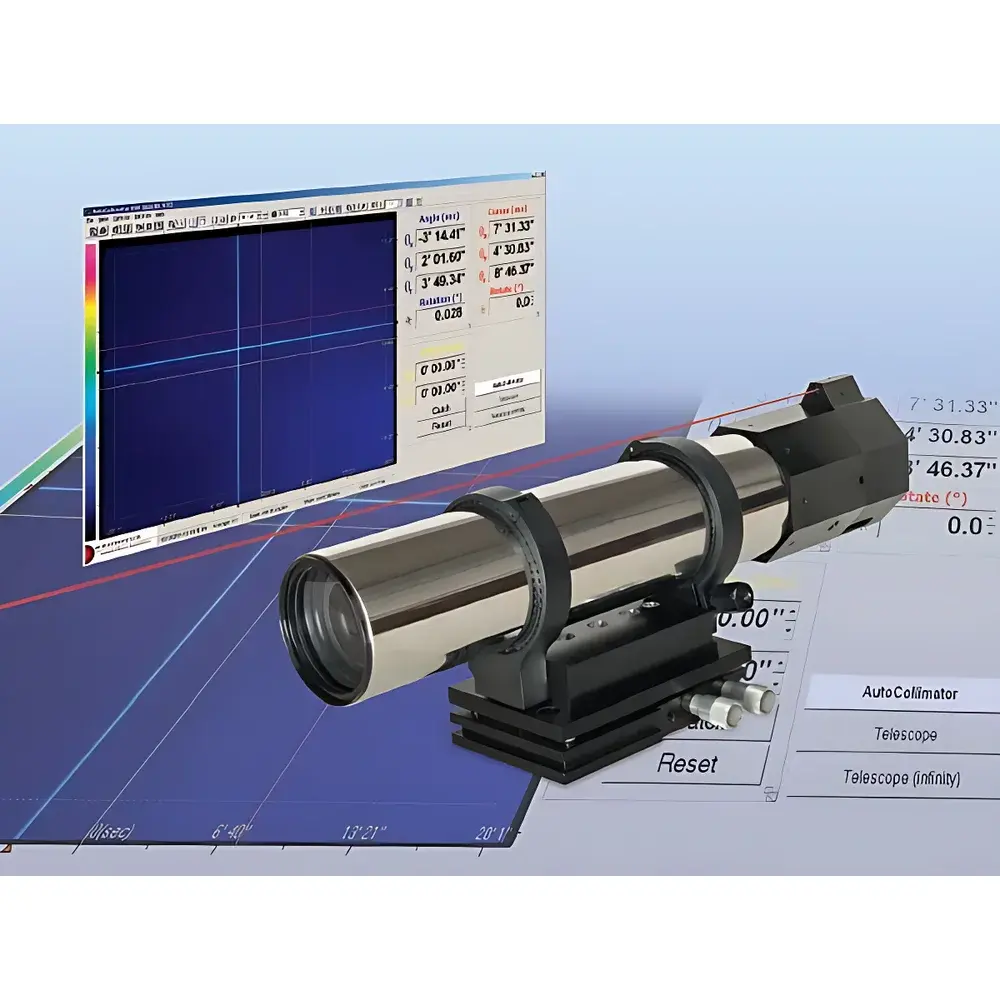
High-Precision Motorized Auto-Collimator EAC-HR by Duma Optronics
| Brand | Duma Optronics |
|---|---|
| Origin | Israel |
| Model | EAC-HR |
| Aperture Diameter | 62 mm |
| Angular Resolution | 0.01 arcsec (0.1 µrad) |
| Field of View | 20′ (H) / 40′ (H) |
| Accuracy | ±1.0 arcsec |
| CCD Sensor | 1/2″ (1/3″ optional) |
| Light Source | 638 nm LED (Class 2, IEC 60825-1) |
| Focus Range | 30 cm to ∞ with boresight retention ±5 arcsec |
| Objective Thread | M67×0.75 mm |
| Collimation Mirror | Ø64 mm, mass 280 g, mounting thread Ø16 mm |
| Interface | USB 2.0, RS232, TCP/IP |
| Operating System | Windows 7 (32/64-bit) |
| Software | Native GUI + ActiveX SDK for integration |
Overview
The Duma Optronics EAC-HR is a high-precision motorized auto-collimator engineered for non-contact angular metrology in optical alignment, interferometric setup verification, and precision mechanical adjustment tasks. Based on the fundamental principle of autocollimation—where a collimated beam is reflected back from a flat mirror and reimaged onto a high-resolution CCD sensor—the EAC-HR quantifies minute angular deviations by measuring centroid displacement of the returned spot. Its optical architecture integrates a stabilized 638 nm LED source, an M67×0.75 mm objective lens with continuous focus adjustment (30 cm to infinity), and a 1/2″ progressive-scan CCD detector delivering sub-pixel resolution. With a calibrated angular resolution of 0.01 arcsecond (0.1 µrad) and traceable accuracy of ±1.0 arcsecond, the system meets stringent requirements for ISO 10110–7 surface orientation verification, telescope collimation, and laser cavity alignment in R&D and production environments.
Key Features
- Motorized focusing mechanism enabling repeatable boresight retention within ±5 arcseconds across the full focus range (30 cm to infinity)
- 62 mm clear aperture objective optimized for low wavefront distortion and minimal vignetting in high-dynamic-range angular measurements
- Dual-field-of-view capability: 20′ (horizontal) and 40′ (horizontal) selectable via software, supporting both fine-alignment and coarse-acquisition modes
- Integrated Class 2 laser alignment aid (638 nm, <1.0 mW) compliant with IEC 60825-1 for rapid initial mirror positioning
- Modular interface support: USB 2.0 for real-time imaging and control; RS232 and TCP/IP for industrial PLC or SCADA integration
- ActiveX-based software development kit enabling seamless embedding into custom LabVIEW, MATLAB, or C# applications under Windows 7 (32/64-bit)
Sample Compatibility & Compliance
The EAC-HR is designed for use with optically flat reflective surfaces—including first-surface mirrors, retroreflectors, and polished metal targets—with minimum reflectivity >90% at 638 nm. It supports standard optical mounts (e.g., kinematic mirror cells, tip-tilt stages) via its Ø64 mm collimation mirror adapter (M16 thread). The instrument complies with IEC 60825-1:2014 for Class 2 laser product safety and conforms to electromagnetic compatibility standards per EN 61326-1. While not certified to ISO/IEC 17025, its calibration traceability follows NIST-traceable angular reference standards, making it suitable for GLP-aligned optical validation protocols and internal quality assurance workflows in photonics manufacturing.
Software & Data Management
The native EAC-HR Control Suite provides real-time spot tracking, statistical analysis (mean, std dev, min/max over time), and automated report generation in PDF or CSV format. All measurement sessions include timestamped metadata (exposure time, gain, focus position, ambient temperature if logged externally). The ActiveX SDK exposes full API access—including asynchronous acquisition, ROI definition, and multi-instrument synchronization—enabling audit-ready data capture compliant with FDA 21 CFR Part 11 when deployed with validated electronic signature modules. No cloud storage or remote telemetry is enabled by default; all data remains local unless explicitly exported by the user.
Applications
- Alignment and stability monitoring of high-power laser cavities and amplifier chains
- Verification of angular repeatability in precision rotary stages and goniometers
- In-process collimation validation during optical component assembly (e.g., beam expanders, afocal systems)
- Dynamic tilt measurement of MEMS mirrors and adaptive optics elements
- Calibration transfer between coordinate measuring machines (CMMs) and optical angle standards
- Telescope primary mirror figure alignment and secondary mirror decentering analysis
FAQ
What is the maximum working distance for reliable measurement?
The EAC-HR maintains specified resolution and accuracy up to 10 meters with a high-reflectivity target; beyond this, signal-to-noise ratio decreases due to beam divergence and atmospheric turbulence.
Can the system measure dynamic angular motion?
Yes—continuous acquisition at up to 30 Hz (dependent on ROI size and USB bandwidth) enables real-time tracking of slow mechanical drift or thermal-induced tilt, though not intended for kHz-range vibration analysis.
Is calibration certification included with purchase?
A factory calibration report with measured linearity, repeatability, and reference standard traceability is supplied; NIST-traceable recalibration services are available through authorized Duma service centers.
Does the software support automated pass/fail criteria for production line use?
Yes—the Control Suite allows user-defined tolerance bands per axis, with visual alerts and exportable binary pass/fail flags compatible with MES integration.
What environmental conditions affect measurement stability?
Ambient temperature gradients >1°C/m and air currents across the optical path introduce refractive index variations; operation in temperature-stabilized, draft-free environments is recommended for sub-arcsecond repeatability.




