
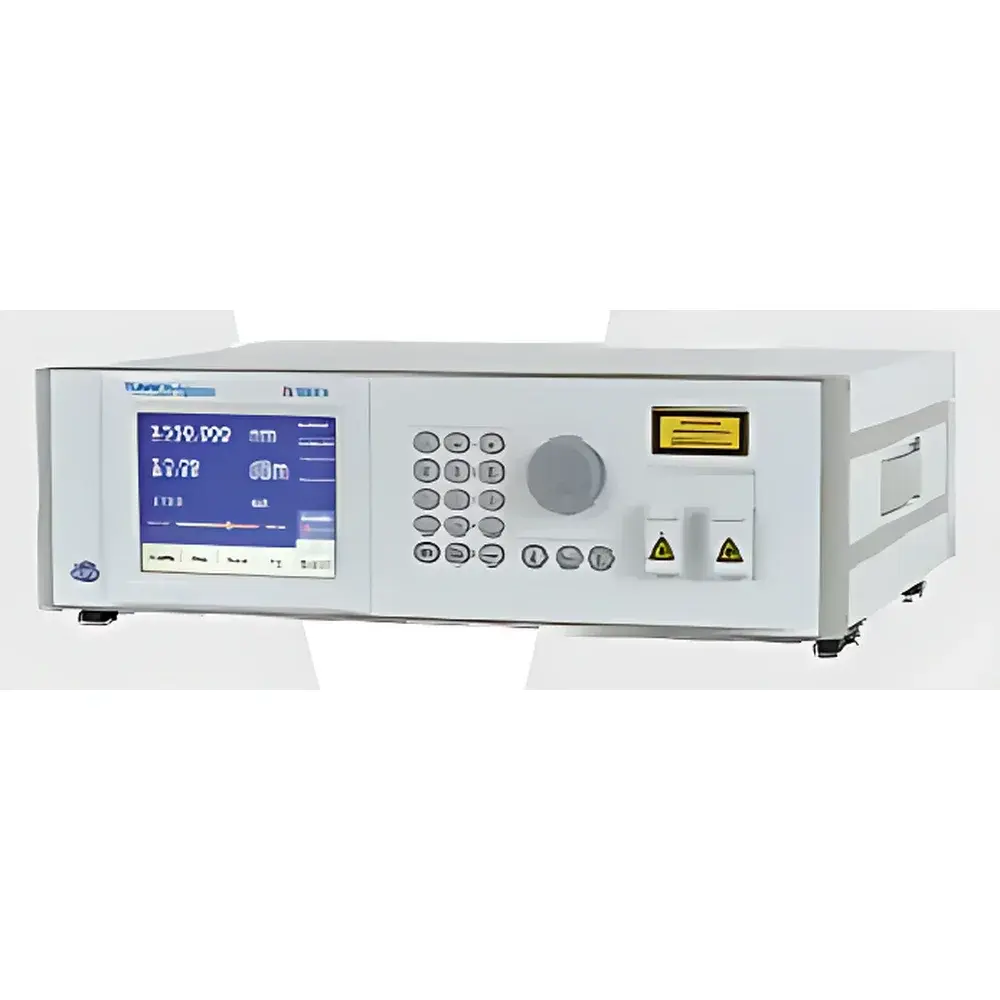
Yenista Tunics Reference ES/SCL High-Performance Tunable Laser Source
| Brand | Yenista |
|---|---|
| Origin | France |
| Model | Tunics Reference ES/SCL |
| Tuning Range (mode-hop-free) | Up to 160 nm |
| Absolute Wavelength Accuracy | ±25 pm (±5 pm with Integrated Wavelength Meter option) |
| Wavelength Stability | ±5 pm/h (±1 pm/h with IWM) |
| Output Power | > +10 dBm |
| Linewidth (FWHM) | 500 kHz typical (coherence-controlled) |
| Wavelength Setting Resolution | 1 pm |
| Scan Speed | 1–100 nm/s (adjustable) |
| Power Stability | ±0.01 dB/h |
| SMSR | >45 dB |
| RIN | –145 dB/Hz (typ.) |
| Optical Isolation | 35 dB |
| Return Loss | 60 dB |
| Interface | RS-232C, IEEE-488.2 (GPIB) |
| Operating Temperature | +18 to +35 °C |
| Dimensions (W×H×D) | 480 × 133 × 370 mm |
| Weight | 12.5 kg |
Overview
The Yenista Tunics Reference ES/SCL is a high-precision, mode-hop-free tunable laser source engineered for metrology-grade optical characterization in research laboratories, component manufacturing test benches, and advanced photonic system validation. Based on external cavity diode laser (ECDL) architecture with active thermal and piezoelectric feedback control, it delivers exceptional wavelength accuracy, long-term stability, and broad spectral coverage across the C- and L-bands. Its core measurement principle relies on interferometric wavelength locking and real-time cavity length compensation—enabling traceable, NIST-compatible calibration paths when paired with an integrated or external wavemeter. Designed for applications demanding sub-picometer repeatability and low phase noise, the Tunics Reference serves as a primary reference source in DWDM filter mapping, optical coherence tomography (OCT) system alignment, silicon photonics wafer-level testing, and fiber Bragg grating (FBG) sensor interrogation.
Key Features
- Mode-hop-free tuning over up to 160 nm—spanning 1390–1610 nm depending on configuration (ES or SCL variant)
- Absolute wavelength accuracy of ±25 pm (3σ), improvable to ±5 pm with optional Integrated Wavelength Meter (IWM) module
- Wavelength stability better than ±5 pm/h (±1 pm/h with IWM), validated per ITU-T G.694.1 channel grid requirements
- Output power exceeding +10 dBm into SMF-28™ fiber with 45 dB side-mode suppression ratio (SMSR)
- Coherence-controlled linewidth of 500 kHz (typ.), configurable to >100 MHz for swept-source OCT or dynamic dispersion compensation
- Sub-1 pm wavelength setting resolution and ±5 pm (±1 pm with IWM) tuning repeatability over 100 consecutive scans
- Programmable scan modes: continuous, step-sweep, and trigger-synchronized; scan speed adjustable from 1 to 100 nm/s
- Optical output isolation ≥35 dB and return loss ≥60 dB—minimizing back-reflection-induced instability in sensitive interferometric setups
- Comprehensive remote control via RS-232C and IEEE-488.2 (GPIB), fully compatible with National Instruments hardware and SCPI command sets
Sample Compatibility & Compliance
The Tunics Reference ES/SCL interfaces seamlessly with industry-standard passive and active photonic components—including arrayed waveguide gratings (AWGs), thin-film filters, MEMS tunable filters, and integrated Mach–Zehnder modulators. Its FC/APC connectorized output ensures compatibility with polarization-maintaining and standard single-mode fiber test fixtures. The instrument meets CE marking requirements under Directive 2014/30/EU (EMC) and 2014/35/EU (LVD). Firmware supports audit-trail logging and user-access control levels aligned with GLP/GMP documentation practices. While not FDA-certified as a medical device, its performance parameters comply with key sections of IEC 61280-2-9 (optical amplifier testing) and Telcordia GR-1312-CORE (tunable laser reliability).
Software & Data Management
Yenista provides the Tunics Control Software (TCS) v4.x—a Windows-based application supporting full instrument configuration, automated calibration routines, and synchronized data acquisition with optical power meters and optical spectrum analyzers. TCS enables script-driven batch scanning, CSV/TXT export with timestamped metadata, and direct integration into LabVIEW via VISA drivers. All wavelength and power measurements include embedded uncertainty estimates derived from self-calibration logs. For regulated environments, optional firmware upgrades support 21 CFR Part 11-compliant electronic signatures, audit trail retention (>18 months), and role-based access control—facilitating compliance during FDA or ISO 17025 laboratory accreditation audits.
Applications
- DWDM component characterization: insertion loss, passband shape, and channel spacing verification per ITU-T G.694.1
- Fiber-optic sensor interrogation: high-resolution FBG and micro-ring resonator resonance tracking
- Photonic integrated circuit (PIC) testing: spectral response mapping of ring resonators, directional couplers, and modulators
- Swept-source optical coherence tomography (SS-OCT): coherence-length-optimized sweeps with <0.25 dB power flatness across 100 nm
- Calibration of optical frequency combs and secondary wavelength standards
- Nonlinear optics experiments requiring narrow-linewidth, high-power tunability (e.g., difference-frequency generation)
- Quantum photonics: preparation of indistinguishable single-photon sources via resonant excitation
FAQ
What is the difference between the Tunics Reference ES and SCL models?
The ES variant covers 1390–1540 nm at 0 dBm output, optimized for extended short-wavelength operation; the SCL variant spans 1460–1610 nm at +10 dBm, emphasizing L-band power and stability for long-haul telecom testing.
Can the laser be locked to an external reference cavity?
Yes—via analog voltage input (–5 to +5 V) supporting Pound–Drever–Hall or side-of-fringe locking schemes; the front-panel modulation inputs (10 kHz–200 MHz) allow direct RF phase-lock loop integration.
Is self-calibration traceable to NIST standards?
Self-calibration uses internal wavemeter references traceable to national metrology institutes; users may perform periodic validation using an external NIST-traceable wavemeter connected via RS-232C.
Does the instrument support multi-channel synchronization?
Yes—through TTL trigger I/O and GPIB bus triggering, enabling precise temporal alignment with oscilloscopes, digitizers, or other Tunics units in multi-laser configurations.
How often is recalibration required under ISO/IEC 17025 conditions?
Annual calibration is recommended; however, built-in self-calibration routines (performed every 24 h or before critical measurements) maintain traceability without interrupting workflow.





