
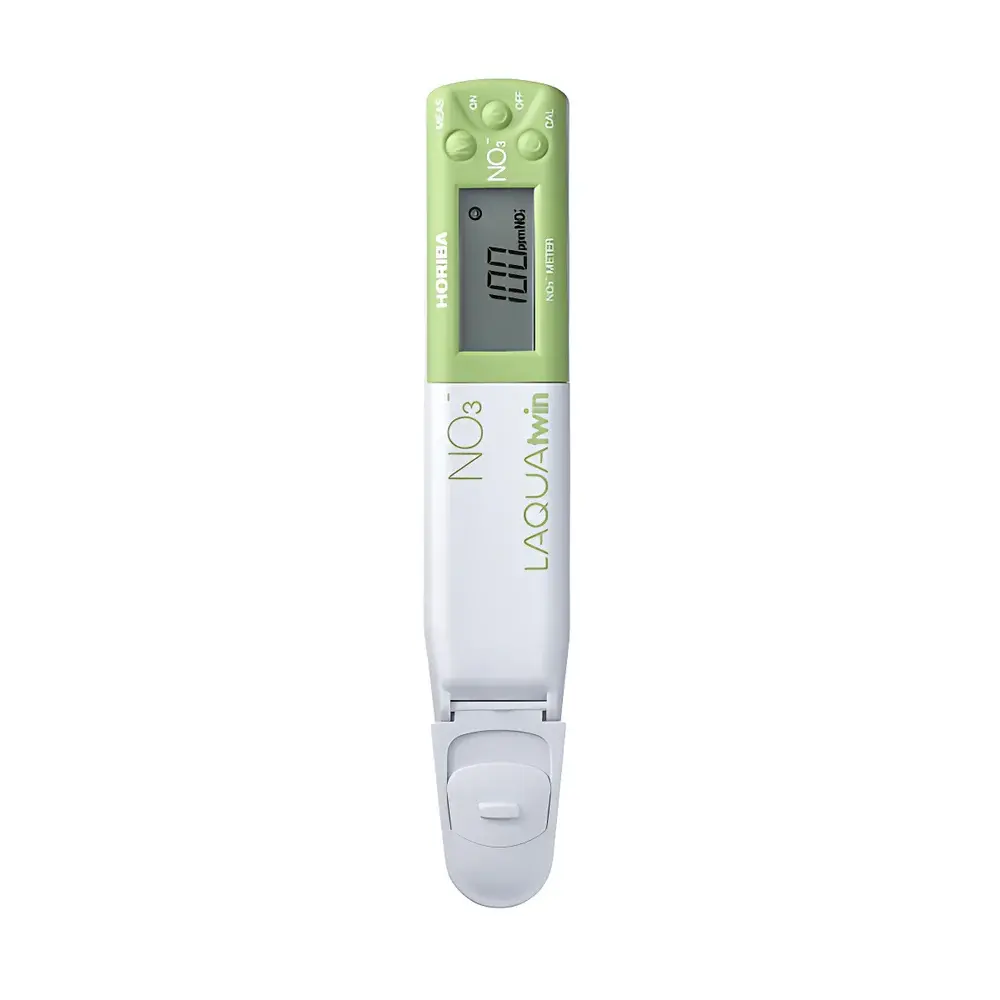
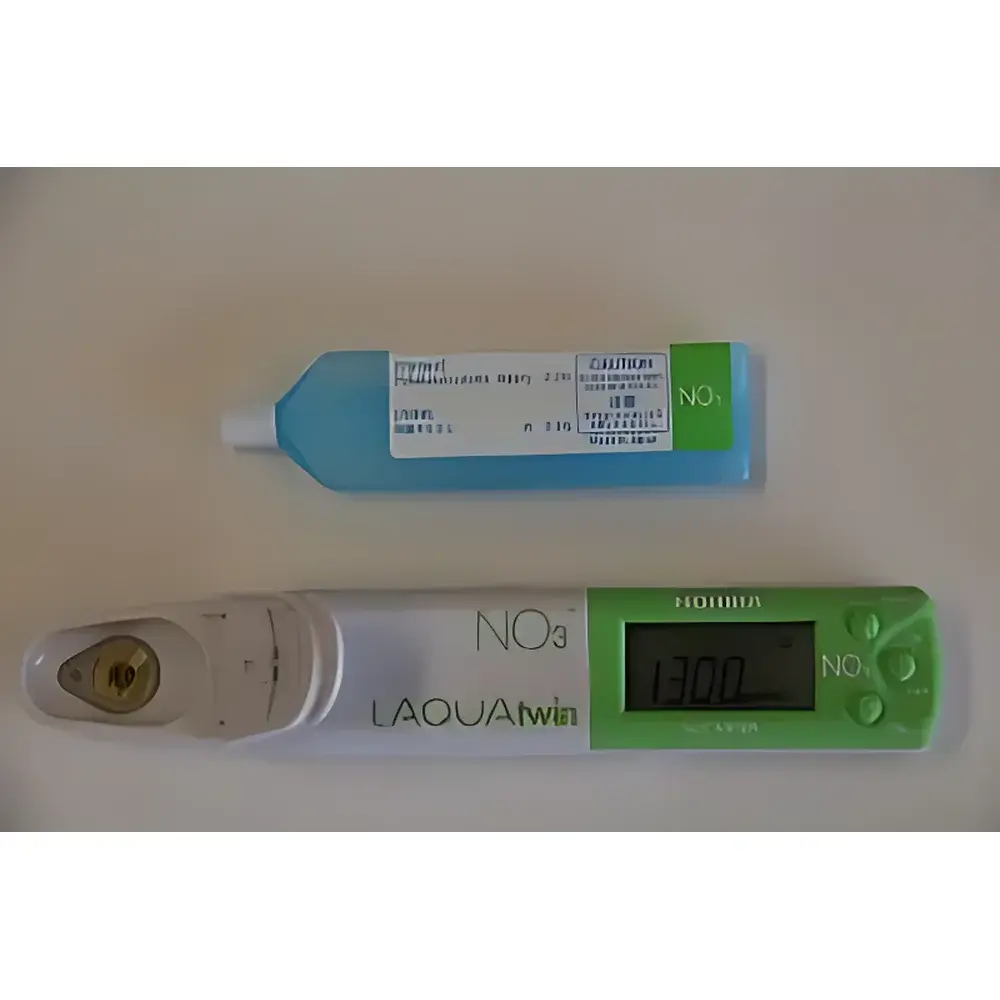
HORIBA B-743 Nitrate Ion Meter
| Brand | HORIBA |
|---|---|
| Origin | Japan |
| Model | B-743 Nitrate Ion Meter |
| Instrument Type | Portable Ion-Selective Electrode (ISE) Meter |
| Measurement Principle | Potentiometric Detection via Nitrate-Selective Electrode |
| Measuring Range | NO₃⁻: 62–6200 ppm (mg/L) [1.0 × 10⁻³ – 1.0 × 10⁻¹ mol/L] |
| NO₃⁻–N | 14–1400 ppm (mg/L) |
| Detection Limit | Same as measuring range (defined by electrode Nernstian response and signal-to-noise threshold) |
| Response Time | ≤30 s (t₉₀) |
| Accuracy | ±10% of reading |
| Temperature Compensation | Automatic (5–40 °C) |
| Environmental Operating Conditions | 5–40 °C, <85% RH (non-condensing) |
| Ingress Protection | IP67 |
| Power Supply | Two CR2032 lithium coin cells |
| Dimensions (L×W×H) | 164 × 29 × 20 mm (excl. probe protrusion) |
| Weight | ~50 g (instrument body only) |
Overview
The HORIBA B-743 Nitrate Ion Meter is a compact, handheld potentiometric analyzer engineered for rapid, field-deployable quantification of nitrate (NO₃⁻) concentration in aqueous environmental samples. Utilizing a solid-state, ion-selective electrode (ISE) with a polymeric membrane selective to nitrate anions, the instrument operates on the Nernst equation principle—generating a millivolt potential proportional to the logarithm of NO₃⁻ activity in solution. Designed specifically for routine water quality screening, the B-743 delivers direct readout in both NO₃⁻ (mg/L or mol/L) and NO₃⁻–N (mg/L) units, supporting regulatory compliance workflows in surface water monitoring, wastewater effluent verification, agricultural runoff assessment, and drinking water pre-screening. Its micro-volume sampling capability (as low as 0.05 mL per measurement) minimizes reagent consumption and enables analysis in constrained or remote locations where sample volume is limited.
Key Features
- Potentiometric ISE Architecture: Integrated nitrate-selective sensor with stable, low-drift membrane chemistry optimized for reproducible response across the 10⁻³–10⁻¹ mol/L activity range.
- Micro-Sampling Capability: Validated for reliable measurement using ≥0.05 mL sample volume—ideal for spot checks in streams, wells, or lab-prepared standards without dilution.
- Automatic Temperature Compensation (ATC): Built-in thermistor ensures accurate mV-to-concentration conversion across the full operational range (5–40 °C).
- IP67-Rated Enclosure: Dust-tight and submersible up to 1 m for 30 minutes—enabling robust use in humid field environments, rain-exposed sampling sites, or wash-down laboratory settings.
- Two-Point Calibration Protocol: Supports standardized calibration using certified nitrate reference solutions (e.g., 100 ppm and 1000 ppm NO₃⁻), traceable to NIST SRMs where applicable.
- Auto-Hold Function: Freezes stable readings after signal stabilization (≤30 s t₉₀), reducing operator dependency and improving inter-user consistency.
- Low-Power Design: Dual CR2032 batteries provide >2000 measurements per set under typical usage; auto-power-off after 10 minutes of inactivity.
Sample Compatibility & Compliance
The B-743 is validated for use with natural waters (freshwater, groundwater, treated effluents), nutrient solutions, and low-TDS aqueous extracts. It exhibits minimal interference from common anions—including chloride (<5000 ppm), sulfate (<2000 ppm), and bicarbonate (<1000 ppm)—when operated within manufacturer-specified ionic strength limits (0.01–0.1 M KNO₃ background recommended). While not intended for high-precision regulatory reporting (e.g., EPA Method 300.0 or ISO 10304-1), the device meets functional requirements for Tier-1 field screening aligned with ASTM D3370 (Standard Practices for Sampling Water) and supports GLP-aligned documentation when paired with calibrated reference standards. Data output complies with basic traceability needs for internal QA/QC logs and preliminary environmental incident response.
Software & Data Management
The B-743 operates as a standalone instrument with no onboard memory or digital interface. All measurements are displayed in real time on a high-contrast LCD and must be manually recorded. For audit-ready workflows, users are advised to document calibration dates, standard concentrations, ambient temperature, and measured values in bound logbooks or LIMS-integrated electronic forms. The instrument’s ±10% accuracy specification aligns with typical tolerances expected in rapid field triage per ISO/IEC 17025 Clause 7.7 (Uncertainty of Measurement) when used with certified calibrants and trained personnel. No firmware updates or software drivers are required—ensuring long-term operational continuity without dependency on proprietary platforms.
Applications
- Field-based nitrate surveillance in watershed management programs
- Rapid assessment of fertilizer leaching risk in agricultural soils (via soil extract analysis)
- Pre-screening of municipal drinking water sources for NO₃⁻ exceedance (vs. WHO 50 mg/L guideline)
- Monitoring denitrification efficiency in wastewater treatment lagoons and bioreactors
- Educational laboratory exercises in environmental chemistry and instrumental analysis
- Validation of portable spectrophotometric nitrate kits via orthogonal ISE confirmation
FAQ
What sample volume is required for a valid measurement?
Minimum 0.05 mL per test; however, volumes ≥0.3 mL are recommended for improved signal stability and reduced air bubble interference.
Can the B-743 measure nitrate in seawater or high-salinity samples?
No—elevated chloride and ionic strength cause significant activity coefficient deviation and electrode interference; use only in freshwater or low-conductivity matrices (<2 mS/cm).
Is calibration traceable to national standards?
Calibration requires user-supplied nitrate standards; traceability depends on the certification level of those standards (e.g., NIST-traceable CRM solutions).
How often should the electrode be cleaned or conditioned?
Rinse with deionized water after each use; soak in 10⁻² M KNO₃ for 30 min weekly if used daily; avoid abrasive cleaning or organic solvents.
Does the instrument comply with FDA 21 CFR Part 11?
No—the B-743 lacks electronic record storage, audit trails, or user authentication; it is not designed for regulated GMP/GLP production environments requiring electronic signature compliance.
Related Products







