
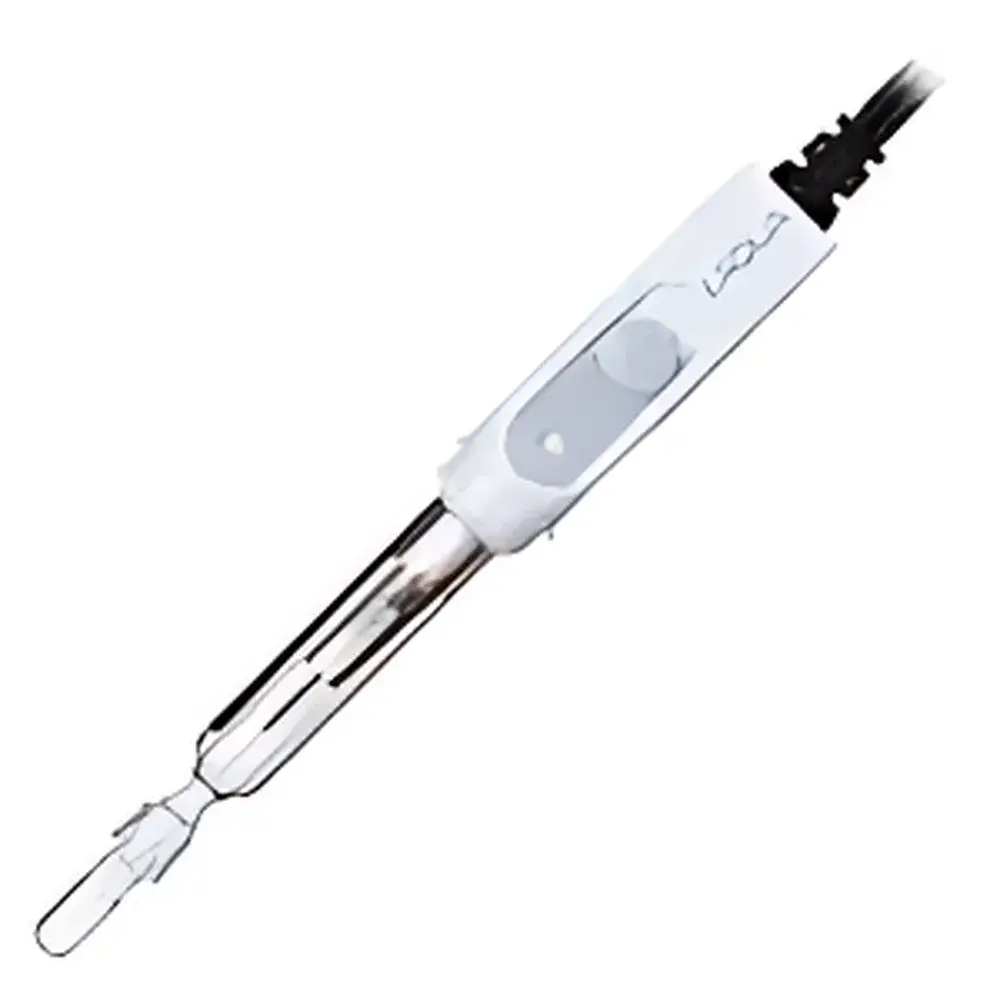
HORIBA 9615-10D / 9625-10D Tri-Combined pH Electrode with Integrated Temperature Sensor
| Brand | HORIBA |
|---|---|
| Origin | Japan |
| Model | 9615-10D / 9625-10D |
| Construction | Integrated Glass pH Sensor, Reference Electrode, and Pt1000 Temperature Sensor |
| Body Material | 9615-10D — Glass Shaft |
| Membrane Type | ToupH Thick-Film Glass (9615-10D) |
| Internal Electrolyte | KCl 3.0 mol/L (Ref. #300) |
| Application Focus | Municipal drinking water, ultrapure water, low-buffered samples, field-deployable environmental monitoring |
Overview
The HORIBA 9615-10D and 9625-10D are tri-combined pH electrodes engineered for high-reliability, field- and lab-grade water quality analysis in environmental monitoring applications. Each electrode integrates three essential sensing elements—pH-sensitive glass membrane, Ag/AgCl reference system, and integrated Pt1000 temperature sensor—within a single, compact probe body. This architecture eliminates inter-electrode calibration drift and thermal lag, enabling real-time, temperature-compensated pH measurement per NIST-traceable protocols. The 9615-10D utilizes HORIBA’s proprietary ToupH thick-film glass technology, delivering rapid response (<15 s to ±0.01 pH in buffer), exceptional long-term stability (<0.002 pH/day drift), and resistance to silver ion leaching—a critical factor in extended deployment across surface water, groundwater, and distribution system monitoring. The 9625-10D replaces the traditional glass shaft with a rugged, chemically inert plastic body rated IP67 (submersible to 1 m for ≤30 minutes), making it suitable for portable, unattended, or harsh outdoor deployments where mechanical impact or breakage risk is elevated. Both models feature a double-junction reference design with ceramic frit junction and KCl 3.0 mol/L internal electrolyte (#300), minimizing liquid junction potential errors in low-conductivity matrices such as drinking water (10–50 µS/cm) and ultrapure water (≤0.1 µS/cm).
Key Features
- True tri-combined architecture: Simultaneous pH, reference potential, and temperature sensing in one probe—eliminates multi-electrode alignment error and simplifies calibration workflow.
- ToupH thick-film glass membrane (9615-10D): Engineered for low electrical resistance and high proton exchange efficiency; optimized for fast equilibration in low-buffered, low-conductivity samples without requiring external electrolyte addition.
- Plastic-body construction (9625-10D): Polyetherimide (PEI) housing with stainless-steel reinforcement; resistant to UV degradation, chlorine exposure, and mechanical abrasion; certified to IEC 60529 IP67.
- Double-junction reference system: Outer chamber filled with KNO₃ or LiAc to prevent clogging and minimize contamination from sulfides, proteins, or heavy metals commonly found in wastewater or natural waters.
- Integrated Pt1000 RTD: Meets IEC 60751 Class B tolerance (±0.3 °C from 0–100 °C); enables automatic temperature compensation per DIN 19265 and ISO 10523 algorithms.
- Low-maintenance design: No refill port required; sealed electrolyte system ensures consistent junction potential over >12 months of continuous use under typical environmental conditions.
Sample Compatibility & Compliance
These electrodes are validated for use across regulatory-compliant water quality testing workflows, including EPA Method 150.1 (pH measurement in drinking water), ASTM D1293 (Standard Test Method for pH of Water), and ISO 10523:2008. The 9615-10D demonstrates reproducible performance in ultrapure water (resistivity ≥18.2 MΩ·cm), while the 9625-10D maintains accuracy in turbid, particulate-laden surface water and chlorinated distribution systems. Both comply with GLP data integrity requirements when paired with HORIBA’s LAQUA Twin or D-74 multi-parameter meters, which support audit-trail logging per FDA 21 CFR Part 11. The double-junction reference configuration meets USP criteria for minimized junction potential interference in non-aqueous or low-ionic-strength matrices.
Software & Data Management
When interfaced with HORIBA’s LAQUA software suite (v4.2+), the electrodes support automated calibration verification (ACV), drift monitoring, and predictive maintenance alerts based on slope and asymmetry potential trends. Data export complies with ASTM E1382-22 for electronic record retention. All measurements include embedded metadata: timestamp, temperature, electrode ID, calibration history, and operator credentials—enabling full traceability in accredited environmental labs operating under ISO/IEC 17025:2017.
Applications
- Municipal drinking water quality surveillance at intake, treatment, and distribution points
- Continuous pH monitoring in reservoirs, rivers, and estuaries using fixed-station or buoy-mounted telemetry systems
- Calibration validation of online analyzers in water treatment plants (e.g., coagulation/flocculation control)
- Field verification of laboratory pH results during compliance sampling (e.g., NPDES permits)
- Long-duration monitoring of groundwater wells where electrode stability and minimal drift are critical
- Validation of ultrapure water systems in pharmaceutical manufacturing (WFI and PW loops)
FAQ
What is the difference between the 9615-10D and 9625-10D?
The 9615-10D uses a borosilicate glass shaft with ToupH membrane for highest accuracy in lab and fixed-station applications; the 9625-10D substitutes a rugged plastic body for enhanced durability in portable, outdoor, or high-risk mechanical environments.
Can these electrodes be used in seawater or high-salinity samples?
Yes—both models feature double-junction reference systems compatible with salinities up to 35 ppt; however, for long-term immersion (>72 h), periodic junction cleaning with 0.1 M HNO₃ is recommended to prevent clogging.
Do they require manual temperature input?
No—the integrated Pt1000 sensor provides automatic, real-time temperature compensation; no external probe or manual entry is needed.
What is the recommended calibration frequency for environmental field use?
Daily two-point calibration (pH 4.01 and 7.00 buffers) is advised for regulatory reporting; slope verification every 4 hours during continuous operation is supported via LAQUA Twin’s ACV function.
Are replacement parts available for the 9625-10D plastic body?
The 9625-10D is a sealed, non-serviceable unit; HORIBA offers full-probe replacement only—consistent with ISO 17025 traceability requirements for certified measurement chains.
Related Products







