
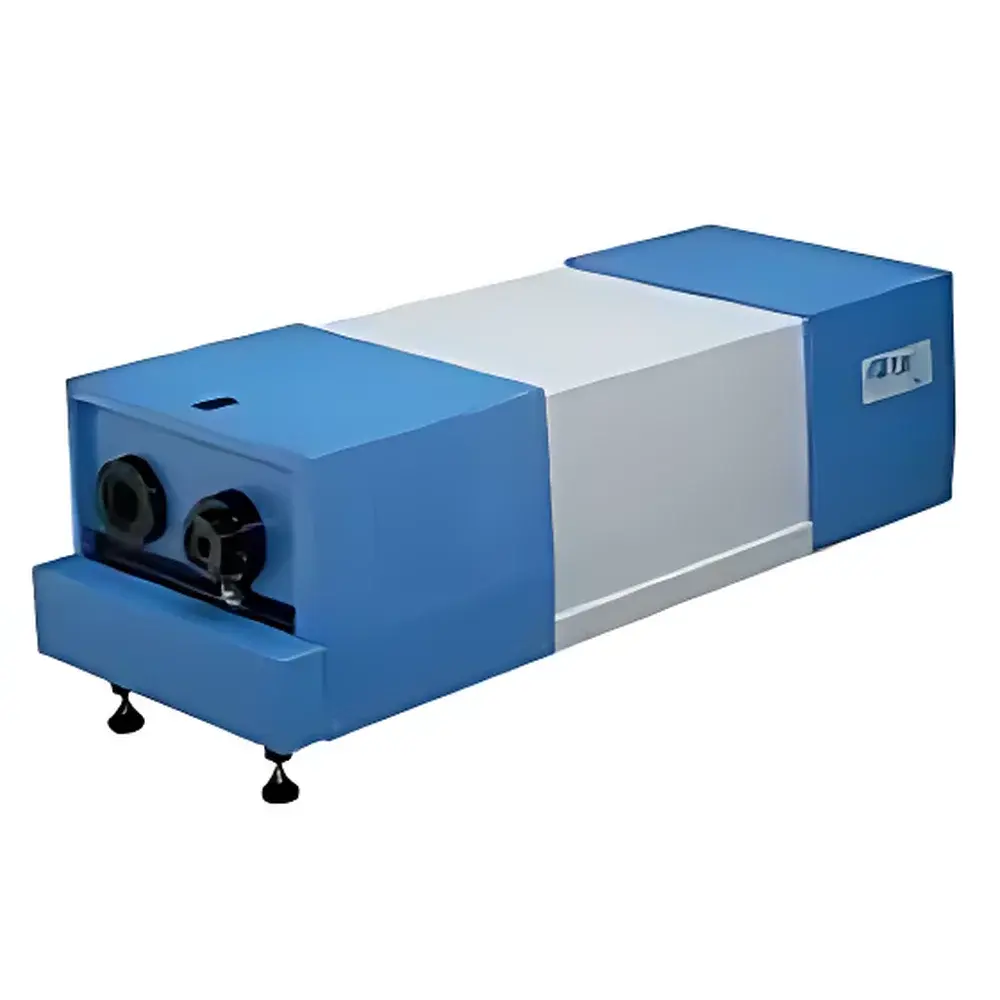
HORIBA FHR640/FHR1000 High-Resolution Grating Spectrometer Monochromator
| Brand | HORIBA |
|---|---|
| Origin | France |
| Model | FHR640/FHR1000 |
| Focal Length | 640 mm (FHR640) / 1000 mm (FHR1000) |
| f-number | f/5.4 (FHR640) / f/9.0 (FHR1000) |
| Spectral Resolution | 0.016 nm (FHR640) / 0.010 nm (FHR1000) |
| Linear Dispersion | 1.2 nm/mm (FHR640) / 0.8 nm/mm (FHR1000) |
| Wavelength Accuracy | ±0.05 nm |
| Wavelength Repeatability | ±0.015 nm |
| Scanning Speed | >300 nm/s |
| Grating Mount | Dual-grating turret (up to two 110×110 mm or 80×110 mm gratings) |
| Output Ports | Dual simultaneous exit ports |
| Structural Design | Monolithic aluminum cast housing |
Overview
The HORIBA FHR640 and FHR1000 are high-performance, long-focal-length Czerny–Turner grating spectrometers engineered for demanding spectroscopic applications requiring exceptional spectral resolution, wavelength stability, and scanning speed. Designed and manufactured in France, these instruments employ a monolithic aluminum cast optical bench architecture—eliminating mechanical joints and thermal expansion mismatches that commonly induce wavelength drift and signal attenuation in conventional modular spectrometers. This structural integrity ensures long-term calibration stability under variable ambient conditions, making the FHR series particularly suitable for quantitative fluorescence spectroscopy, Raman mapping, time-resolved luminescence, and high-resolution atomic emission analysis where reproducibility across days or weeks is critical. Both models operate on the same core optical platform but differ in focal length and f-number to optimize trade-offs between throughput and resolving power: the FHR640 delivers higher light throughput for sensitivity-critical measurements, while the FHR1000 achieves superior resolution for narrow-line spectral discrimination.
Key Features
- Monolithic Cast Aluminum Housing: Minimizes thermally induced misalignment; eliminates wavelength drift and maintains optical coupling efficiency over extended operation and environmental fluctuations.
- In-Plane Grating Scanning Mechanism: Ensures constant optical path geometry during wavelength scanning—preserving resolution, repeatability (±0.015 nm), and photometric linearity across the full spectral range.
- Dual-Grating Turret: Supports up to two large-format ruled or holographic gratings (110 × 110 mm single-grating configuration or 80 × 110 mm dual-grating layout), enabling rapid, software-controlled switching between dispersion regimes without realignment.
- Simultaneous Dual Exit Ports: Allows concurrent connection of two array detectors (e.g., CCD and ICCD) or fiber-coupled accessories—ideal for synchronous reference-sample acquisition or multi-channel detection schemes.
- High-Speed Wavelength Scanning: Achieves >300 nm/s scanning velocity with sub-millisecond step response, significantly reducing data acquisition time for kinetic or mapping experiments.
- Flexible Mounting Options: Includes side-flip capability for vertical sample illumination geometries and compatibility with standard optical tables, vacuum chambers, and cryostat interfaces.
Sample Compatibility & Compliance
The FHR640/FHR1000 spectrometers are fully compatible with HORIBA Jobin Yvon’s ecosystem of excitation sources (Xe lamps, lasers, LEDs), sample stages (microscope couplers, cryogenic holders, liquid nitrogen dewars), and detectors (back-thinned CCDs, EMCCDs, InGaAs arrays). As standalone monochromators or as core components in custom-built spectrofluorometers, they support compliance with ISO/IEC 17025 calibration traceability requirements when used with NIST-traceable wavelength standards. Their mechanical and thermal stability supports GLP/GMP-aligned workflows, especially in regulated pharmaceutical fluorescence assays or materials certification protocols where instrument performance verification must be documented per ASTM E275, ISO 17025 Clause 6.5.2, or USP .
Software & Data Management
Controlled via HORIBA’s Synapse software suite (Windows-based), the FHR systems support full remote operation—including grating selection, slit width adjustment, detector synchronization, and automated wavelength calibration routines. Synapse provides audit-trail logging compliant with FDA 21 CFR Part 11 (when deployed with appropriate IT infrastructure and user access controls), including electronic signatures, session timestamps, and parameter-change history. Raw spectral data are exported in standardized formats (ASCII, CSV, HDF5) and integrate seamlessly with third-party analysis platforms such as MATLAB, Python (via PySpectra or HoribaPy), and Igor Pro for advanced curve fitting, multivariate analysis, or machine learning–driven spectral classification.
Applications
- Steady-state and time-resolved fluorescence spectroscopy of quantum dots, lanthanide complexes, and organic emitters
- High-resolution Raman spectroscopy for strain mapping in 2D materials and semiconductor heterostructures
- Atomic emission analysis in metallurgical QC and plasma diagnostics
- Laser-induced breakdown spectroscopy (LIBS) with multi-element spectral deconvolution
- Photoluminescence quantum yield (PLQY) measurements using integrating sphere-coupled configurations
- Custom vacuum-UV or deep-UV spectroscopy when equipped with MgF₂ optics and solar-blind detectors
FAQ
What is the primary difference between the FHR640 and FHR1000 models?
The FHR1000 offers higher spectral resolution (0.010 nm vs. 0.016 nm) due to its longer focal length (1000 mm) and higher f-number (f/9.0), while the FHR640 provides greater optical throughput (f/5.4) and faster signal acquisition for low-light applications.
Can the FHR spectrometers operate under vacuum or inert gas purge?
Yes—both models feature sealed optical compartments with optional vacuum flanges and purge ports, supporting operation down to 10⁻³ mbar or purging with N₂/Ar for UV-VIS-IR spectral extension.
Is external triggering supported for time-gated detection?
Yes—TTL-compatible trigger inputs and outputs enable precise synchronization with pulsed lasers, gated detectors, or choppers for lifetime decay analysis or pump-probe experiments.
How is wavelength calibration maintained over time?
The monolithic structure minimizes thermal drift; however, periodic recalibration using Hg/Ne/Ar lamp lines or a built-in reference LED is recommended every 72 hours for metrology-grade applications—automated via Synapse’s calibration wizard.
Are OEM integration options available?
Yes—HORIBA provides SDKs (C/C++, .NET, LabVIEW) and mechanical interface drawings for embedded integration into turnkey analytical systems, including CE-marked medical or industrial instrumentation platforms.





