
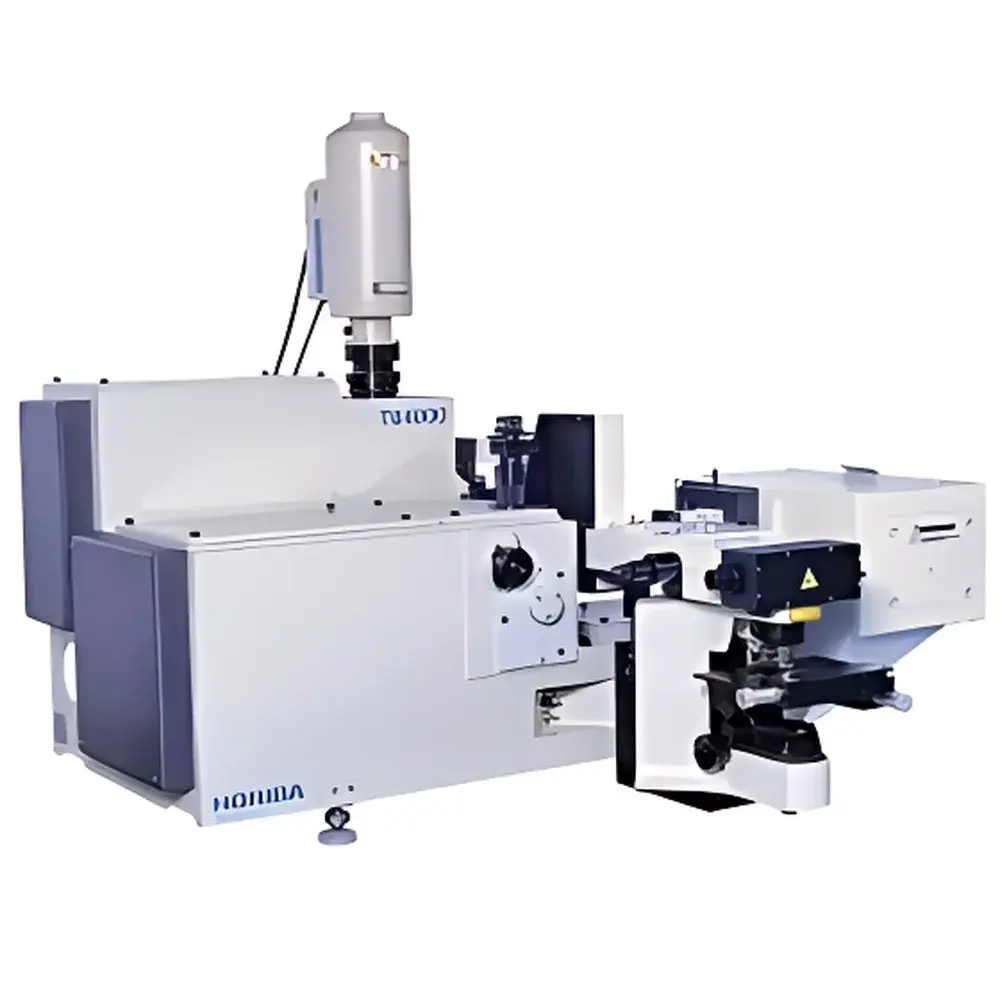
HORIBA Jobin Yvon T64000 Triple-Stage Raman Spectrometer
| Brand | HORIBA |
|---|---|
| Origin | France |
| Model | T64000 |
| Instrument Type | Confocal Micro-Raman Spectrometer |
| Spectral Range | UV–VIS–NIR (excitation-dependent) |
| Spectral Resolution | ≤ 0.15 cm⁻¹ (triple-add mode) |
| Low-Wavenumber Limit | ≥ 5 cm⁻¹ (triple-subtract mode) |
| Spatial Resolution | Sub-micron (confocal, diffraction-limited) |
| Focal Length | 640 mm (single stage), 3 × 640 mm (triple stage) |
| Detector | Research-grade air-cooled large-format CCD |
| Laser Power Control | Multi-step neutral density attenuation |
| Optical Output | Flat-field dispersive output compatible with large-area detectors |
| Polarization Options | Full-suite polarization accessories (excitation, Raman, white-light) |
| Sample Handling | Integrated research microscope + large sample chamber |
| Optional Accessories | XYZ high-precision motorized stage, cryo/heat stages, fiber-optic probes, fast mapping module, simultaneous Stokes/anti-Stokes detection port, secondary detector outlet for PL/NIR-Raman |
Overview
The HORIBA Jobin Yvon T64000 is a research-grade triple-stage Raman spectrometer engineered for ultra-high spectral fidelity and exceptional low-wavenumber performance. Based on the principle of sequential dispersion using three cascaded Czerny–Turner spectrographs, the T64000 achieves rigorous rejection of stray light and Rayleigh scattering—enabling both high-resolution vibrational analysis and reliable detection down to 5 cm⁻¹. Its modular architecture supports triple-add (maximum resolution), triple-subtract (minimum background), and single-stage (high-throughput) configurations, making it uniquely suited for demanding applications in condensed matter physics, 2D materials characterization, pharmaceutical polymorph identification, and nanoscale strain mapping. The system integrates seamlessly with a high-numerical-aperture research microscope and accommodates macro- and micro-sampling geometries without optical realignment.
Key Features
- Triple-stage optical design with independent alignment for phase-add, phase-subtract, and single-pass operation
- Spectral resolution ≤ 0.15 cm⁻¹ (FWHM, triple-add mode) verified with neon lamp calibration lines
- Low-wavenumber cutoff ≥ 5 cm⁻¹ (triple-subtract mode), validated under controlled vacuum and temperature-stabilized conditions
- Flat-field, astigmatism-corrected output optimized for 2048 × 512 or larger format CCD detectors
- Continuous excitation wavelength compatibility from 244 nm to 1064 nm, supporting deep-UV resonance Raman and NIR photoluminescence co-detection
- Confocal pinhole positioning with motorized Z-control and diffraction-limited spatial resolution (< 0.5 µm lateral, < 2 µm axial at 532 nm)
- Integrated motorized XYZ stage with sub-100 nm repeatability and programmable raster scanning for hyperspectral imaging
- Dual-output port configuration: primary spectrometer exit for Raman detection; secondary port configurable for time-resolved PL, NIR-Raman, or external detector coupling
Sample Compatibility & Compliance
The T64000 accommodates diverse sample formats—from bulk crystals and thin films to liquid cells, gas-phase cuvettes, and biological tissues—via interchangeable objectives, custom sample holders, and optional environmental stages (−190 °C to +600 °C). Its optical path meets ISO 17025 traceability requirements when operated with NIST-traceable calibration standards (e.g., silicon, cyclohexane, neon). The system supports GLP-compliant workflows through hardware-enforced audit trails in LabSpec 6 software, including user authentication, parameter logging, and electronic signature capture per FDA 21 CFR Part 11 guidelines. All mechanical and thermal subsystems comply with CE and IEC 61000-6-3 electromagnetic compatibility standards.
Software & Data Management
Controlled by HORIBA’s LabSpec 6 platform, the T64000 provides full instrument orchestration—including laser power ramping, grating selection, slit width adjustment, detector binning, and real-time cosmic-ray rejection. Data acquisition adheres to HDF5-based storage architecture for metadata-rich, self-documenting spectra. Batch processing modules support automated peak fitting (Voigt/Lorentzian/Gaussian), multivariate analysis (PCA, cluster analysis), and false-color Raman mapping with pixel-wise spectral deconvolution. Raw data export is compliant with ASTM E131-22 (Standard Terminology Relating to Molecular Spectroscopy) and supports third-party integration via Python API and COM interface.
Applications
- Strain and doping profiling in graphene, transition metal dichalcogenides (TMDs), and heterostructures
- Polymorph discrimination and crystallinity assessment in active pharmaceutical ingredients (APIs) per USP
- Carbon nanotube chirality assignment via radial breathing mode (RBM) mapping
- In situ electrochemical Raman monitoring of battery electrode interfaces
- Stress-induced phonon shifts in semiconductor devices and MEMS structures
- Time-resolved photoluminescence–Raman correlation studies in perovskite optoelectronics
- Forensic pigment identification in historical artworks using non-invasive micro-sampling
FAQ
What excitation wavelengths are supported?
The T64000 accepts continuous-wave lasers from 244 nm (deep UV) to 1064 nm (NIR), including 325 nm, 405 nm, 488 nm, 532 nm, 633 nm, 785 nm, and 1064 nm lines. Laser coupling optics are optimized per wavelength band.
Can the system perform simultaneous Stokes and anti-Stokes measurements?
Yes—using the optional dual-detector configuration, the T64000 enables synchronized acquisition of Stokes and anti-Stokes spectra with identical instrumental parameters, essential for temperature-dependent phonon population analysis.
Is vacuum operation required for low-wavenumber measurements?
While not mandatory, operation under partial vacuum (< 10 mbar) is recommended below 20 cm⁻¹ to suppress atmospheric CO₂ and H₂O rotational–vibrational interference; the triple-subtract mode inherently minimizes residual Rayleigh wings.
How is spectral calibration maintained over long-term use?
LabSpec 6 supports automated daily calibration using internal neon or mercury–argon reference lamps; drift compensation algorithms correct for thermal expansion-induced grating misalignment in real time.
Does the system meet regulatory requirements for pharmaceutical QC labs?
Yes—the T64000 with LabSpec 6 v6.5+ satisfies 21 CFR Part 11, EU Annex 11, and ICH Q5C guidelines when deployed with documented SOPs, access controls, and periodic verification against certified reference materials.






