
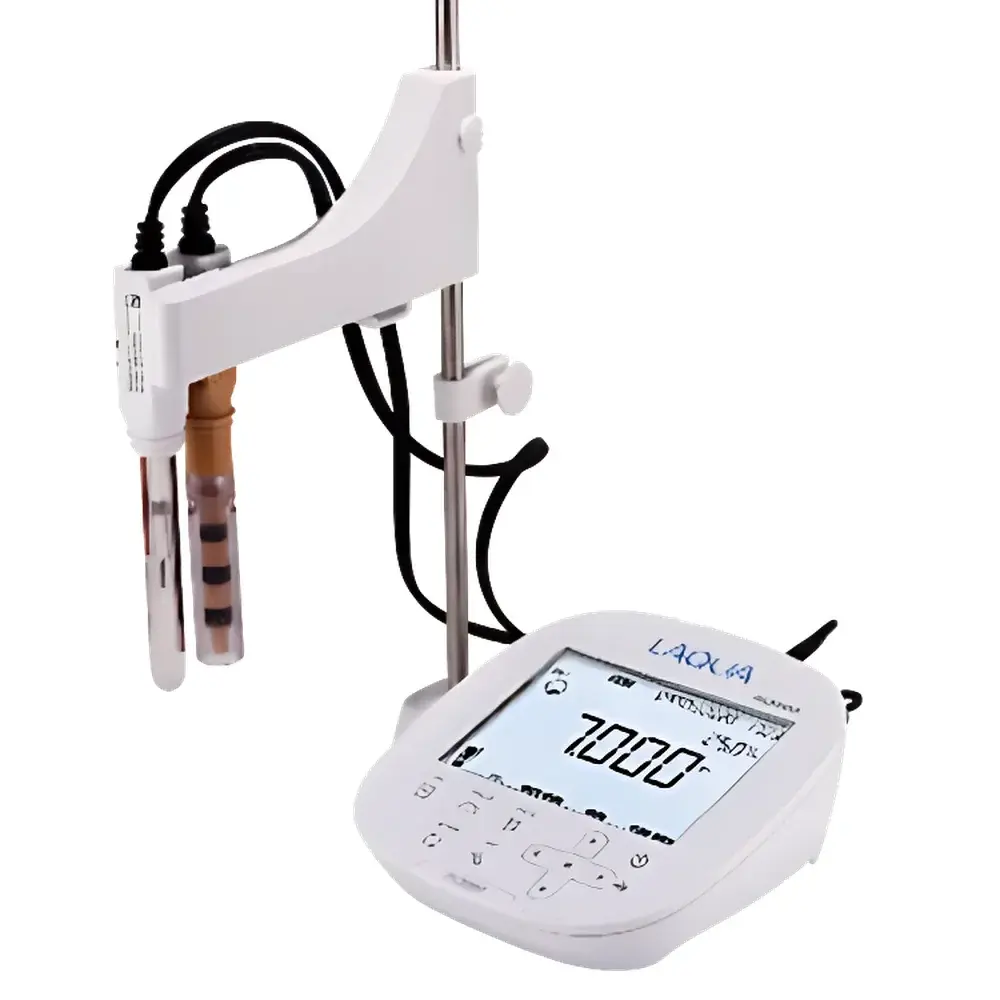
HORIBA LAQUA F2000-S Benchtop Fluoride Ion Meter
| Brand | HORIBA |
|---|---|
| Origin | Japan |
| Model | F2000-S |
| Instrument Type | Benchtop Ion Meter |
| Ion Measured | Fluoride (F⁻) |
| Temperature Range | −30.0 to 130.0 °C |
| pH Range | −2.000 to 20.000 |
| pH Resolution | 0.001 |
| pH Accuracy | ±0.003 |
| ORP Range | ±2000.0 mV |
| ORP Resolution | 0.1 mV |
| ORP Accuracy | ±0.2 mV |
| Ion Concentration Range | 0.000 µg/L to 9999 g/L |
| Ion Resolution | 4 significant digits |
| Ion Accuracy | ±0.3% full scale or ±0.2 mV (whichever is greater) |
| Calibration Points | Up to 5 for pH/ion, up to 6 for DIN buffers |
| Temperature Accuracy | ±0.5 °C |
| Data Storage | 2000 records with timestamp |
| Connectivity | USB/RS-232C via phono jack |
| Display | 5" backlit custom LCD (320 segments) |
| Power | AC adapter (100–240 V, 50–60 Hz) |
| Dimensions | 155 × 150 × 67 mm |
| Weight | 765 g |
Overview
The HORIBA LAQUA F2000-S Benchtop Fluoride Ion Meter is a high-precision, multi-parameter electrochemical analyzer engineered for rigorous quantitative fluoride ion (F⁻) determination in environmental, regulatory, and industrial water quality laboratories. Built upon HORIBA’s LAQUA-ION2000 platform, the F2000-S integrates potentiometric ion-selective electrode (ISE) measurement with simultaneous pH, ORP, and temperature monitoring—enabling thermally compensated, Nernstian-response quantification of fluoride across six orders of magnitude (0.000 µg/L to 9999 g/L). Its compact benchtop architecture supports both routine compliance testing and method development workflows, delivering trace-level sensitivity and long-term stability required for EPA Method 300.0, ISO 10304-1, and ASTM D4192 applications. The system employs a dedicated HORIBA 6561S-10C solid-state fluoride ISE, optimized for low-interference performance in complex matrices including drinking water, wastewater effluents, groundwater, and industrial process streams.
Key Features
- Multi-parameter capability: Simultaneous real-time measurement of F⁻ concentration, pH, ORP, and temperature with automatic thermal compensation
- High-resolution ion quantification: 4-digit significant figures across ultra-trace (sub-ppq) to saturated concentration ranges
- Advanced calibration flexibility: Up to five-point ion calibration using certified standard solutions; support for USA, NIST, NIST2, DIN, and user-defined buffer sets
- Intelligent electrode diagnostics: On-screen status indicators for ISE slope, offset, response time, and junction integrity—critical for GLP/GMP audit readiness
- Regulatory-grade data integrity: 2000-point internal memory with embedded date/time stamping, auto-stabilization logic, and programmable calibration alarm (up to 90 days)
- Robust connectivity: Dual-interface support (USB + RS-232C) for seamless integration with LIMS, laboratory PCs, and thermal printers; BNC input compatible with all standardized ISEs
- Compliance-ready firmware: Supports 21 CFR Part 11–compliant electronic signatures when paired with validated PC software; password-protected configuration and calibration access
Sample Compatibility & Compliance
The F2000-S is validated for use with aqueous samples containing total dissolved solids (TDS) ≤ 50,000 mg/L and turbidity ≤ 10 NTU. It accommodates direct measurement of fluoride in raw and treated waters, soil leachates (per EPA SW-846 Method 9213), and pharmaceutical rinse solutions—provided appropriate ionic strength adjustment (e.g., TISAB II addition) and electrode conditioning protocols are followed. The instrument meets IEC 61010-1 safety requirements for laboratory electrical equipment and conforms to electromagnetic compatibility standards EN 61326-1 and EN 61000-4 series. Its measurement algorithms align with ISO/IEC 17025 technical competence criteria for ion analysis, supporting accredited laboratories in maintaining documented uncertainty budgets per ISO/IEC Guide 98-3 (GUM).
Software & Data Management
Data export is performed via HORIBA’s LAQUA Connect software (Windows-compatible), enabling batch download, graphical trend analysis, statistical reporting (mean, SD, RSD, confidence intervals), and PDF certificate generation. All logged measurements include metadata: operator ID, sample ID, calibration history, electrode serial number, ambient temperature, and QA/QC flags. Audit trails record every configuration change, calibration event, and data deletion—retained for ≥18 months per FDA ALCOA+ principles. Firmware updates are delivered through digitally signed packages verified via SHA-256 checksums, ensuring secure and traceable system evolution.
Applications
- Drinking water compliance monitoring per WHO guideline values (1.5 mg/L) and national standards (e.g., US EPA MCL of 4.0 mg/L)
- Wastewater discharge verification under NPDES permits requiring sub-ppb fluoride detection
- Groundwater contamination assessment near aluminum smelters, phosphate fertilizer plants, or fluorosilicic acid injection sites
- Pharmaceutical excipient purity testing where residual fluoride must be <10 ppm in APIs
- Educational laboratory instruction in analytical electrochemistry, including Nernst equation validation and selectivity coefficient determination
- Calibration verification of online fluoride analyzers used in municipal water treatment control loops
FAQ
What fluoride electrode is supplied with the F2000-S?
The system includes the HORIBA 6561S-10C solid-state lanthanum fluoride (LaF₃) membrane electrode, pre-conditioned and factory calibrated.
Can the F2000-S measure other ions besides fluoride?
Yes—it supports any standard BNC-compatible ion-selective electrode (e.g., Cl⁻, NO₃⁻, NH₄⁺, CN⁻) via customizable ion method setup and calibration.
Is temperature compensation automatic during fluoride measurement?
Yes—integrated ATC (Automatic Temperature Compensation) uses the supplied thermistor probe to correct for solution temperature effects on Nernst slope and liquid junction potential.
Does the instrument meet GLP or GMP requirements?
It provides core GLP/GMP-enabling features: electronic signature support, full audit trail, calibration lockout, and configurable user roles—when deployed with validated procedures and controlled software.
How often does the fluoride electrode require recalibration?
Typical recalibration interval is daily for high-accuracy work or per batch for routine analysis; the built-in calibration alarm alerts users based on programmable time or measurement count thresholds.







