
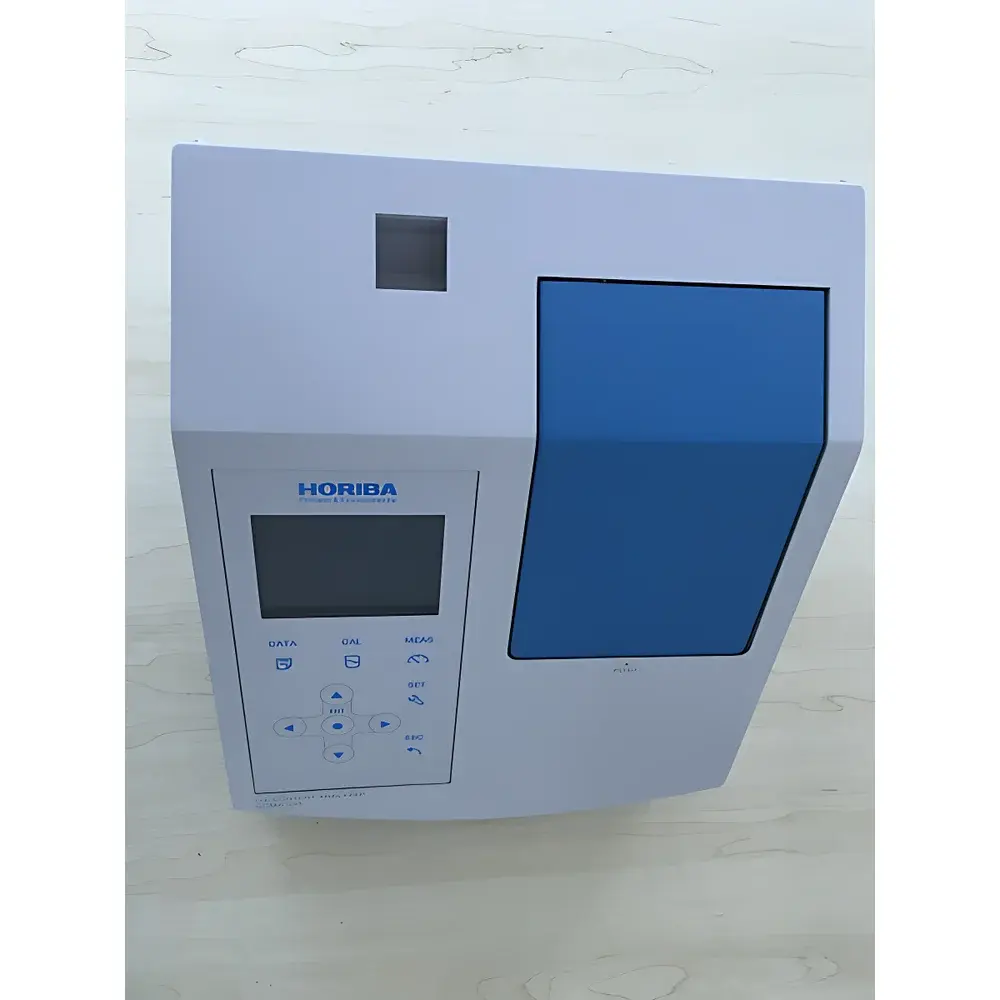
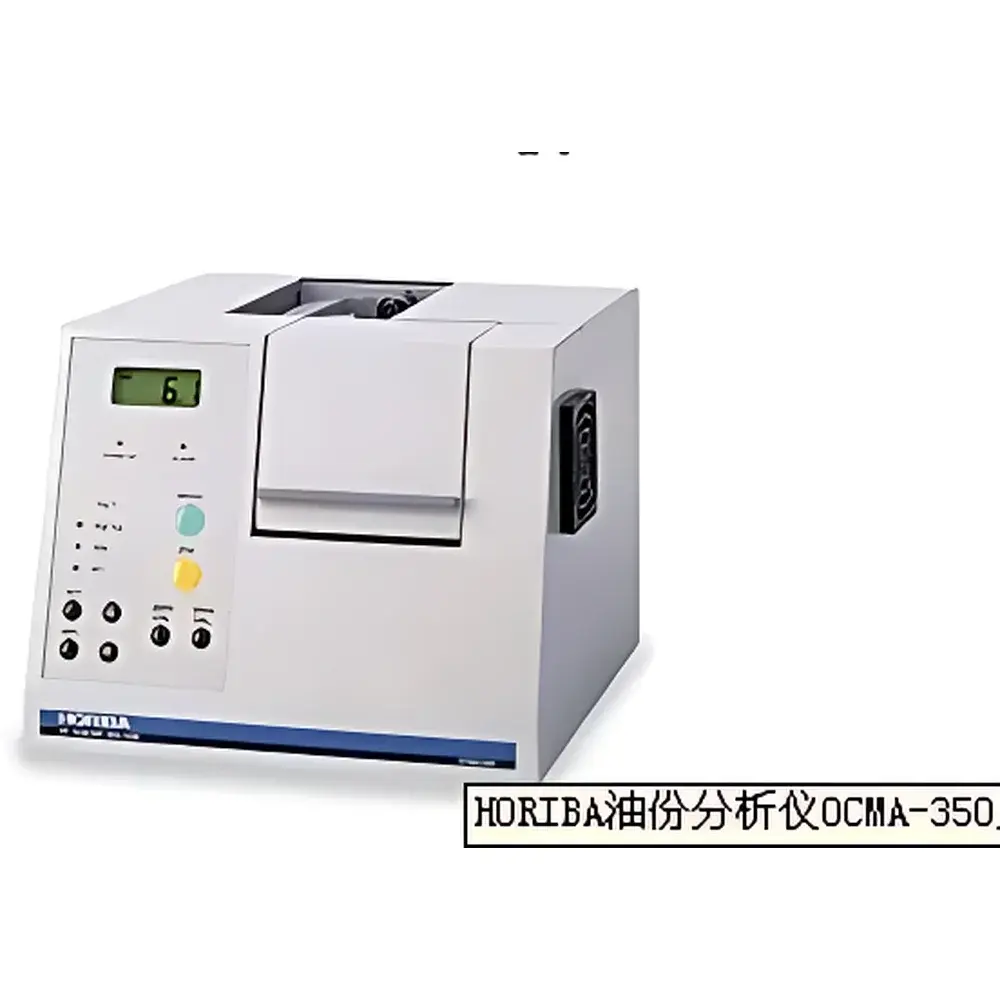
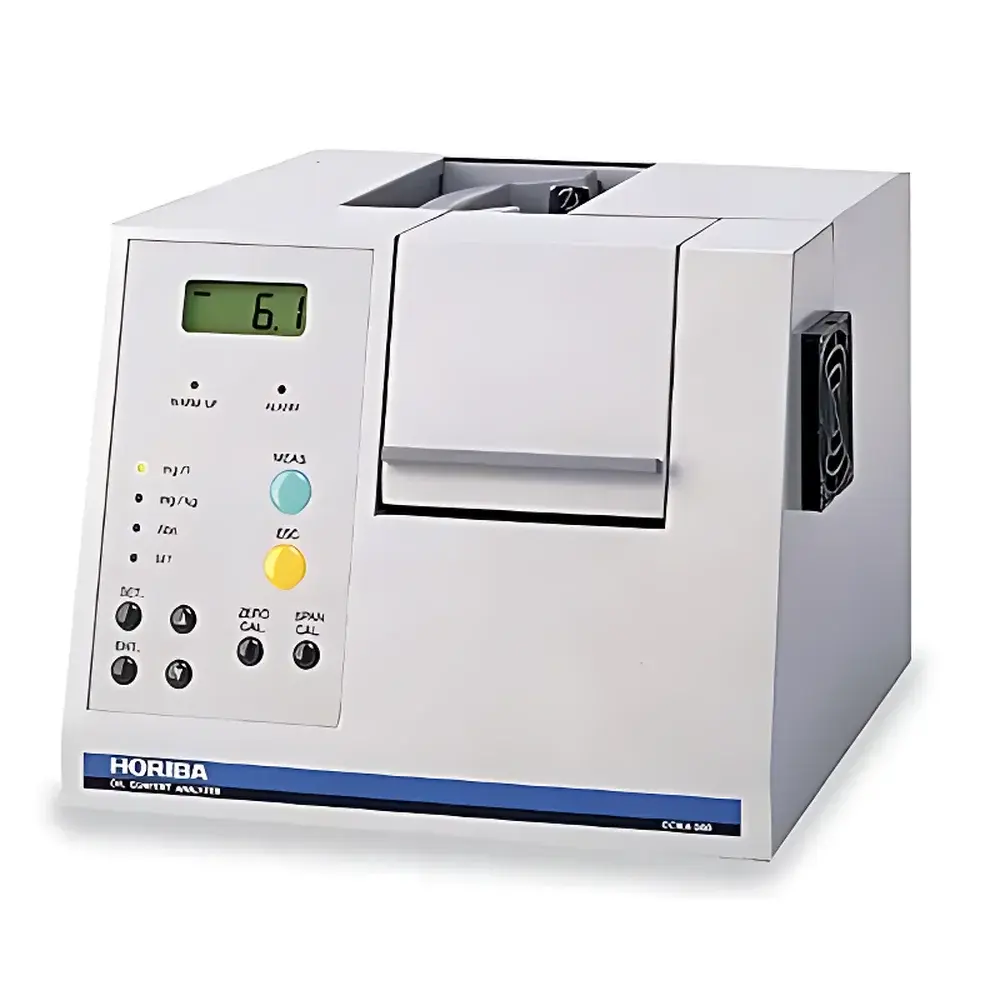
HORIBA OCMA-550/555 Portable Oil Content Analyzer
| Brand | HORIBA |
|---|---|
| Origin | Japan |
| Model | OCMA-550 / OCMA-555 |
| Instrument Type | Portable |
| Measurement Principle | Non-Dispersive Infrared (NDIR) Absorption Spectrophotometry |
| Detection Method | S-316 Solvent Extraction (OCMA-550) / H-997 Solvent Extraction (OCMA-555) |
| Measurement Range | 0–200 mg/L (water), 0–1000 mg/kg (soil), 0–1 Abs |
| Accuracy | ±0.4 mg/L (0–9.9 mg/L), ±2.0 mg/L (10.0–99.9 mg/L), ±4 mg/L (100–200 mg/L), ±1% F.S. (0–1 Abs) |
| Resolution | 0.1 mg/L (typical), 0.01 Abs |
| Detector | Thermoelectric Sensor |
| Display | Backlit LCD with timestamping |
| Interface | RS-232C, Parallel Printer Port |
| Power Supply | 230 V AC, 50 Hz |
| Dimensions | 250 × 200 × 285 mm (W × H × D) |
| Sample Cell | Quartz Cuvette (200 mm path length) |
Overview
The HORIBA OCMA-550 and OCMA-555 are portable, laboratory-grade oil content analyzers engineered for precise quantification of hydrocarbon contaminants in aqueous and solid-phase environmental samples. Both instruments operate on the principle of non-dispersive infrared (NDIR) absorption spectroscopy—specifically targeting the characteristic C–H stretching vibration band near 3.4 µm—enabling selective detection of aliphatic and aromatic hydrocarbons while minimizing interference from water, solvents, or particulates. Unlike fluorescence-based systems, the OCMA series relies on solvent extraction followed by NDIR measurement, offering superior specificity, long-term stability, and trace-level sensitivity down to 0.1 ppm (as total petroleum hydrocarbons, TPH). The OCMA-550 employs S-316 (1,1,2-trichloro-1,2,2-trifluoroethane) as its extraction solvent, whereas the OCMA-555 utilizes H-997 (a proprietary chlorinated hydrocarbon blend), each optimized for regulatory compliance and reproducible recovery across diverse matrix types including wastewater, leachate, soil extracts, and industrial rinse solutions.
Key Features
- Triple-unit display capability: switch seamlessly between concentration units—mg/L (for water), mg/kg (for soil/solid matrices), and absorbance (Abs)—without recalibration.
- Integrated thermal stabilization and zero-point auto-calibration at power-on, ensuring measurement consistency across field deployments and multi-shift laboratory use.
- Backlit monochrome LCD with real-time timestamping supports GLP-compliant data logging; all measurements include date/time stamps embedded in displayed values.
- Dual communication interfaces: RS-232C port enables direct connection to PCs for automated data capture and audit trail generation; parallel printer port supports hard-copy record retention per ISO/IEC 17025 requirements.
- Optimized optical path: 200 mm quartz flow cell provides high signal-to-noise ratio for low-concentration analysis, minimizing dilution errors and enhancing detection reliability in turbid or suspended-solid-laden samples (e.g., SS-containing effluents).
- Thermoelectric detector architecture ensures drift-free performance over extended operation cycles—critical for unattended monitoring in remote or hazardous waste characterization sites.
Sample Compatibility & Compliance
The OCMA-550/555 is validated for use with EPA Method 1664 (revision B), ASTM D7066-04, and ISO 9377-2 for petroleum hydrocarbon determination in water and soil. Its solvent-extraction workflow complies with standard regulatory protocols requiring defined recovery efficiencies (>95% for mineral oils, >85% for PAH-rich fractions). The system accommodates heterogeneous sample types—including emulsified oily wastewaters, metalworking fluid residues on machined parts, textile lubricants, and contaminated soils—when prepared using standardized extraction procedures. All hardware components meet IEC 61010-1 safety standards for electrical equipment used in measurement, control, and laboratory applications. The instrument’s firmware supports configurable user-defined calibration curves, facilitating alignment with site-specific reference materials and internal QC protocols required under FDA 21 CFR Part 11 and EU Annex 11 for regulated environmental testing laboratories.
Software & Data Management
While the OCMA-550/555 operates as a standalone analyzer with no embedded operating system, its RS-232C interface is fully compatible with third-party data acquisition software compliant with Windows OS environments. Raw output includes ASCII-formatted strings containing measurement value, unit identifier, timestamp, and instrument serial number—enabling seamless import into LIMS platforms (e.g., LabWare, Thermo Fisher SampleManager) or custom Excel-based reporting templates. Audit trails can be generated through external logging tools that capture command-response sequences and time-stamped parameter changes. Optional SR-300/SR-305 solvent regeneration units integrate mechanically but require separate configuration; their use reduces solvent consumption by >80%, supporting sustainability objectives aligned with ISO 14001 environmental management systems.
Applications
- On-site screening of produced water, cooling tower blowdown, and industrial effluent prior to discharge—supporting compliance with local NPDES permits and EU Water Framework Directive thresholds.
- Verification of cleaning efficacy in semiconductor wafer fabrication lines, where sub-ppm residual hydrocarbon levels on silicon substrates directly impact die yield and bonding integrity.
- Quantitative assessment of tramp oil carryover in aqueous metalworking fluids, enabling predictive maintenance of filtration systems and optimization of coolant replacement schedules.
- Field-deployable analysis of soil core samples during brownfield remediation projects, delivering rapid feedback for excavation boundary delineation without reliance on off-site GC-FID labs.
- Quality assurance testing of recycled solvents and reclaimed lubricants used in precision machining operations, verifying hydrocarbon purity against ISO 4406 particle contamination limits.
FAQ
What solvent is required for the OCMA-550, and is it hazardous?
The OCMA-550 requires S-316 (1,1,2-trichloro-1,2,2-trifluoroethane), a Class II ozone-depleting substance regulated under the Montreal Protocol. Users must comply with national solvent handling, storage, and disposal regulations (e.g., EPA 40 CFR Part 261).
Can the OCMA-550 measure diesel, gasoline, and lubricating oils with equal accuracy?
Yes—calibration with certified reference standards (e.g., NIST SRM 2721) confirms linear response across C8–C40 hydrocarbon ranges; however, method-specific recovery corrections may be applied for complex mixtures per ASTM D7066.
Is the quartz cuvette included, and what is its optical path length?
Yes—a sealed, 200 mm path-length quartz cuvette is supplied as standard equipment, optimized for maximum sensitivity in low-concentration aqueous extracts.
Does the instrument support multi-point calibration?
No—the OCMA-550/555 performs single-point calibration using factory-installed reference standards; linearity is verified during type examination per JIS K 0121 and maintained via routine zero checks.
How does the SR-305 solvent regenerator interface with the analyzer?
The SR-305 is a standalone unit connected downstream of the extraction step; it does not electrically or pneumatically interface with the OCMA—solvent recycling occurs offline prior to re-injection into the analytical workflow.







