
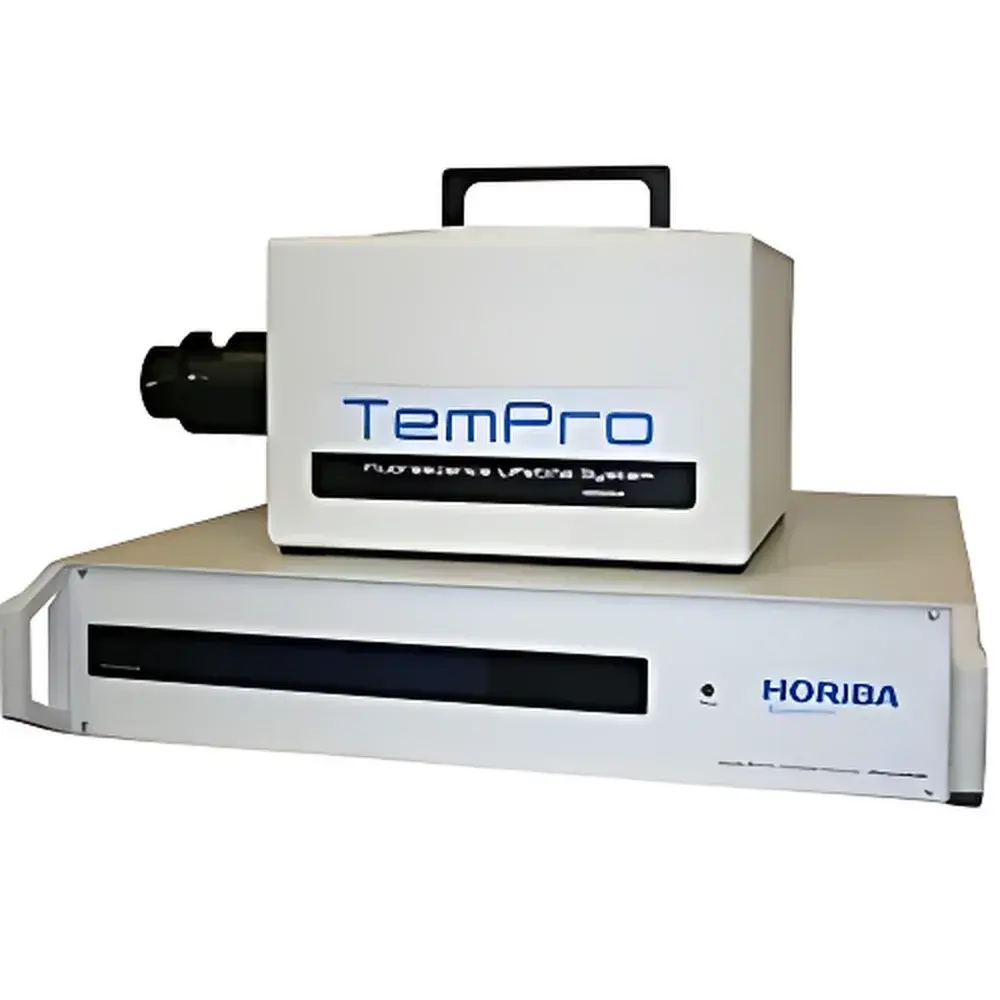
HORIBA Scientific Tempro Time-Resolved Fluorescence Spectrometer
| Brand | HORIBA |
|---|---|
| Origin | United Kingdom |
| Model | Tempro |
| Excitation Source | Pulsed LED/Laser Diodes (255–NIR) |
| Detection Range | 185–650 nm (upgradable to 850 nm or 1700 nm with optional NIR detectors) |
| Lifetime Range | 100 ps to 1 s |
| Detection Method | Time-Correlated Single Photon Counting (TCSPC) |
| Wavelength Selection | Filter-based (monochromator optional) |
| Detector Type | PPD (Photon-Counting Photodiode) Module |
| Software | Horiba FluoroLog®-3 compatible analysis suite |
| Compliance | Designed for GLP/GMP environments |
Overview
The HORIBA Scientific Tempro Time-Resolved Fluorescence Spectrometer is a compact, high-performance TCSPC (Time-Correlated Single Photon Counting) system engineered for quantitative fluorescence lifetime analysis across research and quality control laboratories. Unlike conventional steady-state fluorimeters, the Tempro operates on the principle of time-domain photoluminescence decay measurement—capturing the temporal evolution of photon emission following pulsed excitation. This enables direct determination of excited-state lifetimes without reliance on intensity-based calibration, thereby eliminating artifacts from inner-filter effects, concentration dependence, or photobleaching. The system supports lifetime measurements spanning six orders of magnitude—from 100 picoseconds to 1 second—making it suitable for both short-lived singlet fluorescence and long-lived triplet phosphorescence. Its architecture integrates modular excitation sources (NanoLED and SpectraLED series), a high-speed PPD detector module, and filter-based spectral selection, with optional monochromator upgrade for time-resolved emission spectroscopy (TRES).
Key Features
- TCSPC detection with <10 ps timing resolution and sub-nanosecond instrument response function (IRF), enabling precise deconvolution of multi-exponential decays
- Modular excitation platform: interchangeable pulsed LEDs covering 255 nm to >900 nm, including deep-UV, visible, and NIR options—no optical realignment required during source swaps
- Standard PPD detector with 185–650 nm sensitivity range; field-upgradeable to 850 nm (PPD-850C) or 1700 nm (via InGaAs-based NIR module)
- USB 2.0 interface eliminates need for internal PCI cards—enabling plug-and-play operation on modern Windows-based workstations
- Compact benchtop footprint (<40 cm × 30 cm × 20 cm) optimized for shared lab spaces and glovebox-integrated configurations
- Integrated polarization optics option for anisotropy decay analysis and rotational correlation time quantification
Sample Compatibility & Compliance
The Tempro accommodates liquid, solid, thin-film, and powder samples using standard cuvette holders, solid-sample stages, and fiber-coupled accessories. It complies with ISO/IEC 17025:2017 requirements for analytical instrument validation when deployed in accredited testing labs. Data acquisition and processing meet traceability standards for GLP (Good Laboratory Practice) and GMP (Good Manufacturing Practice) workflows. When paired with Horiba’s validated FluoroLog®-3 software suite—including electronic signatures, user access controls, and full audit trail logging—the system satisfies FDA 21 CFR Part 11 criteria for regulated pharmaceutical and biotech applications.
Software & Data Management
Tempro systems ship with Horiba’s FluoroLog®-3 software, offering intuitive TCSPC data acquisition, global lifetime fitting (including multi-exponential, stretched exponential, and distribution models), and TRES mapping. Raw photon arrival timestamps are stored in vendor-neutral binary format (.sdt) for third-party analysis (e.g., in MATLAB, Python, or commercial packages like DAS6 or Globals Unlimited). The software supports batch processing, automated parameter sweeps (e.g., temperature-, pH-, or concentration-dependent lifetime series), and export to CSV, ASCII, or HDF5 for LIMS integration. All analysis steps—including IRF measurement, convolution fitting, and residual diagnostics—are fully documented within the project file for regulatory review.
Applications
- Protein conformational dynamics via tryptophan lifetime heterogeneity and FRET efficiency mapping
- Organic LED (OLED) and perovskite material characterization—distinguishing radiative vs. non-radiative recombination pathways
- Environmental sensing: dissolved oxygen quenching kinetics in aqueous matrices
- Pharmaceutical stability studies: monitoring aggregation-induced lifetime shifts in monoclonal antibodies
- Time-gated detection for background suppression in biological tissue imaging and turbid media
- Photocatalyst charge-carrier lifetime quantification under operational conditions
FAQ
What excitation wavelengths are supported out-of-the-box?
Standard NanoLED and SpectraLED sources cover 255 nm, 280 nm, 340 nm, 370 nm, 405 nm, 450 nm, 470 nm, 505 nm, 530 nm, 590 nm, 630 nm, and 780 nm—with additional custom diodes available upon request.
Can the system perform time-resolved emission spectra (TRES)?
Yes—by adding the optional scanning monochromator, users can acquire wavelength-resolved decay profiles across 200–900 nm with 0.1 nm step resolution.
Is the detector sensitive to UV-C radiation?
The standard PPD module has certified responsivity down to 185 nm, enabling direct detection of vacuum-UV-excited luminescence without window absorption losses.
How is instrument response function (IRF) measured and corrected?
IRF is acquired using a scattering standard (e.g., Ludox) or mirror reflection; built-in deconvolution algorithms apply iterative reconvolution fitting to extract true decay parameters.
Does the system support kinetic experiments with external triggers?
Yes—TTL-compatible input/output ports allow synchronization with stopped-flow mixers, temperature ramps, or electrochemical potentiostats for reaction-initiated lifetime monitoring.






