
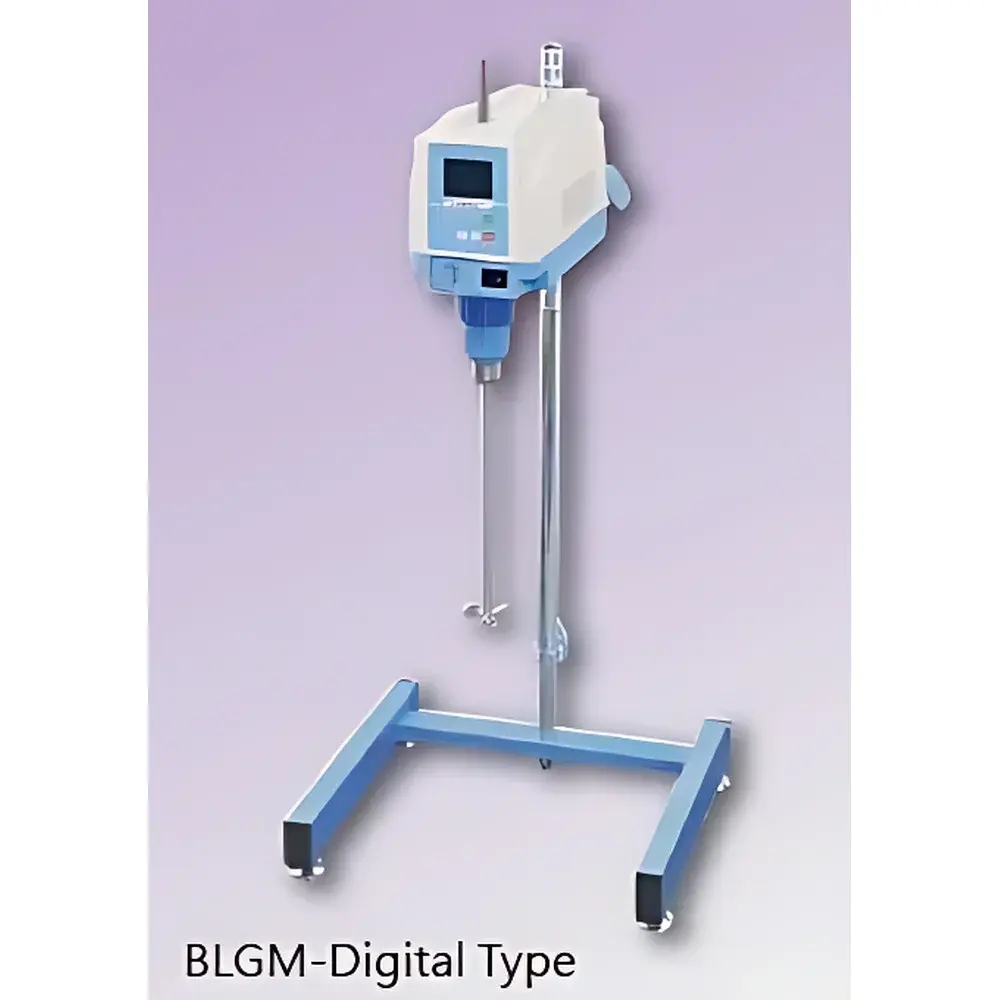
HsiangTai BLG-2D Brushless DC Motor Digital Stirrer
| Brand | HsiangTai |
|---|---|
| Origin | Taiwan |
| Model | BLG-2D / BLG-3D / BLG-4D |
| Maximum Stirring Volume | 5 L |
| Speed Range | 0–1500 rpm (BLG-2D), 0–750 rpm (BLG-3D), 0–375 rpm (BLG-4D) |
| Torque Output | 3 kgf·cm (0.29 N·m) / 6 kgf·cm (0.59 N·m) / 12 kgf·cm (1.18 N·m) |
| Timer Range | 0–99 h 59 min (digital display) |
| Motor Type | Brushless DC |
| Power Input | AC 110 V / 220 V, 50 / 60 Hz |
| Dimensions (W × L × H) | 111 × 232 × 215 mm |
| Net Weight | 3.7 kg |
| Clamp Capacity | Up to Ø10 mm shaft |
| Safety Features | Overload protection, thermal cutoff, fuse-protected circuit |
| Control Interface | Dual torque display (5-step LED + digital), RPM digital display, real-time speed stabilization with automatic torque compensation |
Overview
The HsiangTai BLG-2D is a precision-engineered brushless DC motor-driven digital stirrer designed for reproducible, low-maintenance mixing in analytical, quality control, and research laboratories. Unlike conventional AC induction or brushed DC stirrers, the BLG-2D employs a maintenance-free brushless motor architecture that delivers consistent torque output across its full speed range (0–1500 rpm), eliminates commutator wear, and reduces electromagnetic interference—critical for sensitive instrumentation environments. Its core operational principle relies on closed-loop speed regulation: real-time feedback from the motor encoder enables dynamic torque compensation when viscosity changes occur during stirring (e.g., polymer dissolution or suspension thickening), ensuring stable rotational velocity without manual intervention. The unit is optimized for benchtop use in ISO/IEC 17025-accredited labs, pharmaceutical QC suites, and academic chemistry departments where long-duration, unattended operation and traceable parameter logging are required.
Key Features
- Brushless DC motor with integrated thermal management—no carbon brushes to replace, >10,000-hour service life under nominal load
- Dual-mode torque indication: five-step LED bar graph (20%, 40%, 60%, 80%, 100%) plus real-time digital torque readout (kgf·cm/N·m)
- Precision digital RPM display with ±1 rpm resolution and auto-stabilization algorithm for viscosity-invariant speed maintenance
- Programmable digital timer (0–99 h 59 min) with audible end-of-cycle alert and auto-shutdown
- Stainless-steel universal clamp with Ø10 mm maximum shaft compatibility; hollow shaft design enables vertical adjustment of impeller position
- Triple-layer safety architecture: electronic overload detection, PTC-based thermal cutoff, and redundant fuse protection per IEC 61000-4-5
- Universal power input (AC 110 V / 220 V, 50 / 60 Hz) with active power factor correction (PFC)
Sample Compatibility & Compliance
The BLG-2D supports aqueous, organic, and mildly corrosive media up to 5 L volume in standard borosilicate glass or stainless-steel vessels (e.g., beakers, flasks, jacketed reactors). Its torque profile is validated for Newtonian fluids (water, ethanol, saline) and moderately non-Newtonian systems (e.g., 1–5% CMC solutions, latex dispersions). The device complies with EN 61010-1:2010 for electrical safety in laboratory equipment and meets EMC requirements per EN 61326-1:2013. While not intrinsically rated for hazardous locations, it is suitable for general-purpose Class I, Division 2 environments when operated outside direct solvent vapor zones. For GLP/GMP workflows, the digital timer and RPM/torque logs (when interfaced via optional RS-232) support audit-ready documentation per FDA 21 CFR Part 11 when paired with compliant data acquisition software.
Software & Data Management
The BLG-2D operates as a standalone instrument but includes an RS-232 serial interface (optional cable and driver provided) for integration into centralized lab automation systems. When connected, it transmits real-time RPM, torque percentage, elapsed time, and status flags (e.g., “overheat,” “stall”) at 1 Hz sampling. Compatible with LabVIEW™, Python (pySerial), and MATLAB® via ASCII protocol. No proprietary software is required; raw data streams may be logged directly into LIMS or ELN platforms using standard COM port configuration. Firmware updates are performed via terminal emulator—no cloud dependency or vendor lock-in.
Applications
- Homogenization of reagent batches prior to titration or spectrophotometric analysis
- Controlled dissolution testing of solid dosage forms (aligned with USP agitation parameters)
- Preparation of calibration standards requiring uniform particle suspension (e.g., ISO 13320-compliant laser diffraction samples)
- Long-term stability studies involving temperature-uncontrolled ambient mixing (e.g., emulsion aging, colloidal aggregation kinetics)
- Supporting electrochemical cell conditioning where consistent mass transport is essential (e.g., RDE pre-equilibration)
- Teaching laboratories: ideal for demonstrating Newtonian vs. non-Newtonian fluid behavior via torque-speed response profiling
FAQ
Does the BLG-2D support external temperature feedback for coupled heating/stirring?
No—the BLG-2D is a dedicated stirrer without integrated temperature sensing or PID heating control. It may be used alongside external hotplates or circulators, but no analog/digital temperature interlock is provided.
Can the timer retain settings after power interruption?
Yes—the internal EEPROM preserves timer presets and last-used speed/torque values across power cycles.
Is the stainless-steel clamp autoclavable?
The clamp body is constructed from AISI 304 stainless steel and withstands repeated autoclaving (121 °C, 20 min); however, the motor housing and electronics must never be exposed to steam or immersion.
What is the recommended maintenance interval?
No scheduled maintenance is required beyond periodic cleaning of the clamp and shaft interface; brushless motor design eliminates routine brush replacement or bearing lubrication.
Are calibration certificates available?
Factory calibration reports (traceable to NIST standards) for speed and torque accuracy are available upon request at time of order—certificates include uncertainty budgets per ISO/IEC 17025 Annex A.3.



