
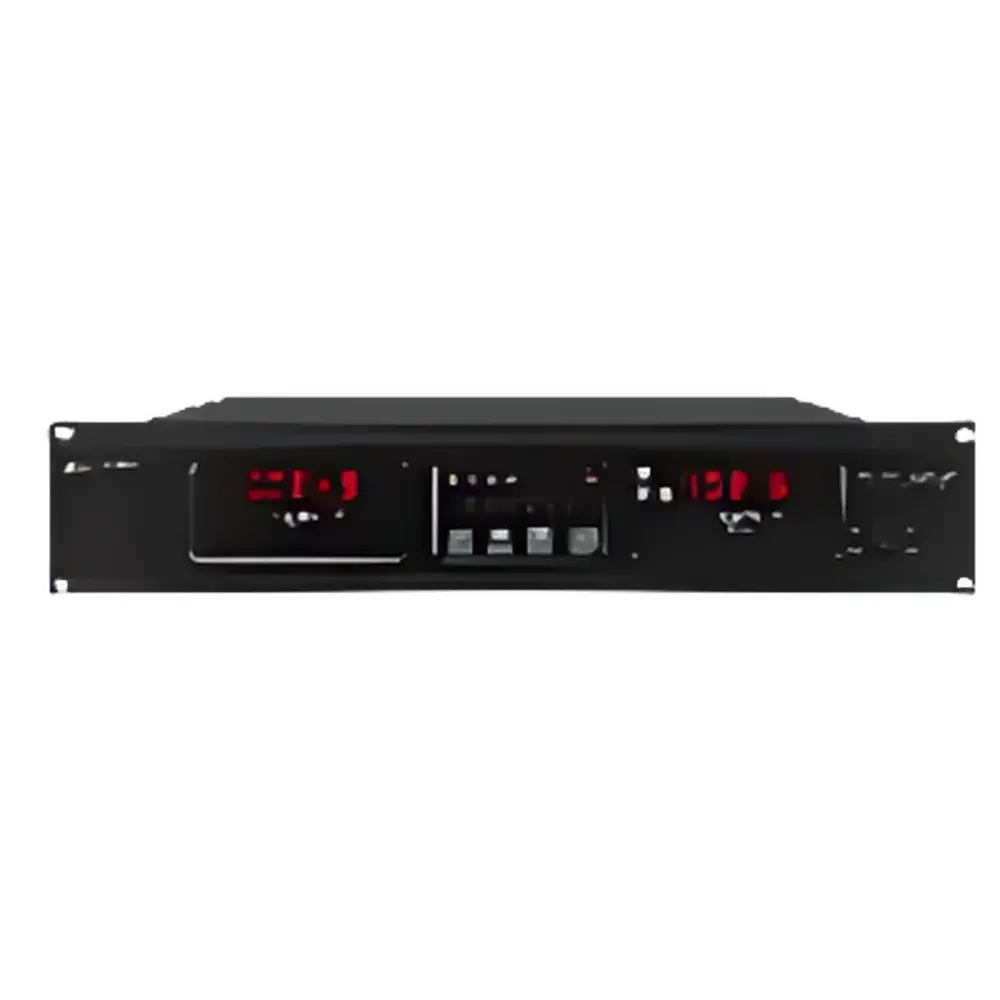
KJ GROUP ZDF-5201V01 Dual-Sensor Composite Vacuum Gauge
| Brand | KJ GROUP |
|---|---|
| Origin | Liaoning, China |
| Model | ZDF-5201V01 |
| Measurement Range | 1.0×10⁵ to 1×10⁻⁸ Pa |
| Effective Range | 3×10³ to 5.0×10⁻⁸ Pa |
| Sensor Configuration | One Pirani (ZJ-52T) + One Hot-Cathode Ionization (ZJ-12) Gauge |
| Display | Dual 5-digit LED, scientific notation |
| Control Outputs | 4 relay channels (expandable to 6), AC220V/3A or DC28V/10A |
| Power Supply | AC 220 V ±10%, 50 Hz, 45 W |
| Dimensions (W×H×D) | 480 × 88 × 260 mm |
| Cutout | 440 × 80 mm |
| Weight | ~4 kg |
| Optional | RS-232/RS-485 interface, 0–5 V / 4–20 mA analog output, custom cable length (standard 5 m), PLC-compatible ionization control, multiple flange interfaces (KF/DN10–40, CF/DN16–35) |
Overview
The KJ GROUP ZDF-5201V01 is a dual-sensor composite vacuum gauge engineered for high-reliability, wide-range pressure measurement in industrial vacuum systems, research chambers, and thin-film deposition environments. It integrates two physically distinct sensing principles—thermal conductivity (Pirani) and hot-cathode ionization—into a single, ARM-based digital platform. The ZJ-52T Pirani sensor provides stable, fast-response measurements in the rough to medium vacuum range (3×10³ Pa to 1×10⁻¹ Pa), while the ZJ-12 hot-cathode ionization gauge extends coverage into the high and ultra-high vacuum (UHV) regime (down to 5.0×10⁻⁸ Pa). Unlike single-principle gauges, this composite architecture eliminates measurement gaps and enables seamless transition across six decades of pressure without manual recalibration or sensor switching. The embedded ARM microcontroller performs real-time non-linear compensation, temperature drift correction, and cross-gas response normalization—significantly improving repeatability (<±3% FS typical) and long-term stability under varying thermal and electromagnetic conditions.
Key Features
- Dual-sensor architecture with automatic range handover: continuous measurement from atmospheric pressure (1.0×10⁵ Pa) down to 5.0×10⁻⁸ Pa
- ARM-based digital signal processing for dynamic error correction, including gas-type-dependent Pirani calibration (optimized for N₂ and air; optional gas-specific firmware available)
- Dual independent 5-digit LED displays using scientific notation (e.g., “2.7E−5” = 2.7×10⁻⁵ Pa), enabling unambiguous reading across full scale
- Four programmable relay outputs (expandable to six) supporting both point-control and band-control logic, with non-volatile memory retention of setpoints after power loss
- Robust electrical isolation and EMI-hardened design: meets IEC 61326-1 for industrial electromagnetic compatibility
- Modular mechanical interface support: interchangeable ZJ-52T (glass/metal/KF/CF) and ZJ-12 (glass/CF) gauge heads with standardized flange options (KF10–KF40, CF16–CF35)
- Configurable analog output (0–5 V or 4–20 mA) and serial communication (RS-232/RS-485 Modbus RTU) for integration into SCADA, PLC, or vacuum system controllers
Sample Compatibility & Compliance
The ZDF-5201V01 is designed for use with clean, dry, non-corrosive gases—primarily nitrogen and ambient air. The ZJ-52T Pirani element relies on thermal conductivity differences between gas species and is not calibrated for reactive, condensable, or highly dissociative gases (e.g., Cl₂, NH₃, silanes); alternative cold-cathode or capacitance manometer solutions are recommended for such applications. The ZJ-12 ionization gauge requires proper conditioning: initial outgassing at ≤10⁻³ Pa for 3–4 cycles is mandatory prior to first UHV operation. Long-term storage under high vacuum (>10⁻⁵ Pa) preserves cathode emission stability and extends gauge life beyond 5,000 operational hours. The instrument complies with GB/T 19022–2003 (equivalent to ISO 10012) for measurement management systems and supports traceable calibration per JJG 1069–2011 (Chinese national metrology verification regulation for vacuum gauges). While not FDA 21 CFR Part 11–certified out-of-the-box, audit-ready data logging and user-access control can be implemented via optional RS-485–connected supervisory software.
Software & Data Management
Though the ZDF-5201V01 operates as a standalone front-panel instrument, its RS-232/RS-485 interface enables bidirectional communication with host systems using ASCII-based command protocols. Standard commands allow remote readout of both sensor values, relay status, setpoint configuration, and diagnostic flags (e.g., “ION_GAUGE_FAULT”, “PIRANI_OVERLOAD”). When integrated with third-party vacuum control software (e.g., LabVIEW, Python-based PySerial scripts, or OEM HMI platforms), the gauge supports time-stamped data acquisition at up to 10 Hz, alarm-triggered event logging, and automated ramp-and-hold sequences. Analog output signals (0–5 V or 4–20 mA) provide direct connection to PLC analog inputs for closed-loop pressure regulation. All configuration parameters—including control hysteresis, display brightness, and unit preference (Pa, Torr, mbar)—are retained in EEPROM, ensuring deterministic behavior after power interruption.
Applications
- Industrial vacuum furnaces and sintering systems requiring robust process monitoring from atmosphere to 10⁻⁷ Pa
- R&D coating systems (e.g., magnetron sputtering, e-beam evaporation) where simultaneous roughing and high-vacuum stage validation is critical
- Accelerator beamline vacuum interlocks and safety interlocks compliant with IEC 61508 SIL-2 requirements
- Leak detection support systems using helium mass spectrometry, where stable base pressure verification precedes sniffing
- University teaching labs demonstrating multi-principle vacuum metrology and sensor physics (Pirani conduction vs. ion current generation)
- Custom vacuum gloveboxes and inert-atmosphere synthesis chambers with dual-stage pumping control
FAQ
Can the ZDF-5201V01 measure hydrogen or argon accurately?
The ZJ-52T Pirani sensor exhibits known sensitivity deviations for H₂ (+15–20%) and Ar (−12–15%) relative to N₂ calibration. For quantitative work with these gases, factory-installed gas correction factors or post-processing algorithms must be applied.
Is the ZJ-12 ionization gauge compatible with oil diffusion pumps?
Yes—provided backstreaming hydrocarbons are minimized via effective cold traps or turbo-molecular pump staging. Prolonged exposure to oil vapor degrades filament emissivity and increases noise floor.
What is the recommended warm-up time before stable UHV readings?
Allow ≥30 minutes after power-on for thermal equilibrium; then perform ZJ-12 bake-out (if equipped) or static outgassing at ≤10⁻³ Pa for 3–4 hours before initiating measurements below 10⁻⁵ Pa.
Does the gauge support GLP/GMP-compliant audit trails?
Not natively—but when connected via RS-485 to validated laboratory information management systems (LIMS), all parameter changes, relay actuations, and measurement timestamps can be archived with user ID and digital signature.
Can I replace the ZJ-52T or ZJ-12 gauge head in the field?
Yes—both sensors use standardized electrical connectors and mechanical mounting. Replacement requires only mechanical reinstallation and zero-point verification; no firmware reprogramming is needed.



