
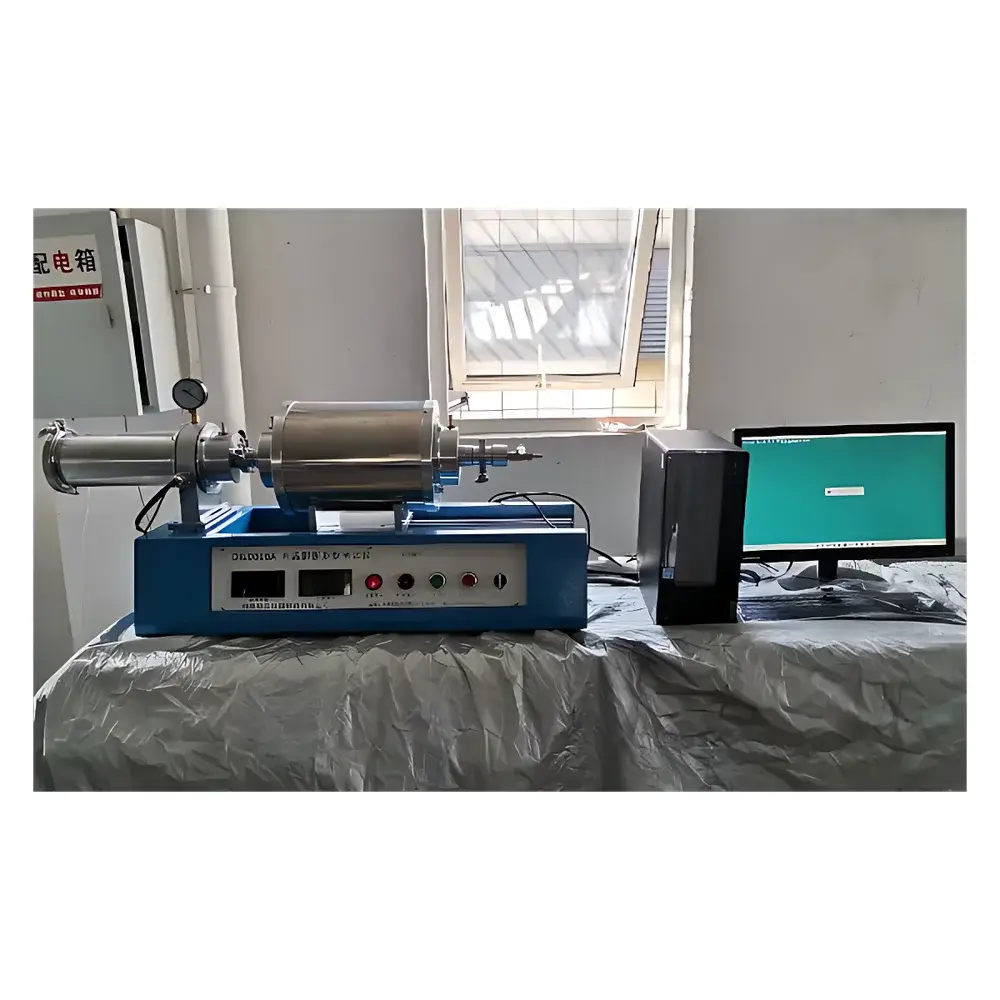
Huafeng DIL0806A-1400 Horizontal High-Temperature Dilatometer
| Brand | Huafeng |
|---|---|
| Origin | Hunan, China |
| Model | DIL0806A-1400 |
| Temperature Range | RT to 1400 °C |
| Heating Rate | 0–20 °C/min |
| Temperature Accuracy | ±0.1 °C |
| Displacement Resolution | 0.1 µm |
| Atmosphere Options | Vacuum and Controlled Gas |
| Sample Holder Material | Alumina |
| Maximum Displacement Range | 5000 µm |
| Sample Dimensions | Ø5–8 mm × 25–50 mm (cylindrical or rectangular) |
| Thermal Expansion Coefficient Resolution | 0.001 × 10⁻⁶ K⁻¹ |
| System Measurement Uncertainty | ±0.1% |
| Interface | USB 2.0 |
| Compliance | ASTM E831, ASTM D696, ASTM D3386, DIN 51045 |
Overview
The Huafeng DIL0806A-1400 Horizontal High-Temperature Dilatometer is a precision instrument engineered for the quantitative measurement of dimensional changes in solid materials as a function of temperature under near-zero load conditions. Operating on the principle of contact-based linear displacement detection via high-resolution differential transformer (LVDT) or optical encoder technology, the system captures thermal expansion, contraction, sintering shrinkage, phase transition onset (e.g., Tg, Tf), and irreversible densification behavior across a continuous temperature range from ambient to 1400 °C. Its horizontal configuration ensures gravitational stability during high-temperature testing of brittle ceramics, refractory metals, and composite preforms—minimizing sagging or bending artifacts common in vertical dilatometers. The furnace employs silicon carbide heating elements with dual-zone thermal profiling and active PID feedback control, delivering uniform axial temperature distribution and long-term thermal stability essential for reproducible coefficient of linear expansion (CTE) determination.
Key Features
- Wide operational temperature range: ambient to 1400 °C, with programmable heating rates adjustable from 0 to 20 °C/min in 0.1 °C/min increments
- High-precision displacement measurement system with 0.1 µm resolution over a full-scale range of 5000 µm, enabling sub-micron tracking of dimensional evolution
- Thermal accuracy of ±0.1 °C at steady state, validated against traceable NIST-certified reference materials
- Dual-atmosphere capability: vacuum (<10⁻² mbar) and inert/oxidizing/reducing gas environments (N2, Ar, O2, CO/CO2) with mass flow controller integration
- Alumina sample holder and pushrod assembly rated for continuous use up to 1600 °C, ensuring chemical inertness and dimensional stability
- Integrated Rate-Controlled Sintering (RCS) algorithm that dynamically modulates heating rate based on real-time sample shrinkage velocity—enabling isokinetic densification protocols
- Compliance with ISO/IEC 17025-aligned calibration procedures and traceable documentation for GLP/GMP-relevant laboratories
Sample Compatibility & Compliance
The DIL0806A-1400 accommodates cylindrical or rectangular specimens with diameters or edge lengths between 5 and 8 mm and lengths from 25 to 50 mm. It supports diverse material classes including oxide and non-oxide ceramics (Al2O3, SiC, ZrO2), metallic alloys (stainless steels, superalloys, Ti-based systems), polymer-derived ceramics, cementitious composites, and powder compacts. All measurements adhere to internationally recognized standards: ASTM E831 (linear thermal expansion of plastics), ASTM D696 (CTE of plastics), ASTM D3386 (thermal expansion of electrical insulating materials), and DIN 51045 (dilatometric analysis of solids). Instrument validation includes certified alumina reference standard (CTE = 8.1 × 10⁻⁶ K⁻¹, 25–1000 °C) supplied with each system.
Software & Data Management
The Windows-native acquisition and analysis software provides fully automated experiment setup, real-time data visualization, and post-processing tools compliant with FDA 21 CFR Part 11 requirements—including electronic signatures, audit trails, user role management, and immutable raw data archiving. Key functionalities include automatic CTE calculation (mean and instantaneous), derivative-based inflection point detection (Tg, Tf), multi-curve overlay, baseline correction, and export to CSV, XML, or PDF formats. Data integrity is preserved through timestamped metadata embedding (temperature setpoint, actual furnace temperature, displacement, atmosphere pressure, gas composition). Software supports batch processing of up to 99 sequential runs with customizable pass/fail criteria for QA/QC release workflows.
Applications
This dilatometer serves critical roles in R&D and quality assurance across multiple industrial sectors. In advanced ceramics manufacturing, it characterizes sintering kinetics, quantifies residual stress development, and validates binder burnout profiles. For aerospace-grade superalloys, it determines high-temperature CTE mismatch in thermal barrier coating systems. In nuclear fuel development, it evaluates dimensional stability of UO2 and SiC-clad fuel pellets under simulated reactor conditions. Academic users apply it to study glass transition dynamics in bioresorbable polymers, phase transformation hysteresis in shape-memory alloys, and thermal strain relaxation in additive-manufactured metal lattices. Its compatibility with controlled atmospheres also enables oxidation-induced expansion studies in refractory linings and catalytic substrate materials.
FAQ
What is the maximum recommended sample mass for reliable measurement?
For optimal thermal equilibration and mechanical coupling, samples should not exceed 10 g; heavier specimens may require extended soak times and are subject to increased axial thermal gradients.
Can the system be upgraded to support higher temperatures beyond 1400 °C?
The DIL0806A-1400 is structurally and thermally optimized for 1400 °C operation; exceeding this limit compromises furnace lifetime and measurement fidelity. Huafeng offers dedicated 1600 °C and 1750 °C models (DIL0806B and DIL0806C) with molybdenum disilicide heating elements and recrystallized alumina insulation.
Is third-party calibration certification available?
Yes—NIST-traceable calibration reports issued by ISO/IEC 17025-accredited laboratories are available upon request, covering temperature uniformity mapping, displacement linearity verification, and CTE accuracy validation using SRM 735a and SRM 736a.
How does the Rate-Controlled Sintering (RCS) mode interface with custom process recipes?
RCS operates as a closed-loop feedback module within the software; users define target shrinkage rate (µm/min), tolerance band (±5%), and maximum allowable heating rate—system autonomously adjusts power output in real time without external PLC intervention.
Are there options for in-situ XRD or mass spectrometry coupling?
While the DIL0806A-1400 is a standalone platform, its flanged vacuum port (KF40) and standardized mounting dimensions allow integration with residual gas analyzers (RGAs) and synchrotron-compatible dilatometry stages via custom adapter kits—supporting simultaneous structural and dimensional monitoring.



