
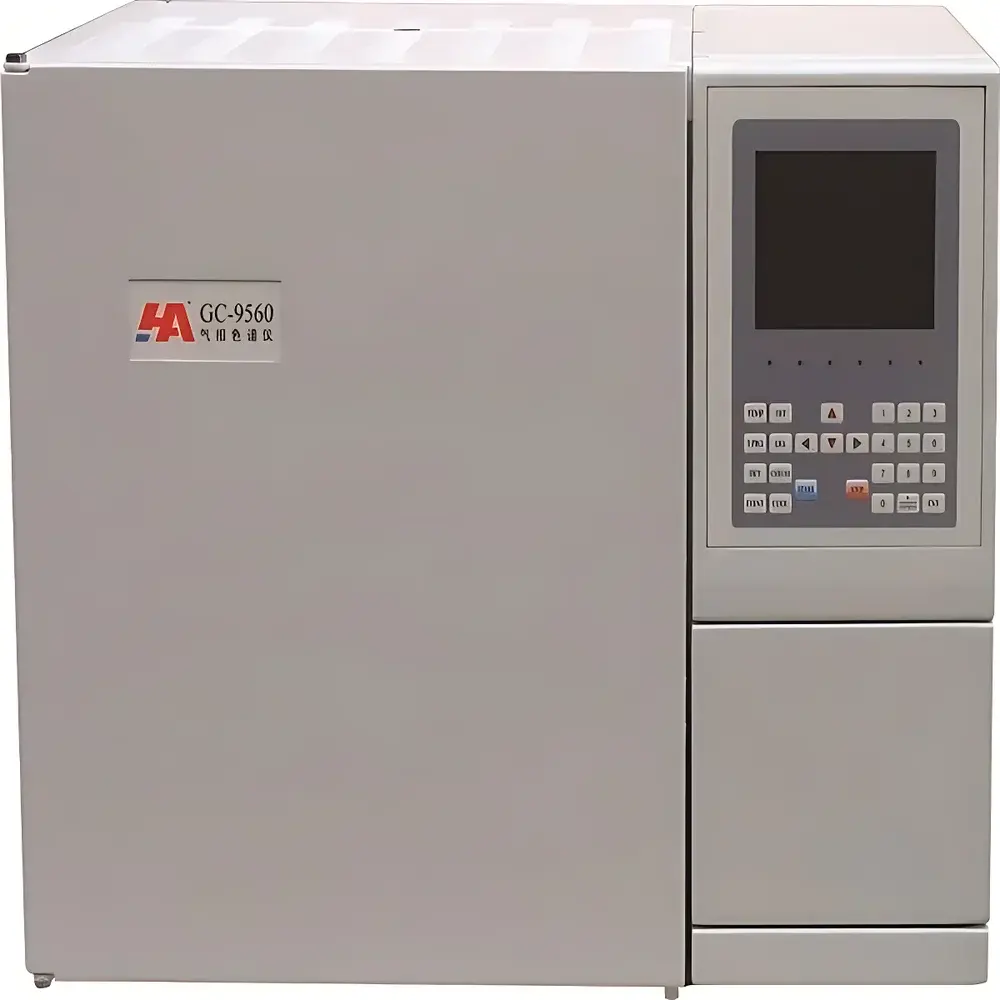
HuaiAi GC-9560-GAS Helium Ionization Gas Chromatograph for Trace Impurity Analysis in Ethylene and Propylene
| Brand | HuaiAi |
|---|---|
| Origin | Shanghai, China |
| Manufacturer Type | Manufacturer |
| Origin Category | Domestic |
| Model | GC-9560-GAS |
| Pricing | Upon Request |
| Detection Principle | Pulsed Discharge Helium Ionization Detection (PDHID) |
| Target Analytes | H₂, O₂, CO, CO₂, C₂H₂, CH₃OH, PH₃ |
| Detection Limits (ppm) | H₂/O₂/PH₃ ≤ 0.01 |
| Compliant Standards | GB/T 7715–2003, GB/T 7716–2002, GB/T 3393–2009, GB/T 3394–2009, GB/T 12701–1990, GB/T 3396–2002 |
| Column Configuration | Four-Valve, Five-Column Center-Cut & Back-Flush System |
| Sample Valve | Purge-Protected 6-Port or 10-Port Rotary Valve |
| Auxiliary Components | Integrated He Purifier, Zero-Dead-Volume Sampling Valve |
Overview
The HuaiAi GC-9560-GAS is a dedicated high-sensitivity gas chromatograph engineered for trace-level impurity analysis in polymer-grade ethylene and propylene feedstocks. It operates on the principle of pulsed discharge helium ionization detection (PDHID), a non-destructive, universal detection method particularly suited for permanent gases and low-molecular-weight organics. Unlike flame ionization or thermal conductivity detectors, PDHID delivers exceptional sensitivity for hydrogen, oxygen, and reactive species without requiring combustion gases or catalytic conversion—critical for maintaining sample integrity and minimizing baseline drift in ultra-trace applications. The system is purpose-built to meet stringent quality control requirements in petrochemical refining, polyolefin production, and catalyst manufacturing environments where sub-ppm impurity quantification directly impacts polymerization efficiency and resin quality.
Key Features
- Four-valve, five-column center-cut and back-flush configuration enables complete separation and selective elution of seven target impurities—H₂, O₂, CO, CO₂, C₂H₂, CH₃OH, and PH₃—in a single injection cycle.
- VICI-sourced PDHID detector with optimized discharge cell geometry and stable helium plasma generation ensures reproducible response factors and long-term signal stability under continuous operation.
- Purge-protected multi-position rotary valve (6-port or 10-port) minimizes carryover and cross-contamination between injections; integrated purge gas routing eliminates dead volumes at switching points.
- Onboard helium purifier maintains ≥99.999% He purity (≤100 ppb H₂O/O₂), essential for sustaining PDHID baseline stability and preventing detector quenching.
- Zero-dead-volume sampling valve with metal-sealed interface guarantees quantitative transfer of pressurized gas samples without adsorption or dilution artifacts.
- Rugged, temperature-controlled oven with ±0.1 °C uniformity supports precise retention time locking across extended run sequences.
Sample Compatibility & Compliance
The GC-9560-GAS is validated for direct analysis of industrial-grade ethylene (≥99.95% purity) and propylene (≥99.5% purity) streams containing hydrocarbon matrices up to C₄. It accommodates both cylinder-sourced calibration standards and on-line process gas sampling via heated stainless-steel lines. All analytical methods implemented on this platform conform to Chinese national standards including GB/T 7715–2003 (industrial ethylene), GB/T 7716–2002 (industrial propylene), GB/T 3393–2009 (trace H₂ determination), GB/T 3394–2009 (CO/CO₂/C₂H₂), GB/T 12701–1990 (methanol), and GB/T 3396–2002 (O₂ by electrochemical reference). While not pre-certified for FDA 21 CFR Part 11 or ISO/IEC 17025, the system architecture supports full audit trail implementation—including user access logs, method versioning, and electronic signature integration—when deployed within GLP- or GMP-aligned laboratory information management systems (LIMS).
Software & Data Management
Instrument control and data acquisition are managed through HuaiAi’s GC Navigator v3.x software, a Windows-based platform compliant with IEC 62443-3-3 cybersecurity guidelines. The software provides real-time chromatogram visualization, automated peak integration using retention time windowing and spectral deconvolution algorithms, and customizable reporting templates aligned with GB standard formatting requirements. Raw data files (.hdf5 binary format) retain full detector voltage traces, valve event timestamps, and oven temperature profiles—enabling retrospective reprocessing and forensic validation. Audit trail functionality records all parameter modifications, calibration events, and report exports with operator ID, timestamp, and reason-for-change fields. Export options include CSV, PDF/A-2, and XML formats compatible with enterprise LIMS and ERP interfaces.
Applications
- Quality assurance of ethylene/propylene monomers prior to Ziegler–Natta or metallocene-catalyzed polymerization.
- Monitoring catalyst poison levels (e.g., CO, H₂O, O₂, PH₃) in olefin purification units.
- Verification of cryogenic distillation column performance in ethylene plants.
- Supporting root-cause analysis during reactor fouling incidents or unexpected melt index shifts.
- Method transfer from R&D labs to central QC facilities operating under CNAS-accredited protocols.
FAQ
What carrier gas is required for PDHID operation?
Helium of ≥99.999% purity is mandatory; the integrated purifier removes residual H₂O and O₂ to prevent discharge instability.
Can the system quantify acetylene in propylene without interference from propadiene?
Yes—the five-column configuration includes a porous polymer PLOT column optimized for C₂–C₄ hydrocarbon separation, resolving acetylene from propadiene and allene isomers with baseline resolution.
Is methanol analysis performed in the gas phase or after derivatization?
Direct headspace injection of liquid-phase methanol standards is used; no derivatization is needed due to PDHID’s inherent sensitivity toward polar compounds.
How often does the PDHID discharge cell require maintenance?
Under normal operation with purified helium and clean samples, the discharge cell typically requires cleaning every 6–12 months; replacement parts are field-serviceable without detector recalibration.
Does the system support unattended overnight operation?
Yes—integrated auto-sampler compatibility (optional), thermal shutdown safeguards, and software-driven sequence recovery ensure robust 24/7 operation in production QC labs.





