
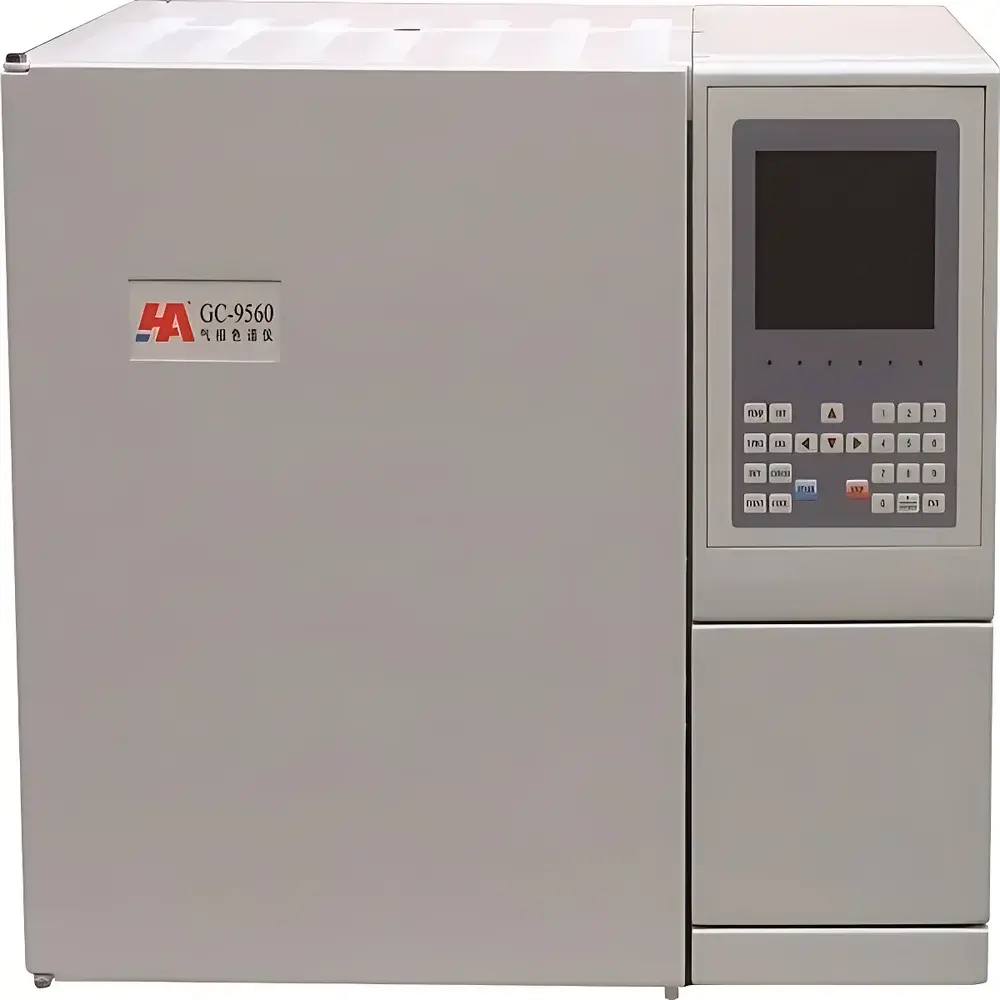
HuaiAi GC-9560-EG Helium Ionization Gas Chromatograph for Electronic Grade Gas Analysis
| Brand | HuaiAi |
|---|---|
| Origin | Shanghai, China |
| Manufacturer Type | Original Equipment Manufacturer (OEM) |
| Regional Classification | Domestic (China) |
| Model | GC-9560-EG |
| Instrument Type | Laboratory Gas Chromatograph |
| Application Domain | Ultra-High-Purity (UHP) and Electronic Grade (EG) Gas Analysis |
| Oven Temperature Range | +8 °C to 400 °C |
| Oven Ramp Rate | 0.1–40 °C/min |
| Oven Cool-Down Rate | 400 °C → 50 °C in ~7 min |
| Carrier Gas Flow Control Range | 0–400 mL/min |
| Carrier Gas Pressure Control Range | 0–1000 psi |
| Injector Maximum Operating Temperature | 400 °C |
| Injector Pressure Setting Range | 0–1000 psi |
| Injector Total Flow Setting Range | 0–400 mL/min |
Overview
The HuaiAi GC-9560-EG is a purpose-engineered laboratory gas chromatograph designed exclusively for trace-level impurity analysis in ultra-high-purity (UHP) and electronic grade (EG) process gases—particularly silane (SiH₄), phosphine (PH₃), arsine (AsH₃), diborane (B₂H₆), ammonia (NH₃), and related semiconductor feedstock gases. At its core lies the Pulsed Discharge Helium Ionization Detector (PDHID), a non-radioactive, universal-response detector capable of sub-ppb (ng/g) detection limits across inorganic and light organic species—including H₂, O₂, N₂, CH₄, CO, CO₂, C₂ hydrocarbons, and SiHn fragments. Unlike thermal conductivity (TCD) or flame ionization (FID) detectors, the PDHID operates via controlled pulsed helium plasma (13.5–17.7 eV photons, metastable He*, and high-energy electrons), enabling simultaneous, quantitative detection of permanent gases and hydrides without chemical derivatization or catalytic conversion. The system integrates VALCO high-integrity multi-port switching valves (6-way and 10-way), cryogen-free center-cut and back-flush chromatography, and an integrated helium purifier—ensuring zero dead volume, minimal memory effects, and reproducible retention time stability under stringent GLP/GMP-aligned operation.
Key Features
- PDHID detector with sub-50 ppb detection limits for H₂, O₂+Ar, N₂, CO, CH₄, CO₂, C₂/C₃ hydrocarbons, and silane-related impurities (e.g., SiH₃Cl, Si₂H₆)
- Thermally stable oven architecture with precision temperature control from +8 °C to 400 °C and ramp rates adjustable from 0.1 to 40 °C/min
- Valve-driven multidimensional GC configuration using VALCO electropolished stainless-steel 6-port and 10-port switching valves for robust, leak-tight gas routing
- Dual independent pressure/flow control modules for carrier (He) and makeup gases—enabling precise optimization of PDHID response and peak shape
- Injector operating up to 400 °C with programmable pressure and total flow control (0–1000 psi / 0–400 mL/min), compatible with both packed and capillary columns
- Cool-down from 400 °C to 50 °C in approximately 7 minutes—reducing cycle time without compromising column integrity or baseline stability
- Helium purification subsystem (integrated or external) meeting ASTM D7606-22 specifications for UHP carrier gas purity (≤100 ppt H₂O, ≤50 ppt O₂, ≤50 ppt total hydrocarbons)
Sample Compatibility & Compliance
The GC-9560-EG is validated for analysis of electronic-grade silicon-based gases per SEMI F63-1117 (Specification for Silane) and SEMI F21-0317 (Specifications for Phosphine and Arsine). It supports compliance with ISO 8573-1:2010 Class 1 compressed air purity requirements when adapted for inert gas matrices. All wetted surfaces—valves, liners, and detector cell—are electropolished stainless steel or fused silica, minimizing adsorption and catalytic decomposition of reactive hydrides. System validation adheres to ICH Q2(R2) guidelines for analytical method verification, including specificity, linearity (0.1–1000 ppb), LOD/LOQ determination, repeatability (RSD ≤3% at 50 ppb), and intermediate precision. Data acquisition and audit trails conform to FDA 21 CFR Part 11 requirements when operated with compliant chromatography data systems (CDS).
Software & Data Management
Instrument control, sequence management, and quantitative reporting are executed via HuaiAi ChromaSoft™ v4.x—a Windows-based CDS compliant with ASTM E2577-20 (Standard Practice for Validation of Chromatographic Systems). The software supports automated calibration curve generation (linear, quadratic, or weighted), peak integration using valley-to-valley and tangent skim algorithms, and customizable reporting templates aligned with ISO/IEC 17025 laboratory accreditation requirements. Raw data files (.chd) are stored with embedded metadata (operator ID, instrument ID, method version, audit trail hash), and all parameter changes—including detector bias voltage, pulse width, and oven program steps—are timestamped and user-attributed. Optional integration with LIMS platforms (e.g., LabWare, Thermo Fisher SampleManager) is supported via ASTM E1394-17 compliant ASCII export or direct ODBC connectivity.
Applications
- Trace impurity profiling in silane used for epitaxial silicon deposition (epi-Si) and low-pressure CVD of SiNₓ and SiO₂ films
- Verification of PH₃ and AsH₃ purity prior to ion implantation and dopant diffusion processes
- Monitoring of residual moisture, oxygen, and hydrocarbon contaminants in bulk nitrogen and argon purge gases for cleanroom tool qualification
- Analysis of byproduct gases (e.g., SiH₂Cl₂, SiCl₄) in effluent streams from CVD reactors per SEMI E10-0318 (Equipment Reliability Standard)
- Supporting supplier qualification audits under JEDEC JESD22-A108 (Steady-State Temperature Humidity Bias Life Test) where gas purity directly impacts device lifetime metrics
FAQ
What makes PDHID superior to TCD or FID for electronic-grade gas analysis?
PDHID delivers universal, near-equimolar response with detection limits 100–1000× lower than TCD and broad analyte coverage beyond FID’s hydrocarbon selectivity—critical for detecting electronegative impurities (e.g., O₂, CO₂) and hydrides (e.g., AsH₃) in UHP matrices.
Can the GC-9560-EG analyze corrosive gases such as ClF₃ or WF₆?
No—the system is optimized for non-corrosive, thermally stable EG gases; analysis of halogenated or fluorinated compounds requires specialized passivated flow paths and detector modifications not included in this configuration.
Is helium the only viable carrier gas for PDHID operation?
Yes. PDHID relies on metastable helium (He*) and vacuum-ultraviolet (VUV) photoionization; substitution with hydrogen or nitrogen results in complete signal loss and potential detector damage.
How is column bleed managed during high-temperature analysis of silane?
The system employs low-bleed, metal-clad fused-silica capillary columns (e.g., Agilent DB-HRGC or Restek Rtx-1Sil MS) coupled with active solvent venting and post-run bake-out protocols to suppress baseline drift and ghost peaks.
Does the instrument support unattended operation for extended purity monitoring campaigns?
Yes—when paired with a 16-position autosampler and scheduled method sequences, the GC-9560-EG supports 72+ hours of continuous operation with automatic calibration injection and system suitability checks at user-defined intervals.






