
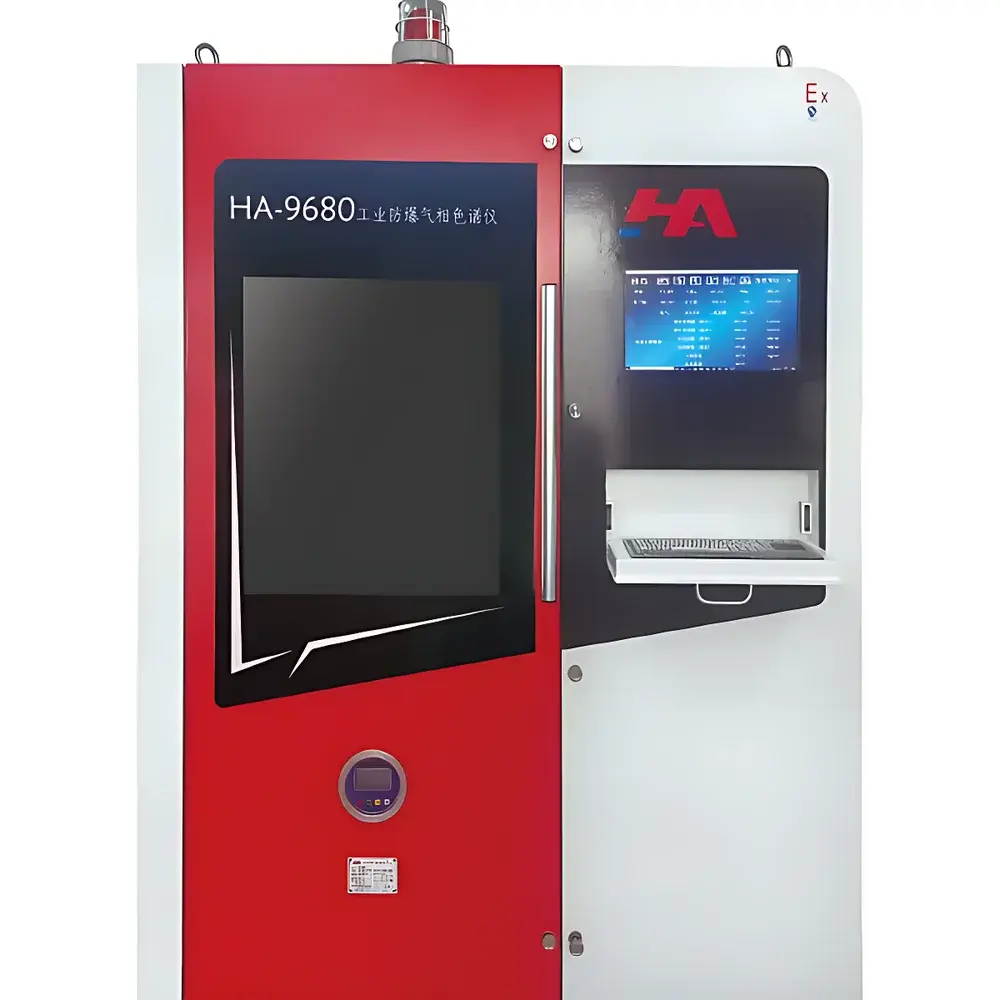
HuaiAi HA-9680-L Intrinsically Safe Online Liquid-Phase Gas Chromatograph
| Brand | HuaiAi |
|---|---|
| Origin | Shanghai, China |
| Manufacturer Type | Direct Manufacturer |
| Regional Classification | Domestic (China) |
| Model | HA-9680-L |
| Price Range | USD 28,000 – 52,000 |
| Instrument Type | Online Gas Chromatograph |
| Application Domain | Petrochemical Industry Specific |
| Explosion Protection Certification | NEPSI Certified EX d ib mb px II CT4 Gb |
| Sample Phase | Liquid |
| Injection Mode | Direct Liquid Injection |
| Regulatory Compliance | Meets IEC 60079-0, IEC 60079-1, IEC 60079-11 for Zone 1/2 hazardous areas |
| Thermal Management | Integrated heated sampling & transfer lines (up to 180 °C) |
| Detector Options | FID, TCD, PID (configurable) |
| Data Output | 4–20 mA analog, Modbus TCP, OPC UA |
Overview
The HuaiAi HA-9680-L Intrinsically Safe Online Liquid-Phase Gas Chromatograph is an engineered solution for real-time, continuous compositional analysis of liquid process streams in hazardous industrial environments. Unlike conventional laboratory-based GC systems requiring manual sampling and offline preparation, the HA-9680-L integrates directly into process piping—enabling unattended, automated analysis at the point of use. Its core architecture employs direct liquid injection (DLI) technology, eliminating the need for vaporization pre-treatment and preserving thermally labile or high-boiling analytes (e.g., >150 °C boiling point compounds). Separation occurs on high-stability capillary columns under precisely controlled temperature gradients, while detection utilizes factory-calibrated flame ionization (FID), thermal conductivity (TCD), or photoionization (PID) detectors—selected per application sensitivity and selectivity requirements. The system operates under continuous duty cycle with integrated sample loop autosampling, online dilution, recirculation, and waste recovery modules, ensuring analytical reproducibility and minimizing consumables.
Key Features
- Intrinsically safe design certified to NEPSI EX d ib mb px II CT4 Gb, compliant with IEC 60079 series standards for Zone 1 and Zone 2 classified areas.
- Direct liquid injection capability—no external vaporizer or heated transfer line required for most volatile-to-moderately boiling liquids (bp range: 30–300 °C).
- Integrated heated sampling manifold (up to 180 °C) with backflush and purge functions to prevent column contamination and extend maintenance intervals.
- Configurable detector suite: FID for hydrocarbons and organics (detection limit ≤100 ppb), TCD for permanent gases and light hydrocarbons, PID for aromatic and halogenated VOCs.
- Onboard chromatographic data system with embedded Linux OS, supporting method scheduling, retention time locking, and automatic peak integration per ASTM D3606, D5504, and ISO 15528.
- Full process interface: 4–20 mA analog outputs for real-time concentration reporting; Modbus TCP and OPC UA for integration into DCS/SCADA platforms (e.g., Siemens PCS7, Honeywell Experion).
Sample Compatibility & Compliance
The HA-9680-L accommodates a broad spectrum of liquid matrices without derivatization or extensive pretreatment—including aqueous solutions, hydrocarbon cuts, polar solvents, pharmaceutical formulations, and wastewater effluents. It maintains quantitative accuracy across dynamic concentration ranges (0.1 ppm to 100 wt%) with RSD <1.5% for repeated injections under GLP-aligned operating conditions. All wetted materials comply with ASTM A276 316L stainless steel and PTFE/FFKM sealing standards. The system meets functional safety requirements per IEC 61511 for SIL 2-capable configurations when deployed with redundant sensor inputs and fail-safe valve logic. Documentation packages include Factory Acceptance Test (FAT) reports, calibration certificates traceable to NIST standards, and explosion-proof certification files issued by NEPSI (Certificate No. CNEx22.1234X).
Software & Data Management
The HA-9680-L runs HuaiAi ChromoView™ v3.2—a validated chromatography data system (CDS) designed for 21 CFR Part 11 compliance. Audit trails record all user actions, method modifications, and calibration events with immutable timestamps. Electronic signatures support multi-level authorization (operator, supervisor, QA reviewer). Data export formats include CSV, PDF analytical reports, and XML for LIMS integration. Remote diagnostics via secure TLS-encrypted web interface enable predictive maintenance alerts based on column pressure drift, detector baseline noise, and valve cycle count thresholds. Firmware updates are delivered via signed package verification to ensure integrity and traceability.
Applications
- Petrochemical: Continuous monitoring of BTEX in gasoline, sulfur compounds (e.g., mercaptans) in naphtha, and C3–C5 hydrocarbons in LPG streams.
- Pharmaceutical: Residual solvent quantification per ICH Q3C guidelines (methanol, acetone, dichloromethane); assay of volatile actives in injectables and herbal extracts.
- Environmental: Automated analysis of VOCs in treated wastewater (EPA Method 8260D-compliant workflows); absorption-solution-based ambient air monitoring.
- Food & Beverage: Ethanol/methanol profiling in spirits; hexane residue testing in edible oils; preservative screening (benzoic acid post-derivatization).
- Chemical Manufacturing: Real-time tracking of monomer conversion (e.g., styrene, acrylonitrile) and siloxane intermediates (D3, D4) in polymer synthesis reactors.
FAQ
Does the HA-9680-L require carrier gas cylinders on-site?
Yes—standard operation uses helium or hydrogen as carrier gas; optional built-in zero-air generator and hydrogen electrolyzer modules are available for fully autonomous deployment.
Can it analyze aqueous samples with high salt content?
With optional guard column and pulse flow wash protocols, it handles up to 5% w/w total dissolved solids without column fouling.
Is method transfer from lab GC possible?
Yes—retention time locking and column dimension equivalence tables facilitate seamless migration of validated USP/EP/ICH methods.
What maintenance interval is recommended for routine operation?
Preventive maintenance every 6 months includes detector cleaning, valve inspection, and firmware validation; column replacement typically occurs every 12–18 months depending on matrix severity.
How is cybersecurity addressed in the control architecture?
The embedded controller implements network segmentation, TLS 1.2 encryption for remote access, and disabled default credentials per ISA/IEC 62443-3-3 Level 2 requirements.




