
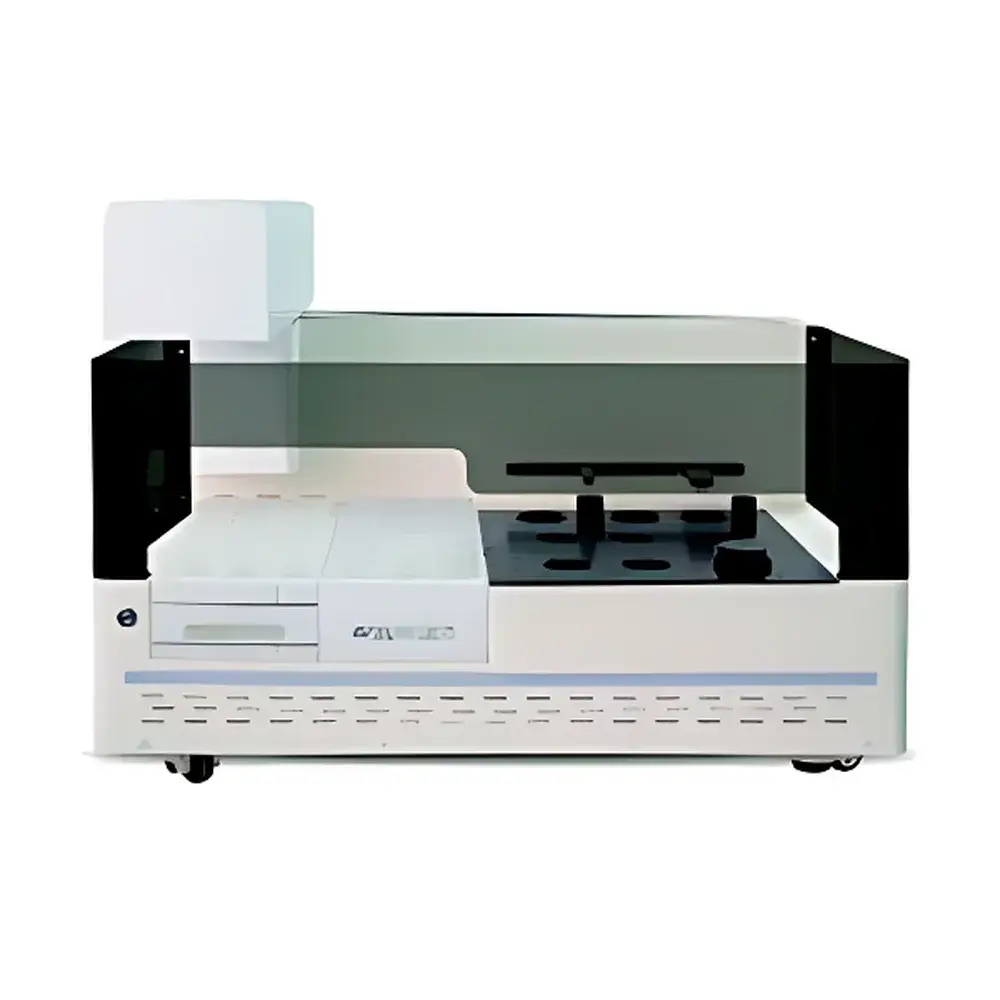
HUANKONG 1600N Seawater Chemical Oxygen Demand (COD) Analyzer
| Brand | HUANKONG |
|---|---|
| Origin | Shandong, China |
| Manufacturer Type | Direct Manufacturer |
| Product Origin | Domestic (China) |
| Model | 1600N |
| Instrument Type | Laboratory Benchtop Analyzer |
| Measurement Principle | Potassium Dichromate Digestion Method (Online-Capable Configuration) |
| Accuracy | ≤10% RSD |
| Analysis Time | <10 min per sample |
| Batch Capacity | 36 samples |
| Sample Tray | 36-position carousel |
| Digestion Temperature | 100°C with auto-detection and timer control |
| Digestion Method | Electric oil-bath heating for thermal stability |
| Titration Endpoint Detection | Full-spectrum colorimetric recognition (yellow to blue transition) |
| Reagent Delivery System | 8 independent peristaltic pump–valve channels |
| Sample Transfer | Automated precision liquid handling with volumetric accuracy |
| Calibration & Analysis Mode | Simultaneous auto-calibration and sample titration |
| Condensation System | Dual independent recirculating water condensers |
| Titrant Dispensing Resolution | 0.02 mL |
| Titration Environment | Light-shielded chamber with dedicated opaque cover |
| Reagent Arms | Dual independent robotic reagent arms |
Overview
The HUANKONG 1600N Seawater Chemical Oxygen Demand (COD) Analyzer is a fully automated, benchtop laboratory instrument engineered for precise, high-throughput determination of chemical oxygen demand in marine and estuarine water matrices. It implements the standardized potassium dichromate digestion method—aligned with ISO 6060 and APHA Standard Methods 5220B—adapted specifically for saline environments where chloride interference, matrix complexity, and low organic load require robust analytical control. Unlike generic COD analyzers, the 1600N integrates chloride compensation logic during digestion and employs dual-wavelength colorimetric endpoint detection to mitigate spectral overlap from seawater chromophores. Its architecture supports both discrete batch analysis and semi-automated online interfacing via optional I/O modules, enabling integration into centralized environmental monitoring labs operating under GLP or ISO/IEC 17025 quality frameworks.
Key Features
- 36-position automated sample carousel with barcode-compatible tray indexing for traceable sample tracking
- Electric oil-bath digestion system maintaining ±0.5°C thermal stability at 100°C, eliminating steam variability inherent in air-heated units
- Dual independent recirculating water condensers prevent reflux loss during prolonged digestion cycles and ensure consistent volatile retention
- Full-spectrum colorimetric titration module with real-time RGB channel analysis, calibrated for seawater-specific endpoint transitions (Cr³⁺ green → Cr⁶⁺ yellow → indicator-mediated blue)
- Eight isolated reagent delivery channels with chemically resistant fluoropolymer tubing and solenoid valves, minimizing carryover between acid, silver sulfate, mercury sulfate, and ferroin reagents
- Dual robotic reagent arms performing parallel additions—e.g., digestion acid + catalyst—and synchronized timing to reduce inter-sample variance
- Light-isolated titration chamber with motorized opaque lid and ambient light rejection algorithm, essential for low-intensity endpoint discrimination in turbid or colored seawater samples
- Automated calibration routine using certified KHP standards; drift correction applied across multi-point curves prior to each batch
Sample Compatibility & Compliance
The 1600N is validated for unfiltered and filtered seawater (salinity range: 20–40 g/kg NaCl), brackish estuarine water, and coastal river discharge samples containing suspended solids ≤50 mg/L. It meets performance criteria outlined in EPA Method 410.4 and Chinese standard HJ 828–2017 for COD determination in saline waters. All fluidic pathways comply with USP Class VI biocompatibility requirements; reagent contact materials include PTFE, PFA, and borosilicate glass. The system supports audit-ready data logging compliant with FDA 21 CFR Part 11 when paired with optional secure software licensing—enabling electronic signatures, user role-based access, and immutable audit trails for QA/QC review.
Software & Data Management
Control and data acquisition are managed via HUANKONG Analytical Suite v3.2—a Windows-based application supporting method templates, SOP-driven workflows, and customizable report generation (PDF/CSV/XLSX). Raw absorbance spectra, titration curves, digestion thermograms, and reagent consumption logs are timestamped and stored with SHA-256 hash integrity verification. Data export interfaces include OPC UA and Modbus TCP for LIMS integration. Software validation documentation (IQ/OQ/PQ protocols) is provided for regulated laboratories requiring GMP or GLP compliance.
Applications
- Monitoring anthropogenic organic loading in offshore aquaculture zones and port discharge plumes
- Time-series assessment of eutrophication dynamics in semi-enclosed bays and lagoons
- Validation of wastewater treatment efficiency for desalination plant effluents
- Interlaboratory comparison studies under IOC-UNESCO reference material programs
- Supporting MARPOL Annex IV compliance reporting for shipboard sewage treatment verification
FAQ
Does the 1600N correct for chloride interference in seawater?
Yes—it applies a pre-digestion chloride masking protocol using mercury sulfate and incorporates post-digestion spectral deconvolution to isolate Cr³⁺ absorbance from chloride-derived complexes.
Can it analyze samples with high turbidity or particulate matter?
It accepts unfiltered seawater up to 50 mg/L total suspended solids; however, filtration through 0.45 µm PVDF membranes is recommended for reproducible endpoint detection.
Is remote operation supported?
The analyzer includes Ethernet connectivity and supports secure remote diagnostics and method upload via TLS 1.2 encrypted sessions.
What maintenance intervals are required for long-term reliability?
Peristaltic pump tubing replacement every 6 months; condenser water filter cleaning biweekly; optical sensor calibration quarterly using NIST-traceable color standards.
Related Products







