
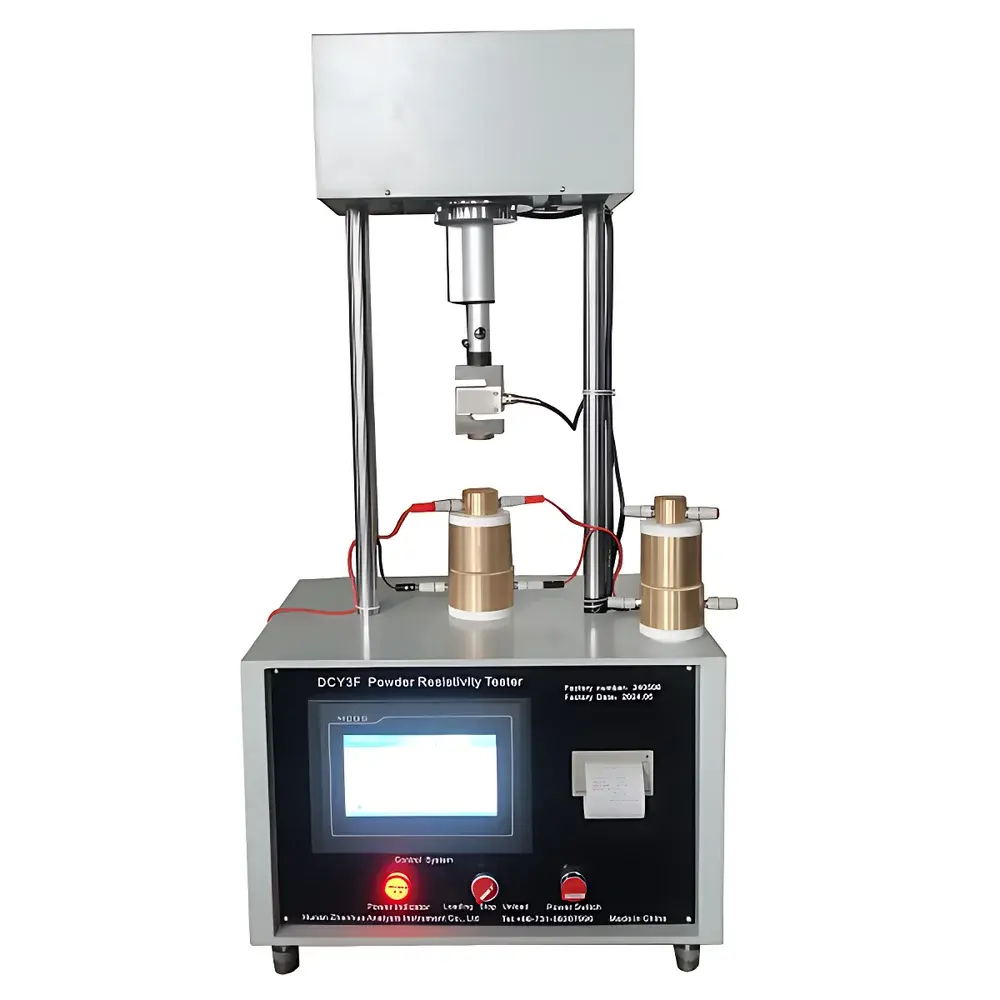
ZHENHUAFENXI DCT Graphite and Carbon Resistivity Tester
| Brand | ZHENHUAFENXI |
|---|---|
| Origin | Hunan, China |
| Manufacturer Type | Authorized Distributor |
| Country of Origin | China |
| Model | DCT |
| Max. Applied Force | 300 kg |
| Max. Piston Stroke | 130 mm |
| Current Output Range | 0–5 A (Resolution: 0.01 A) |
| Voltage Measurement Range | 0–200 mV (Resolution: 0.01 mV) |
| Resistivity Measurement Range | 1–1800 µΩ·m |
| Compliant Standards | ISO 10143:1995, YS/T 587.6 |
Overview
The ZHENHUAFENXI DCT Graphite and Carbon Resistivity Tester is a precision instrument engineered for the quantitative determination of electrical resistivity in powdered and compacted carbonaceous materials—including graphite powders, carbon anodes, cathode blocks, calcined coke, and synthetic graphite granules. It operates on the four-terminal (Kelvin) measurement principle, eliminating lead resistance and contact potential errors to ensure high reproducibility in low-resistance measurements. The system applies controlled uniaxial compaction via a hydraulic loading mechanism with a 300 kg maximum force capacity and 130 mm piston stroke, enabling consistent densification of powder samples prior to resistivity evaluation. This mechanical preconditioning step is critical for simulating industrial pressing conditions and generating data relevant to electrode manufacturing, battery material quality control, and metallurgical carbon product certification.
Key Features
- Hydraulic loading system with high-ratio transmission for smooth, vibration-free force application and stable dwell pressure maintenance during measurement.
- Integrated digital force transducer calibrated against traceable standard load cells—ensuring compliance with ISO 376 requirements for force measurement accuracy.
- High-stability constant-current source (0–5 A, resolution 0.01 A) paired with a low-noise, high-resolution voltmeter (0–200 mV, resolution 0.01 mV) for precise voltage drop detection across defined electrode spacing.
- Dual-sample tube configuration: interchangeable small-bore (≥20 mm ID, ≥330 mm² cross-section, 10 mm electrode spacing) and large-bore (≥30 mm ID, ≥700 mm² cross-section, 20 mm electrode spacing) cylinders to accommodate varying particle size distributions and bulk densities.
- Real-time digital display of current, voltage, and applied force—enabling immediate verification of measurement conditions without external instrumentation.
- Resistivity calculation engine embedded in firmware, referencing geometric constants and automatically applying correction factors per ISO 10143:1995 Annex B for cylindrical sample geometry and current distribution uniformity.
Sample Compatibility & Compliance
The DCT tester supports standardized testing of raw and processed carbon materials used in aluminum smelting, lithium-ion battery anodes, fuel cell bipolar plates, and refractory composites. Its mechanical and electrical design conforms to the dimensional and procedural specifications outlined in ISO 10143:1995 “Carbonaceous materials for the production of aluminium — Calcined coke and anthracite — Determination of resistivity” and the Chinese industry standard YS/T 587.6 “Test methods for calcined petroleum coke — Part 6: Determination of resistivity”. All force, current, and voltage subsystems are calibrated using NIST-traceable references, supporting laboratory accreditation under ISO/IEC 17025. The instrument’s architecture facilitates audit-ready documentation when integrated into GLP or GMP environments requiring full traceability of test parameters and operator actions.
Software & Data Management
While the base DCT model features standalone operation with front-panel digital readouts, optional USB or RS-232 connectivity enables integration with laboratory information management systems (LIMS) or custom data acquisition platforms. Exported datasets include timestamped records of applied force, current setpoint, measured voltage, calculated resistivity (µΩ·m), and sample identification metadata. When deployed in regulated settings, the optional software package provides electronic signatures, user access levels, and 21 CFR Part 11–compliant audit trails—including modification history of calibration coefficients and test method parameters.
Applications
- Quality assurance of calcined petroleum coke and needle coke supplied to aluminum smelters.
- In-process verification of green anode mix resistivity prior to baking in carbon electrode production.
- Comparative evaluation of graphitization degree in synthetic graphite batches via resistivity correlation with XRD-derived crystallite size (La, Lc).
- Research into particle packing effects on electron transport in composite electrode formulations for Li-ion and Na-ion batteries.
- Validation of binder distribution homogeneity in carbon paste extrusion processes through localized resistivity mapping (using segmented electrode fixtures).
FAQ
What standards does the DCT tester support?
ISO 10143:1995 and YS/T 587.6 are fully implemented in both mechanical configuration and calculation algorithms.
Can the instrument measure bulk resistivity of sintered carbon blocks?
Yes—by using the large-diameter sample tube with appropriate end-contact electrodes and adjusting the current range to maintain optimal signal-to-noise ratio for higher-resistivity specimens.
Is calibration traceable to national metrology institutes?
Force, current, and voltage channels are calibrated using equipment certified to ISO/IEC 17025 by CNAS-accredited laboratories; certificates include uncertainty budgets and reference standard IDs.
How is contact resistance minimized during measurement?
The four-terminal sensing topology isolates current injection from voltage sensing, while spring-loaded brass electrodes ensure uniform pressure distribution and oxide-layer penetration on carbon surfaces.
Does the system support automated test sequences?
With optional PC interface and scripting module, users can define multi-step protocols—including ramped force application, dwell intervals, and sequential current sweeps—for advanced material characterization studies.



