
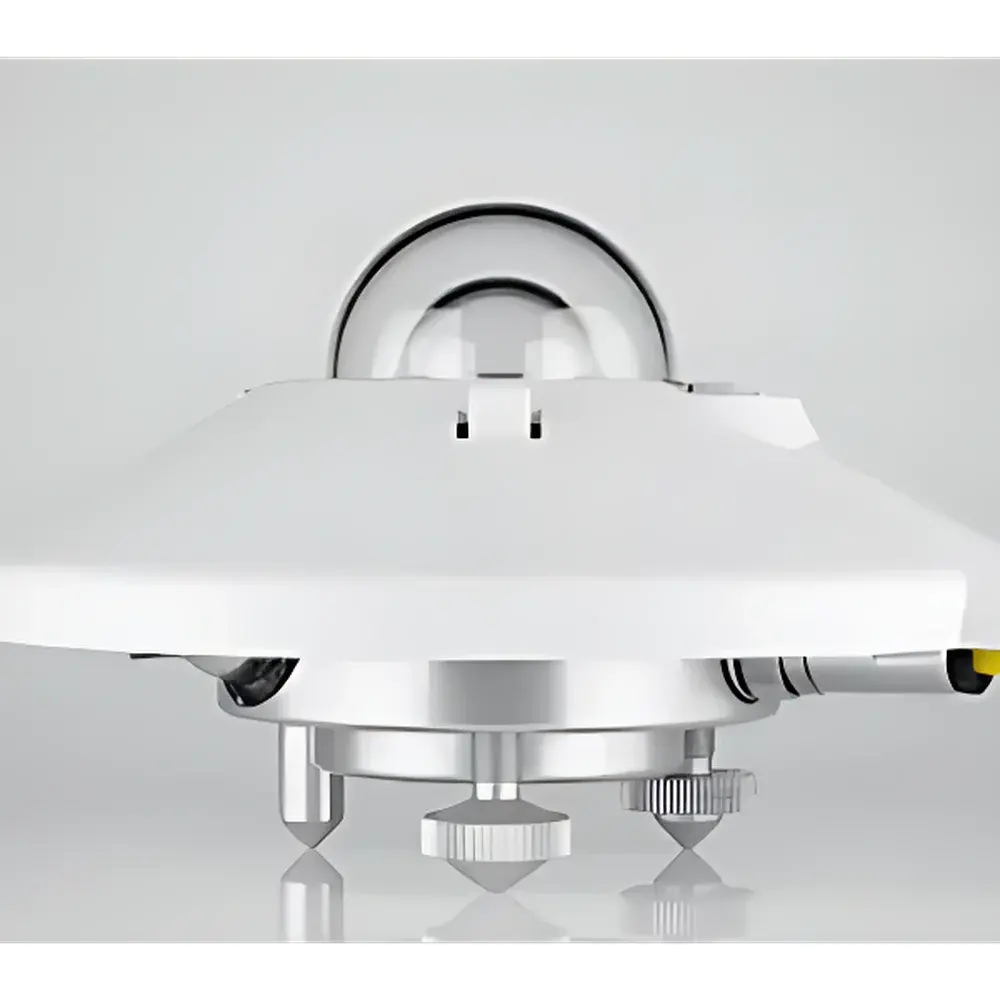
Kipp & Zonen CMP6 Pyranometer
| Brand | Kipp & Zonen |
|---|---|
| Origin | Netherlands |
| Model | CMP6 |
| Spectral Range | 285–2800 nm |
| Sensitivity | 5–20 µV/W/m² |
| Response Time | 18 s |
| Zero Offset A | < 10 W/m² |
| Zero Offset B | < 4 W/m² |
| Directional Error (up to 80°, 1000 W/m² beam) | < 20 W/m² |
| Temperature Dependence of Sensitivity (−10 °C to +40 °C) | < 2 % |
| Operating Temperature Range | −40 °C to +80 °C |
| Maximum Irradiance | 2000 W/m² |
| Field of View | 180° |
| Output Signal | 0–20 mV (passive, no power required) |
Overview
The Kipp & Zonen CMP6 Pyranometer is a thermopile-based instrument engineered for high-accuracy measurement of global solar irradiance on a horizontal plane. It operates on the principle of thermal detection: incident solar radiation is absorbed by a blackened thermopile sensor surface, generating a temperature gradient across multiple thermocouple junctions—64 in series—which produces a proportional millivolt output signal (0–20 mV) without requiring external power. Fully compliant with ISO 9060:2018 classification as a Class A (formerly “Secondary Standard”) pyranometer, the CMP6 delivers metrologically traceable performance suitable for climatological monitoring, solar resource assessment, and long-term environmental observation networks. Its design integrates fundamental radiometric principles—including spectral flatness, cosine response correction, and thermal equilibrium stability—to ensure reproducible measurements under variable solar elevation, diffuse sky conditions, and diurnal thermal cycling.
Key Features
- Thermopile sensor with 64-series thermocouple junctions for enhanced signal-to-noise ratio and long-term drift resistance
- Carbon-based inorganic black coating offering uniform spectral absorptance across 285–2800 nm and proven stability over multi-year deployments
- Dual-dome quartz construction minimizing thermal offset errors and improving directional response up to 80° solar zenith angle
- Increased thermal mass relative to the CMP3, reducing sensitivity to rapid ambient temperature fluctuations
- Integrated bubble level relocated to the top of the housing—accessible without removing the redesigned snap-on shading cap—ensuring rapid field-leveling verification
- Gold-plated electrical contacts enabling reliable signal integrity, simplified cable interchange, and straightforward recalibration procedures
- Screw-in desiccant chamber with user-replaceable silica gel cartridges; included spare desiccant ensures uninterrupted operation in humid environments
- Passive operation: zero power requirement, eliminating battery dependency or power supply integration complexity
Sample Compatibility & Compliance
The CMP6 is designed exclusively for outdoor, unobstructed horizontal mounting in open-sky conditions. It is compatible with standard meteorological mounting hardware (e.g., leveling plates, solar tracker interfaces) and integrates seamlessly into automated weather stations (AWS), hydrological monitoring networks, and agricultural microclimate observatories. As a Class A instrument per ISO 9060:2018, it meets the stringent requirements for spectral error, directional response, temperature dependence, and non-stability—making it suitable for use in WMO GAW (Global Atmosphere Watch) sites and national reference networks. While not intrinsically certified for specific regulatory frameworks such as IEC 61724-1 (photovoltaic system performance monitoring) or ASTM E892 (solar irradiance measurement practice), its metrological characteristics support compliance when deployed within validated measurement systems adhering to those standards.
Software & Data Management
The CMP6 outputs an analog voltage signal (0–20 mV) proportional to irradiance (W/m²), requiring connection to a calibrated data logger with appropriate input range and resolution (e.g., ≥16-bit ADC, ±0.1 mV accuracy). For applications demanding higher signal robustness or compatibility with industrial control systems, Kipp & Zonen’s AMPBOX signal conditioner is recommended—providing amplified 0–1 V, 0–5 V, 0–10 V, or 4–20 mA outputs with built-in temperature compensation and galvanic isolation. Raw data acquisition must account for instrument-specific calibration coefficients (provided on individual calibration certificates, traceable to the World Radiometric Reference at PMOD/WRC). When integrated into larger environmental monitoring platforms, the CMP6 supports audit-ready data workflows compliant with GLP and basic GMP documentation practices—particularly when paired with data loggers featuring time-stamped, tamper-evident storage and configurable metadata tagging.
Applications
- Long-term solar radiation monitoring in national meteorological services and climate research stations
- Input validation for satellite-derived irradiance products (e.g., CAMS, NSRDB)
- Performance ratio (PR) and yield analysis in utility-scale and distributed photovoltaic power plants
- Evapotranspiration modeling and irrigation scheduling in precision agriculture systems
- Surface energy balance studies in hydrological and ecological field campaigns
- Calibration transfer and intercomparison exercises among reference and secondary instruments
- Baseline irradiance characterization for building energy modeling and daylighting simulation
FAQ
Does the CMP6 require external power to operate?
No. The CMP6 is a passive thermopile sensor and generates its own millivolt output in response to incident irradiance.
What is the recommended recalibration interval?
Kipp & Zonen recommends recalibration every two years for critical applications; annual verification against a reference instrument is advised for high-accuracy networks.
Can the CMP6 be mounted on a solar tracker?
Yes, but only in fixed-horizontal orientation. It is not designed for tilted-plane or direct-normal irradiance (DNI) measurement; use a pyrheliometer (e.g., CHP1) with a sun tracker for DNI.
How does the dual-glass dome reduce thermal offset?
The outer dome shields the inner dome and sensor from convective cooling/heating, while the air gap between domes dampens rapid thermal transients—reducing Zero Offset A and B contributions.
Is the CMP6 suitable for indoor or artificial light measurements?
No. Its spectral response and calibration are optimized for natural solar spectra (285–2800 nm); artificial sources with strong UV/IR discontinuities will introduce significant measurement uncertainty.







