
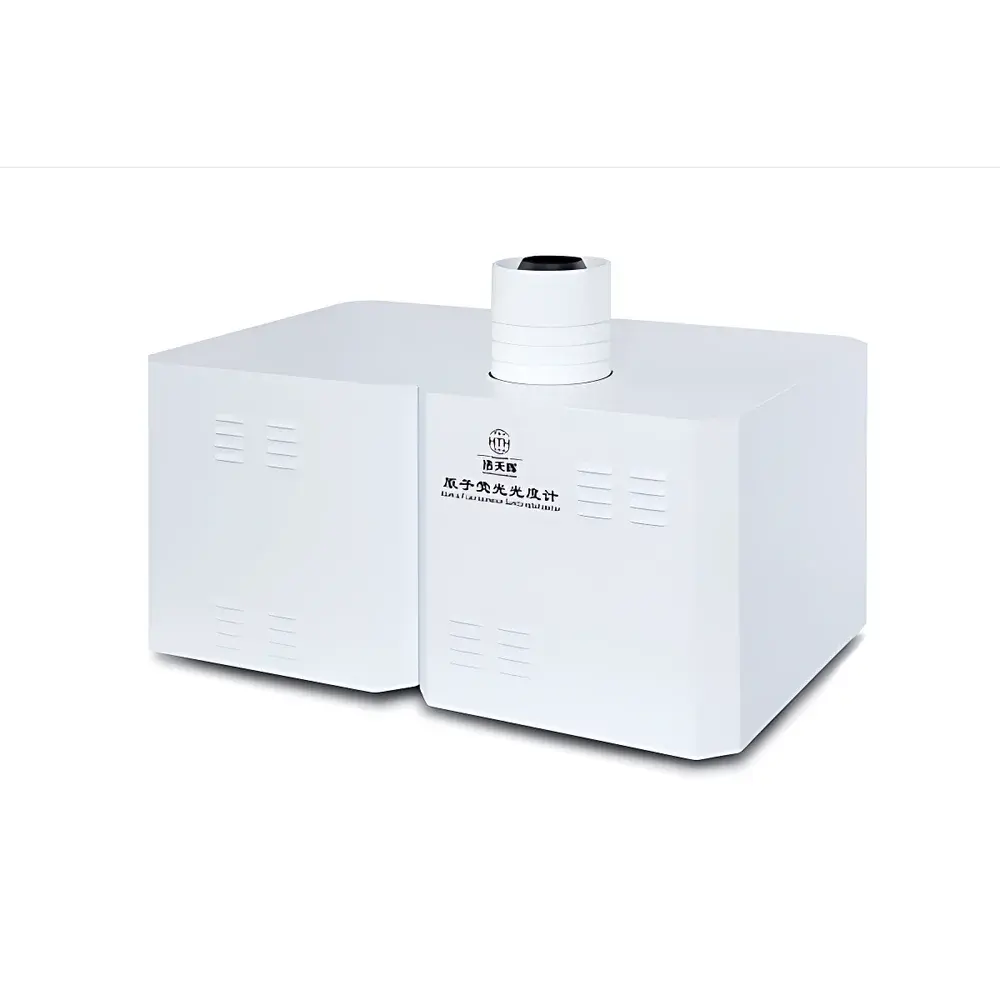
Huayisanpu AFS-100 Semi-Automatic Dual-Channel Atomic Fluorescence Spectrometer
| Brand | Beijing Huayisanpu |
|---|---|
| Origin | Beijing, China |
| Model | AFS-100 |
| Detection Elements | As, Se, Pb, Bi, Sb, Te, Sn, Hg, Cd, Ge, Zn, Au |
| Linear Range | Dual-channel ≥ 0.999 |
| Detection Limit | Dual-channel ≤ 0.03 ng/mL |
| Atomizer Temperature Control Range | 15–30 °C |
| Operating Ambient Temperature | 15–30 °C |
| Relative Humidity | ≤75% |
| Argon Supply Pressure | 0.2–0.3 MPa (regulated to 0.2 MPa) |
| Alarm Threshold | <0.15 MPa |
| Power Supply | 220 V ± 22 V AC |
| Host Power Consumption | ≤400 W |
| Warm-up Time | 30 min |
| Repeatability | Dual-channel ≤1% |
Overview
The Huayisanpu AFS-100 Semi-Automatic Dual-Channel Atomic Fluorescence Spectrometer is a hydride-generation atomic fluorescence (HG-AFS) instrument engineered for high-sensitivity, trace-level quantification of hydride-forming and cold-vapor elements. It operates on the principle of atomic fluorescence spectroscopy: analyte elements are chemically reduced (typically using sodium borohydride in acidic medium) to form volatile hydride species or elemental vapor (e.g., AsH3, Hg0), which are swept into a quartz atomization cell where they are atomized by a flameless quartz furnace. Excitation is achieved via high-intensity hollow cathode lamps (HCLs), and element-specific fluorescence emission is detected at right angles to the excitation beam—minimizing background scatter and enabling sub-ng/mL detection limits. Unlike conventional atomic absorption or emission techniques, HG-AFS offers superior selectivity for Group IV–VI elements due to its reliance on chemical speciation prior to atomization, effectively eliminating spectral interferences common in complex matrices.
Key Features
- Dual-channel optical path design enables simultaneous measurement of two elements (e.g., As and Se), improving throughput while maintaining independent calibration and signal processing per channel.
- Temperature-stabilized quartz furnace atomizer (15–30 °C control range) ensures consistent atomization efficiency and minimizes thermal drift during extended analyses.
- Integrated argon gas management system with real-time pressure monitoring and automatic alarm at <0.15 MPa prevents incomplete hydride generation and safeguards pneumatic components from acid backflow.
- Optimized flow-injection hydride generation module with programmable carrier gas flow and reaction delay timing enhances precision and reduces memory effects between samples.
- High-stability hollow cathode lamps with dedicated power supplies ensure stable spectral output and long-term intensity reproducibility across multi-hour sequences.
- Modular hardware architecture supports field-upgradable lamp housings, photomultiplier tube (PMT) assemblies, and gas delivery manifolds without recalibration.
Sample Compatibility & Compliance
The AFS-100 is validated for analysis of aqueous liquid samples—including drinking water, wastewater, biological fluids (urine, serum), soil extracts (EPA Method 6010D/6020B digests), food homogenates, and pharmaceutical excipients—following standard hydride-generation protocols. It complies with key regulatory frameworks governing trace metal analysis: ASTM D5673 (arsenic in water), ISO 17294-2 (water quality — inductively coupled plasma mass spectrometry — Part 2: applications), and Chinese national standards GB/T 5750.6–2023 (Standard Methods for Examination of Drinking Water — Metals). While not inherently 21 CFR Part 11 compliant, its data acquisition software supports audit-trail-enabling configurations when deployed in GLP/GMP environments with appropriate IT governance controls (e.g., user access logs, electronic signature integration, and raw data immutability).
Software & Data Management
The instrument is controlled via Windows-based acquisition software distributed on USB drive, supporting method setup (lamp current, PMT voltage, delay times, integration periods), real-time signal visualization, peak area/intensity integration, and calibration curve fitting (linear, quadratic, or forced-zero intercept). Raw spectral data (time-resolved fluorescence intensity vs. time) and processed results (concentration, %RSD, LOD estimation) are stored in vendor-neutral CSV and XML formats. Software permits batch processing of up to 96 samples with auto-dilution factor application and QC flagging (e.g., signal saturation, baseline noise >5% of peak height). All method parameters and result metadata are timestamped and exportable for laboratory information management system (LIMS) ingestion.
Applications
- Environmental Monitoring: Quantification of arsenic and antimony in groundwater per WHO guideline values (10 µg/L), mercury in sediment pore water, and selenium in agricultural runoff.
- Food Safety Testing: Screening of inorganic arsenic in rice products (Codex Alimentarius STAN 193–1995), cadmium in shellfish, and lead in infant formula extracts.
- Clinical & Toxicological Analysis: Measurement of urinary arsenic speciation metabolites (AsIII, MMA, DMA) following derivatization, and blood mercury levels in occupational exposure assessment.
- Geological Exploration: Rapid field-deployable screening of gold and tellurium in leachates from rock core samples using aqua regia digestion.
- Pharmaceutical Quality Control: Verification of catalyst residues (e.g., Pd, Pt) in active pharmaceutical ingredients (APIs) via indirect hydride generation or cold-vapor adaptation.
FAQ
What elements can the AFS-100 quantify, and what sample preparation is required?
The AFS-100 measures As, Se, Pb, Bi, Sb, Te, Sn, Hg, Cd, Ge, Zn, and Au. Samples must be acid-digested (e.g., HNO3/H2O2) to ensure complete oxidation of organometallic species and subsequent reduction to volatile hydrides. Mercury requires cold-vapor generation without reduction reagent.
Is the instrument compatible with automated sample introduction systems?
The AFS-100 accepts standard RS-232 serial communication and supports external autosampler triggering via TTL-level I/O ports. Third-party XYZ autosamplers (e.g., CETAC ASX-520) may be integrated with custom script configuration.
How is instrument performance verified and maintained?
Daily verification uses certified reference materials (CRMs) such as NIST SRM 1640a (Trace Elements in Natural Water) or EPA LCS spikes. Annual PM includes quartz tube cleaning, lamp alignment validation, and gas line leak testing per ISO/IEC 17025 clause 6.4.3.
Does the system support multi-element calibration curves?
Yes—dual-channel operation allows independent calibration for two elements per run. Multi-element analysis requires sequential lamp switching and shared hydride generation; correlation coefficients (r) ≥0.998 are routinely achieved across 3–5 point calibrations spanning 0.1–100 ng/mL.
What safety features prevent operator exposure during hydride generation?
The reaction chamber is fully enclosed with negative-pressure exhaust linked to a fume hood. Acid-resistant PU tubing and silicone connectors minimize leakage risk, and the system halts analysis automatically if argon pressure drops below operational threshold or furnace temperature deviates by >2 °C from setpoint.




