
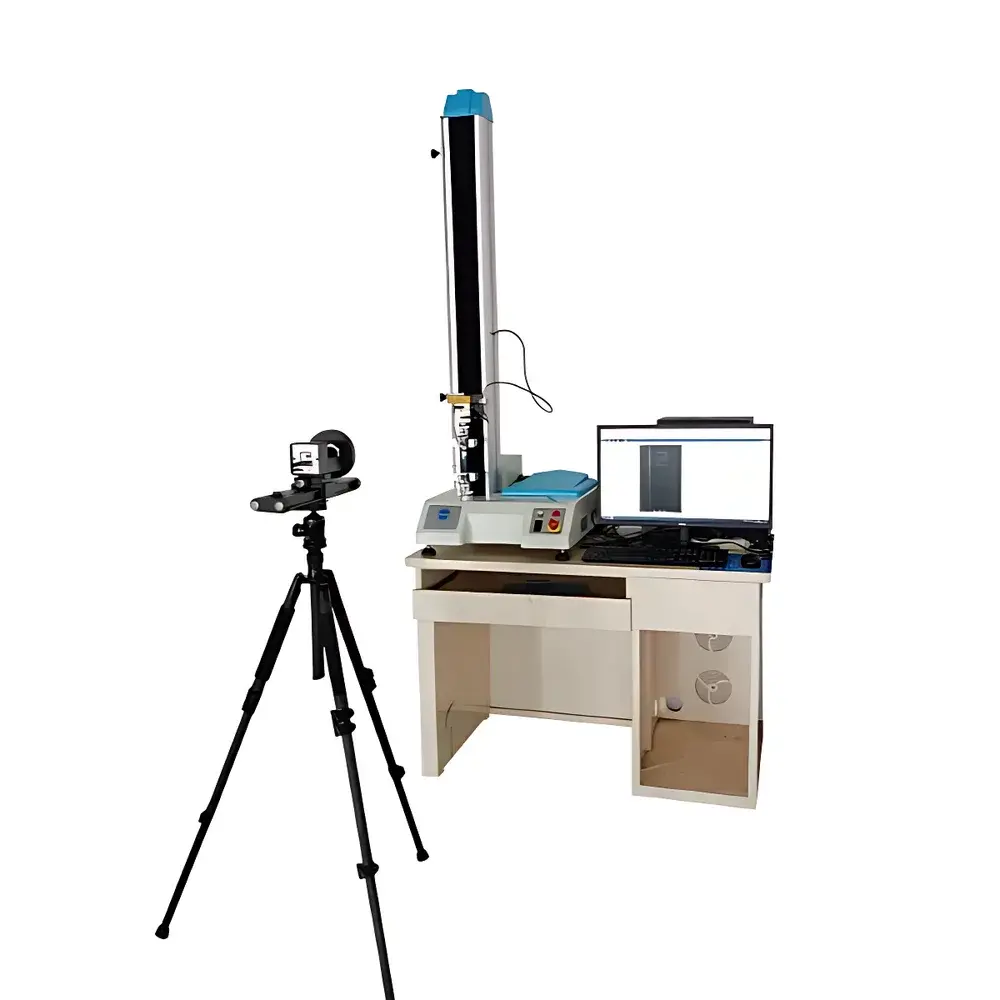
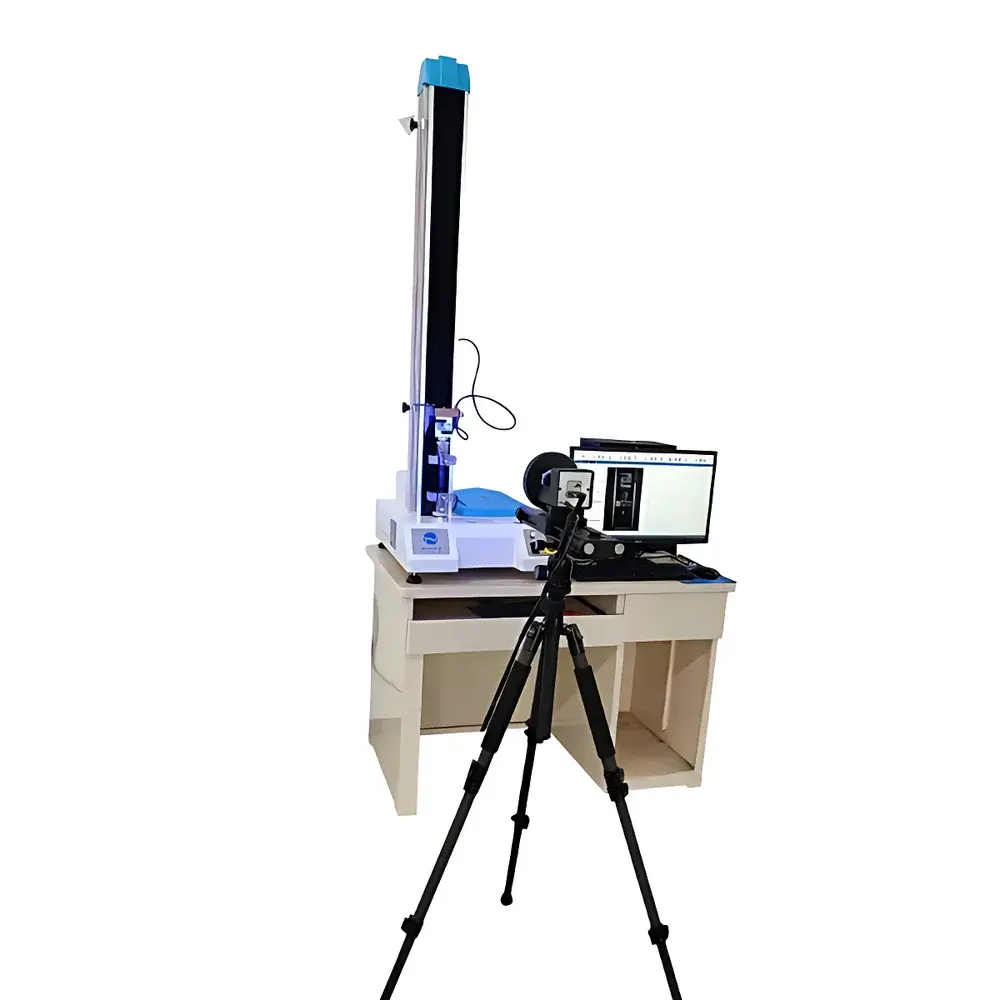
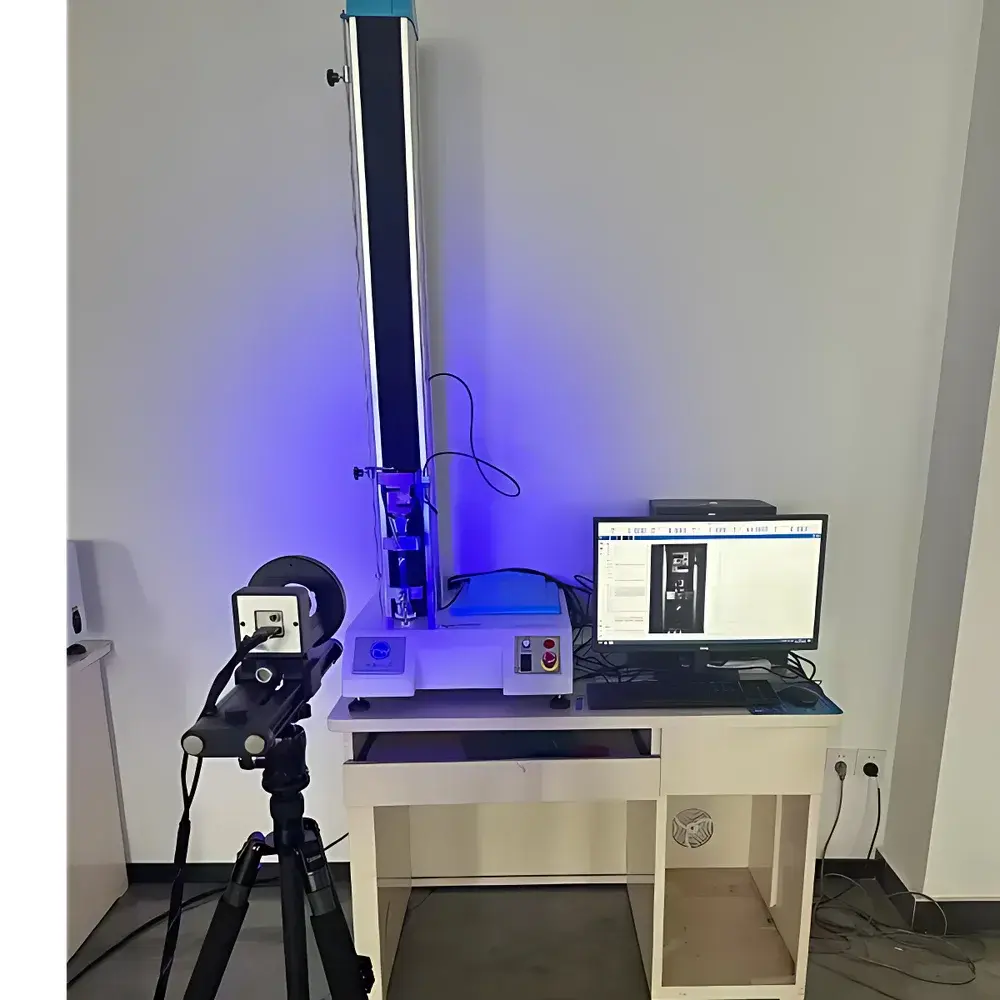
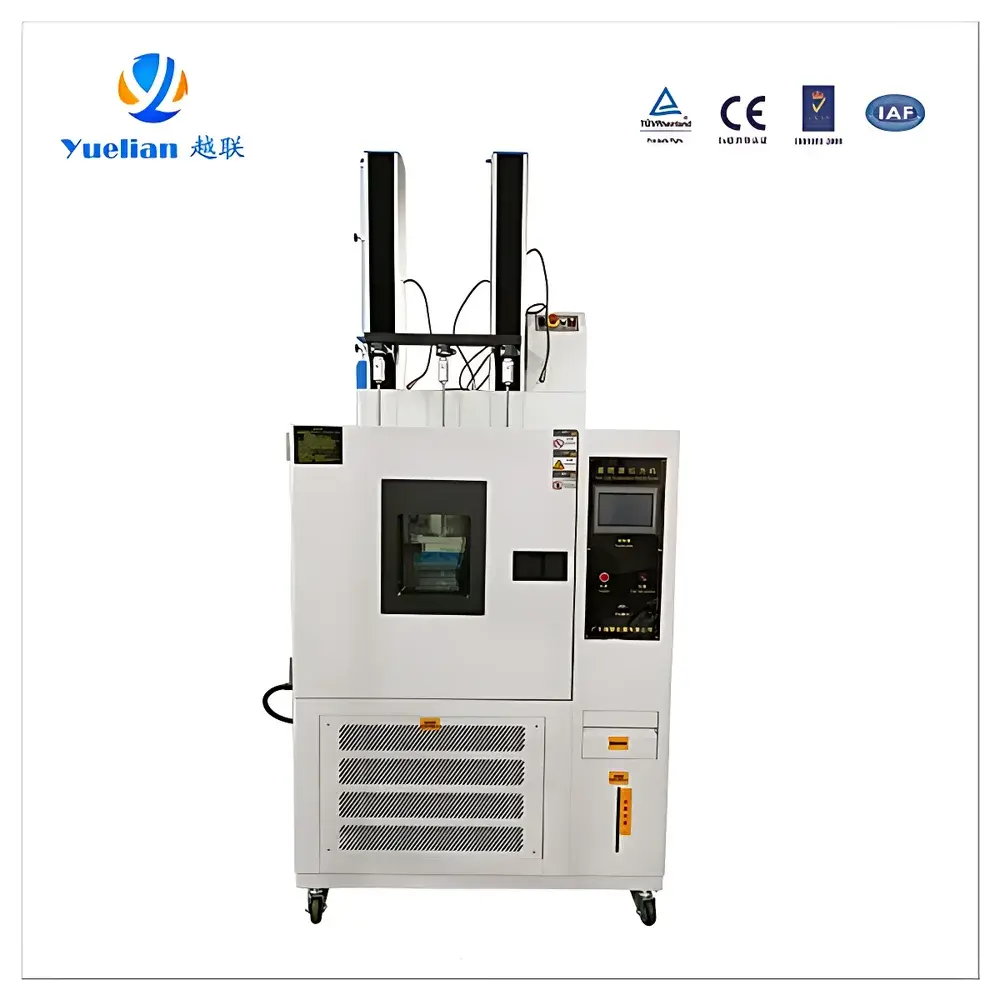
YueLian PW-US72 Video Extensometer-Integrated Universal Tensile Testing Machine
| Brand | YueLian / PW |
|---|---|
| Origin | Guangdong, China |
| Manufacturer Type | Authorized Distributor |
| Country of Origin | China |
| Model | PW-US72 |
| Max Test Load | 5 kN |
| Force Accuracy | ±0.03% of full scale |
| Force Resolution | 1/1,000,000 FS |
| Travel Range | 600 mm |
| Displacement Resolution | 0.001 mm |
| Optical Resolution | 0.5 µm |
| Displacement Accuracy | ±1 µm (within 800 mm FOV) |
| Field of View | Adjustable from 60–150 mm (standard), up to 1000 mm (extended) |
| Gauge Length Range | Up to 1000 mm |
| Frame Rate | Up to 200 fps |
| ISO 9513 Compliance | Class 0.5 |
| Power Supply | 220/380 V, 50/60 Hz, 30 A |
| Total Power Consumption | ~5 kW |
| Dimensions (W×D×H) | 150 × 230 × 300 cm |
| Weight | ~350 kg |
Overview
The YueLian PW-US72 is a fully integrated video extensometer-equipped universal tensile testing machine engineered for high-fidelity, non-contact mechanical characterization of materials undergoing large-strain deformation. Unlike conventional clip-on or knife-edge extensometers, the PW-US72 employs a single-camera digital image correlation (DIC)-based optical measurement system to capture real-time surface displacement and strain fields without physical contact. It operates on the principle of sub-pixel intensity correlation across sequential high-resolution frames, enabling quantitative tracking of surface features—including natural texture or user-applied speckle patterns—under dynamic loading. This architecture eliminates mechanical interference, slippage artifacts, and boundary-condition distortion common in contact-based methods, making it especially suitable for soft, brittle, viscoelastic, or geometrically complex specimens such as elastomers, thin films, hydrogels, composites, and fine wires. The system complies with ISO 9513:2012 Class 0.5 requirements for extensometer verification and supports synchronized acquisition of force, displacement, and full-field strain data under ASTM D412, ISO 37, ISO 527, and GB/T 528 test protocols.
Key Features
- Non-contact, full-field optical strain measurement via monocular DIC technology with sub-pixel resolution (≤0.5 µm displacement resolution)
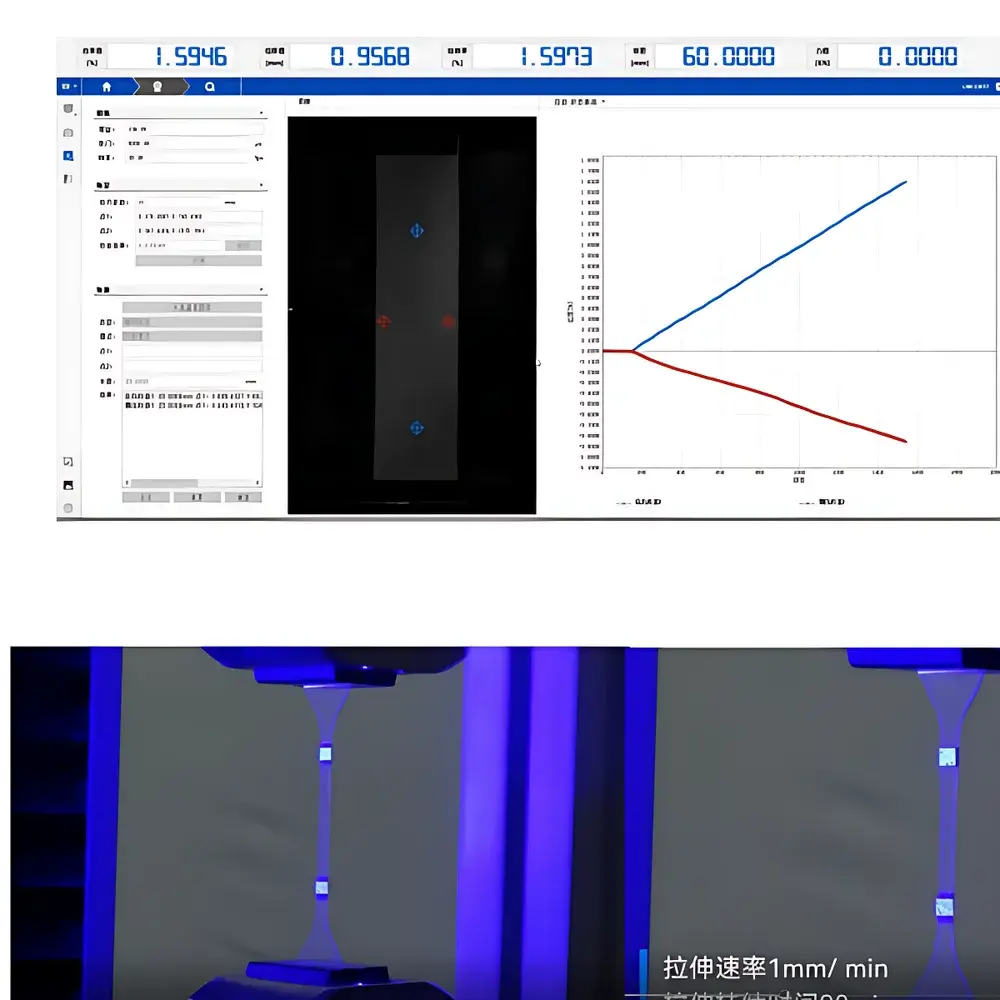
- Real-time dual-axis strain computation: simultaneous longitudinal and transverse strain mapping across customizable gauge lengths (0.1–1000 mm)
- Dynamic range covering strains from 0.002% to >1000%, validated per ISO 9513 Class 0.5 calibration standards
- Automated calibration suite supporting both auto-target and manual reference-scale modes (PW-RU60/PW-RU200 calibration rulers included)
- Integrated LED blue-light illumination system with flicker-free, uniform field and continuous brightness control
- Modular hardware interface: 16-bit analog I/O (2 outputs, 16 inputs), TTL synchronization, and USB 3.0 camera connectivity
- Motorized or manual precision rail system for repeatable working distance adjustment (FOV scaling and depth-of-field optimization)
- Multi-mode acquisition: interval-triggered, fatigue-cycle monitoring, creep-duration logging, and event-driven image capture
Sample Compatibility & Compliance
The PW-US72 accommodates a broad spectrum of specimen geometries and material classes without modification: flat sheets (metals, polymers), cylindrical rods (steel, CFRP), filaments (monofilament, textile yarns), thin films (<10 µm), rubber compounds, biological tissues, and cementitious composites. Its non-contact nature eliminates preload-induced artifacts and enables testing under environmental chambers (optional integration for −70°C to +300°C operation). The system meets metrological traceability requirements for GLP/GMP-regulated laboratories: audit trails, electronic signatures, and 21 CFR Part 11-compliant software modules are available upon configuration. All firmware and measurement algorithms are validated against NIST-traceable reference standards and certified per JJG 762–2007 (Chinese national verification regulation for extensometers).
Software & Data Management
PW 2023 software provides a unified platform for instrument control, image acquisition, DIC computation, and mechanical property derivation. Core capabilities include: real-time curve overlay (stress–strain, force–time, εlong–εlat), multi-gauge concurrent analysis (up to 10 independent gauge sets), post-hoc redefinition of gauge length and origin, and export of time-synchronized datasets in Excel-compatible CSV format. Advanced features include noise suppression filters (configurable low/medium/high levels), edge-detection-assisted automatic specimen width tracking, thread-steel speckle-free recognition, and imported image replay analysis. Data integrity safeguards include cyclic redundancy checksums, timestamped metadata embedding, and immutable raw image archiving (lossless TIFF or compressed MP4). Software logs all user actions, parameter changes, and calibration events in an encrypted audit trail compliant with ISO/IEC 17025 documentation requirements.
Applications
The PW-US72 serves critical roles across R&D and QA/QC workflows: determination of tensile modulus, yield strength, ultimate elongation, and Poisson’s ratio in elastomeric formulations; evaluation of ductility and necking behavior in ultra-thin metal foils; validation of strain uniformity in stretchable electronics substrates; fatigue life assessment of polymer fibers under cyclic loading; and high-strain compression testing of cellular biomaterials. It is routinely deployed in automotive NVH component qualification, medical device packaging integrity testing, aerospace composite laminate certification, and academic studies of rate-dependent viscoelasticity. Case studies confirm robust performance in ASTM D638 Type I–V specimen configurations, ISO 527-2 multipoint strain mapping, and GB/T 1040.2 film tear propagation analysis—all without specimen preparation beyond standard gripping.
FAQ
Does the PW-US72 require speckle pattern application on specimens?
No. While optimized with stochastic speckles, the system supports speckle-free measurement using intrinsic surface texture or edge-based tracking—particularly effective for machined metals, extruded profiles, and woven textiles.
Can it synchronize with third-party load frames?
Yes. Standard analog/digital I/O interfaces support bidirectional triggering and real-time data streaming with Instron, MTS, Zwick, and Shimadzu systems via IEEE 1394, Ethernet/IP, or custom RS-422 protocols.
Is thermal drift compensation available?
The software includes ambient temperature logging and optional thermal expansion correction coefficients for aluminum, steel, and polymer fixtures—critical for long-duration creep tests.
What is the minimum measurable gauge length?
The optical system resolves displacements down to 0.5 µm at 60 mm FOV, permitting reliable measurements on gauge lengths as short as 0.5 mm when using high-magnification lenses (optional accessory).
How is measurement uncertainty quantified?
Per ISO 9513 Annex C, total uncertainty is calculated from repeatability (σr), reproducibility (σR), calibration error (δc), and environmental influence (δe), yielding expanded uncertainty U = k·uc (k=2) reported in each test certificate.



