
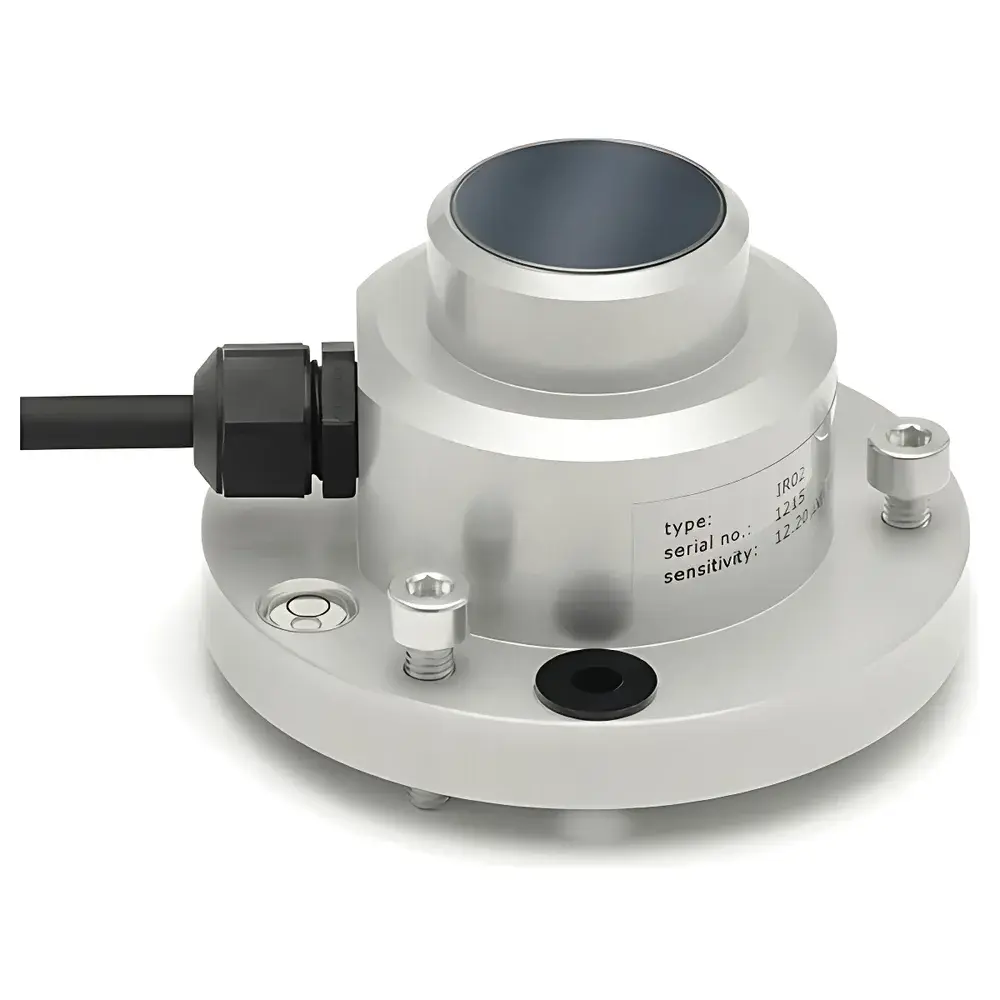
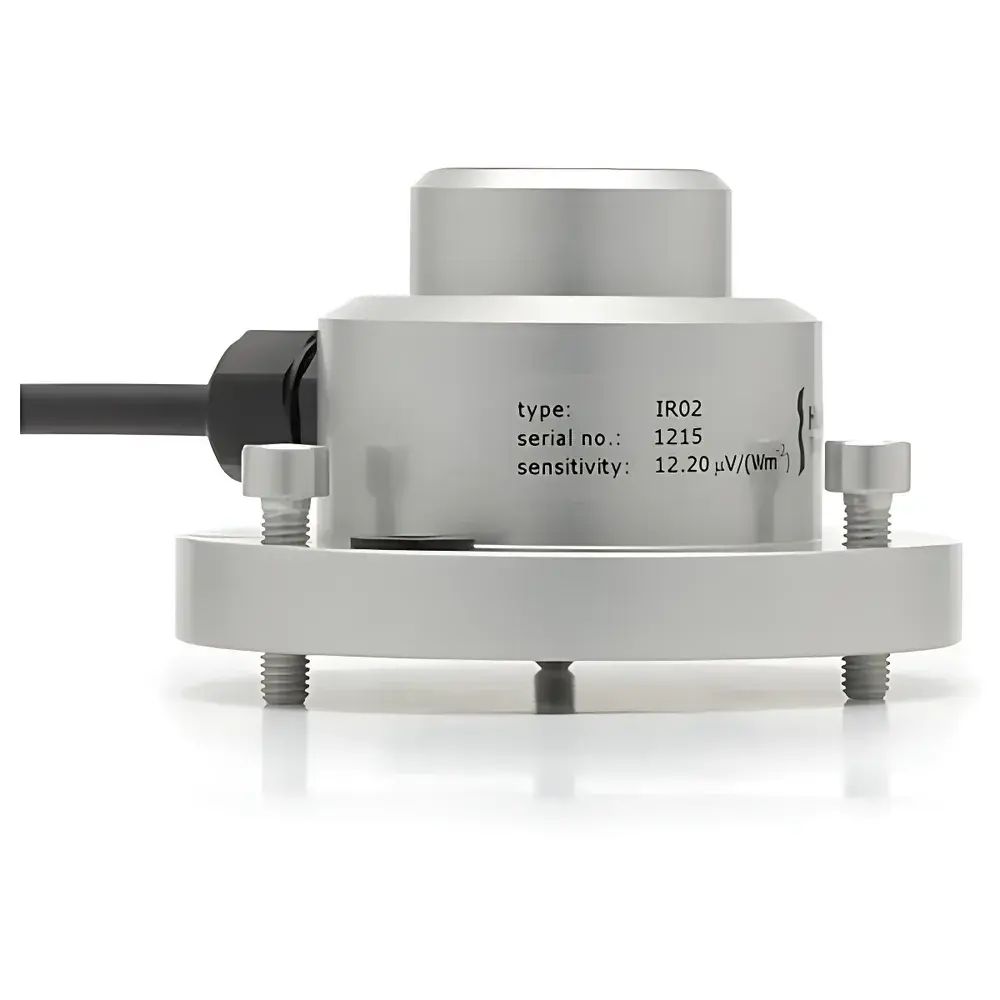

Hukseflux IR02 Long-Wave Pyrgeometer
| Brand | Hukseflux (Netherlands) |
|---|---|
| Origin | Netherlands |
| Model | IR02 |
| Spectral Range | 4.5–42 µm |
| Field of View | 150° |
| Response Time | 18 s |
| Sensitivity | 15 µV/(W/m²) |
| Operating Temperature | −40 to +80 °C |
| Temperature Dependence | < ±3 % (−10 to +40 °C) |
| Heater Power | 1.5 W @ 12 VDC |
| Standard Cable Length | 5 m |
| Weight | 0.5 kg |
| IP Rating | IP67 |
Overview
The Hukseflux IR02 is a precision long-wave pyrgeometer engineered for continuous, high-reliability measurement of downward or upward terrestrial infrared radiation in the 4.5–42 µm spectral band. Unlike solar pyranometers, the IR02 measures thermal emission from the atmosphere and Earth’s surface—radiation governed by Planck’s law and quantified via the Stefan–Boltzmann relationship. Its thermopile-based detector features a blackened absorber surface optimized for broadband long-wave response, coupled with a spectrally selective silicon window that blocks shortwave radiation (<4.5 µm) while transmitting atmospheric window wavelengths. The 150° field of view (FOV) represents a deliberate engineering compromise: it maintains high cosine response across typical sky angles while minimizing manufacturing complexity and cost—without compromising metrological integrity for standard meteorological applications.
Key Features
- Integrated resistive heater (1.5 W @ 12 VDC) prevents dew, frost, and condensation on the optical window—critical for unattended operation in humid, sub-zero, or diurnal transition conditions.
- Thermally stable anodized aluminum housing with IP67 ingress protection ensures robustness in outdoor environments, including agricultural fields, mountain stations, and polar observatories.
- Calibration traceable to the World Infrared Standard Group (WISG); optional ITS-90 blackbody calibration available for applications requiring highest metrological confidence (e.g., climate reference networks).
- Low-temperature coefficient (< ±3 % over −10 to +40 °C) and built-in Pt100 temperature sensor enable real-time thermal offset correction during post-processing or embedded compensation.
- Standard 5 m low-noise shielded cable with screw-terminal or M12 connector options; extendable in 5 m increments for remote mast or tower installations.
Sample Compatibility & Compliance
The IR02 is compatible with all standard data loggers supporting low-level DC voltage input (typically ±10 mV full scale), including Campbell Scientific CR series, Delta-T DL6, Onset HOBO RX3000, and custom SCADA interfaces. Its analog output requires no internal signal conditioning—enabling direct integration into legacy and modern monitoring systems alike. The instrument complies with ISO 9060:2018 classification for “secondary standard” pyrgeometers and meets the performance criteria outlined in WMO Guide to Meteorological Instruments and Methods of Observation (CIMO Guide, Chapter 8). It supports GLP-compliant data acquisition when paired with loggers offering audit-trail functionality and timestamped calibration metadata storage.
Software & Data Management
No proprietary software is required. Raw voltage output (µV) is converted to irradiance (W/m²) using the factory-determined sensitivity value (provided on the calibration certificate) and corrected for instrument body temperature via the integrated Pt100. Equations follow the widely adopted method defined in ASTM E2832–18 and validated against BSRN (Baseline Surface Radiation Network) processing protocols. Users may implement corrections in Python (NumPy/SciPy), MATLAB, R, or spreadsheet environments. For automated networks, the IR02 integrates seamlessly with open-source platforms such as ECHMET, MetPy, or IOOS SensorML workflows. Optional 4–20 mA output version (IR02-TR) enables compatibility with industrial PLCs and DCS systems without additional signal converters.
Applications
- Meteorological surface radiation budget monitoring in national weather services and research-grade climate observatories.
- Frost and freeze-warning systems in precision agriculture—where real-time long-wave flux informs irrigation, heating, or row-cover deployment decisions.
- Surface energy balance studies in eddy covariance towers, alpine catchments, and urban heat island assessments.
- Validation of satellite-derived land surface temperature (LST) and atmospheric downward longwave radiation (DLR) products (e.g., CERES, MODIS, ERA5).
- Long-term trend analysis in GCOS (Global Climate Observing System) reference sites requiring WISG-traceable instrumentation.
FAQ
How is the IR02 calibrated, and what documentation is provided?
Each IR02 ships with a NIST-traceable calibration certificate referencing WISG standards. Sensitivity, non-linearity, and temperature dependence data are listed. Optional ITS-90 blackbody calibration includes full spectral responsivity characterization and uncertainty budget per ISO/IEC 17025.
Can the IR02 measure upward long-wave radiation (e.g., from soil or canopy)?
Yes—the instrument is bidirectional by design. When inverted and mounted on a leveled platform with proper thermal shielding, it accurately measures upward terrestrial radiation. Best practice includes installing a reflective dome or ventilated radiation shield to minimize convective heating effects.
What is the impact of the 150° FOV versus ideal 180° hemispherical response?
The 150° FOV introduces negligible error (<0.5 % under clear-sky conditions) for most operational networks. Edge-of-sky contributions beyond 75° zenith angle carry minimal radiative weight due to atmospheric absorption and low path radiance—making the trade-off between cost, durability, and accuracy highly favorable for routine monitoring.
Is heater operation mandatory, or can it be disabled?
Heater use is strongly recommended for unattended deployments but configurable via external power control. Continuous heating at 12 VDC maintains window temperature ~5–10 °C above ambient—sufficient to suppress dew formation without inducing thermal gradients across the sensor element.
Related Products







