
Hukseflux IR20WS Long-Wave Pyrgeometer
| Brand | Hukseflux |
|---|---|
| Origin | Netherlands |
| Model | IR20WS |
| Spectral Range | 1.0–50 µm |
| Field of View | 180° |
| Response Time | 3 s |
| Sensitivity | 17 µV/(W/m²) |
| Operating Temperature | −40 to +80 °C |
| Temperature Dependence | < ±0.4 % (−30 to +50 °C) |
| Heating Power | 1.5 W @ 12 VDC |
| Cable Length | 5 m (standard) |
| Weight | 0.5 kg (sensor only), 1.0 kg (with cable) |
| IP Rating | IP67 |
| Calibration Traceability | WISG or optional ITS-90 blackbody |
Overview
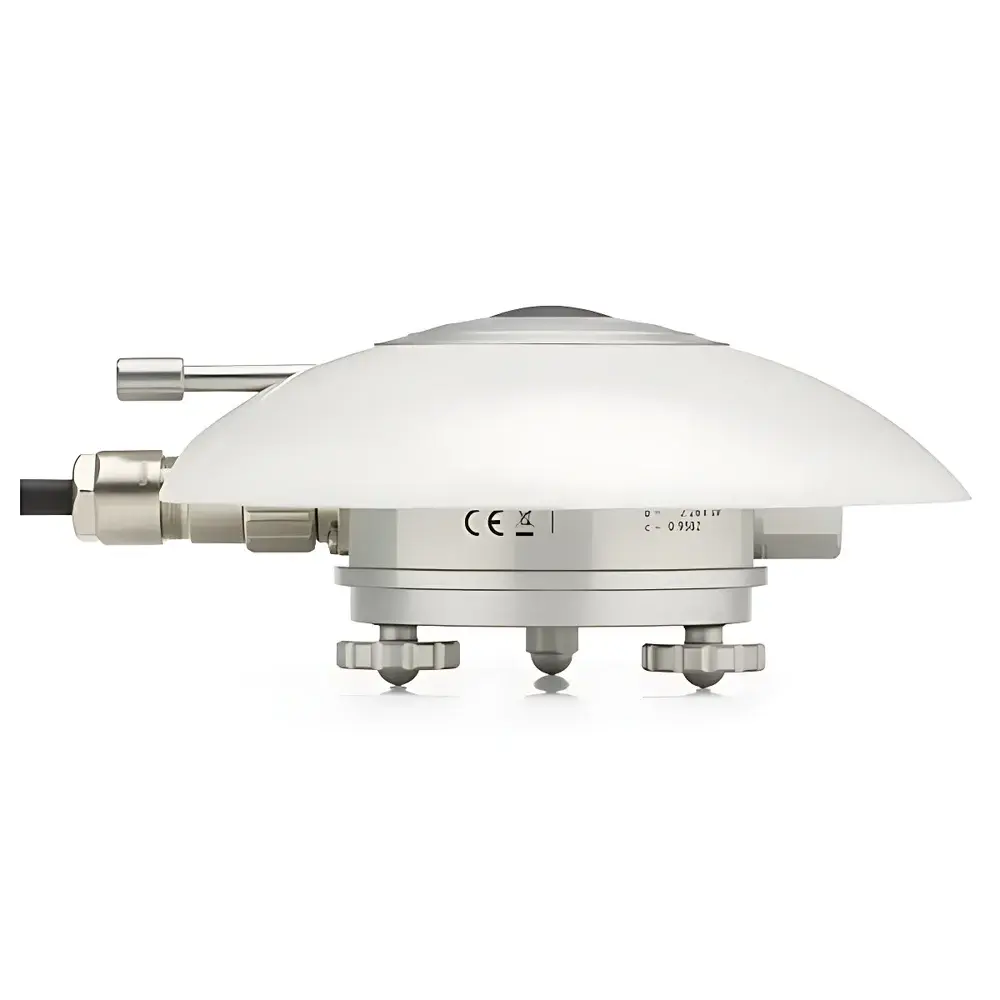
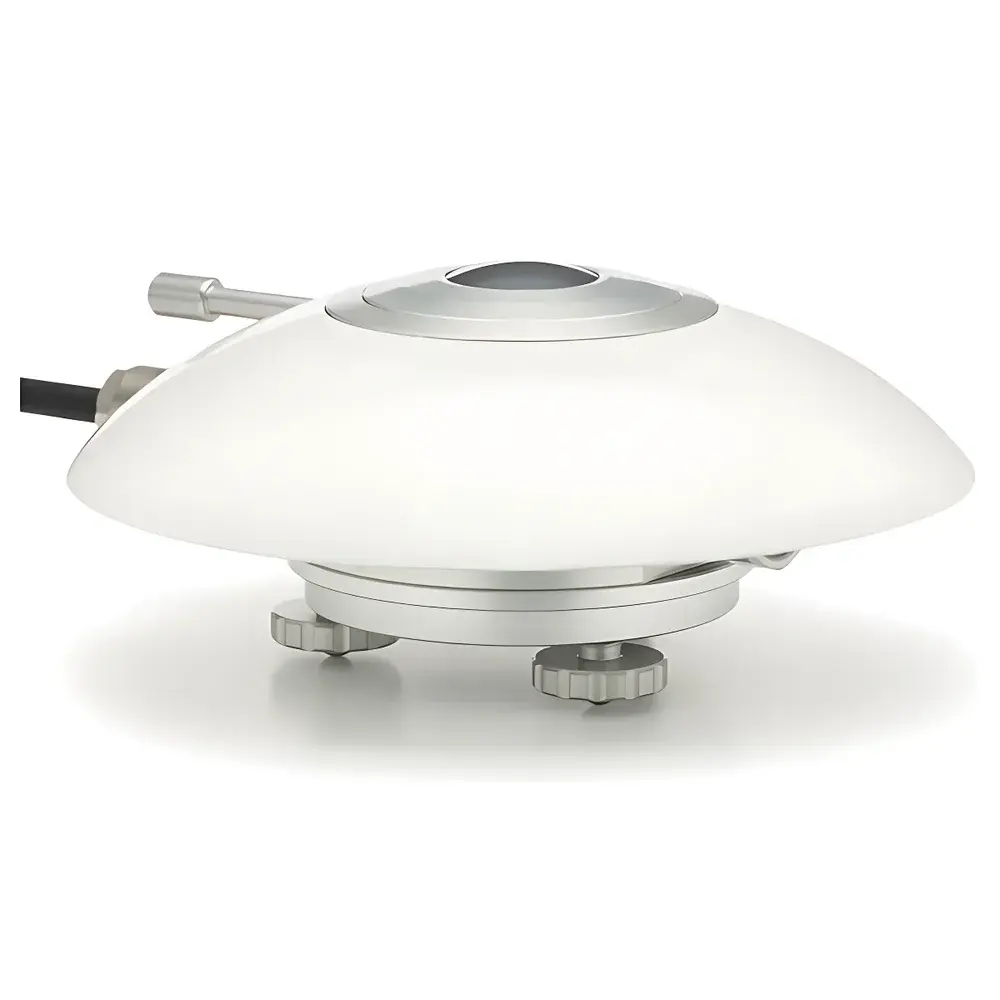
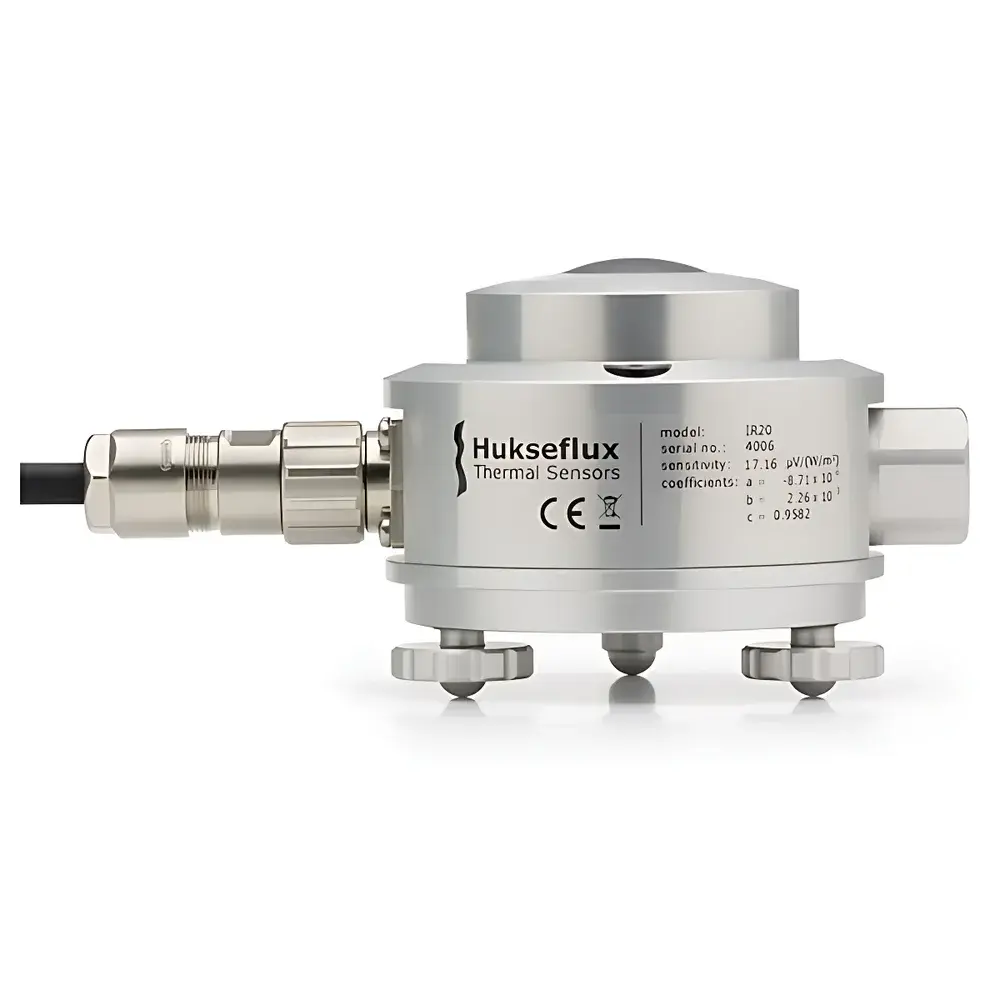
The Hukseflux IR20WS is a research-grade long-wave pyrgeometer engineered for high-accuracy measurement of downward and upward terrestrial infrared irradiance (W/m²) in meteorological, climatological, and environmental monitoring applications. It operates on the principle of thermopile-based detection of net long-wave radiation emitted by the Earth’s surface and atmosphere—typically defined as electromagnetic radiation in the 4–50 µm spectral band, where solar emission is negligible. Unlike shortwave instruments, the IR20WS is specifically optimized for conditions devoid of direct solar irradiance, making it ideal for nighttime and low-solar-angle measurements. Its extended spectral range (1.0–50 µm), with a 5% cutoff at 1.0 µm, ensures superior signal fidelity under diffuse sky conditions and enhances accuracy in low-radiance environments—particularly critical for polar, maritime, and high-altitude networks. The instrument features a precision silicon dome with an integrated long-pass filter, calibrated to meet World Meteorological Organization (WMO) definitions for long-wave irradiance and compatible with Baseline Surface Radiation Network (BSRN) protocols.
Key Features
- Extended spectral response: 1.0–50 µm range with certified 5% cutoff at 1.0 µm—optimized for solar-free operation and improved low-signal resolution.
- Thermopile sensor with ultra-low thermal resistance: Eliminates need for empirical correction between sensor surface and housing temperature—reducing systematic bias common in competitive designs.
- Onboard Peltier heater (1.5 W @ 12 VDC): Prevents dew, frost, or condensation on the dome surface—critical for continuous operation in humid, sub-zero, or marine environments.
- Fast thermal response (3 s): Enables stable measurements on dynamic platforms including aircraft, buoys, and unmanned aerial systems (UAS).
- High sensitivity (17 µV/(W/m²)): Delivers robust signal-to-noise ratio, minimizing contribution of data logger uncertainty to overall measurement error.
- Temperature-compensated output: Each unit is supplied with individual temperature coefficient parameters for integration into calibration equations—ensuring accuracy across −30 to +50 °C without interpolation artifacts.
- Ruggedized construction: IP67-rated enclosure and stainless-steel housing ensure long-term reliability in extreme climates—from Arctic tundra to tropical coastal zones.
Sample Compatibility & Compliance
The IR20WS is designed for unobstructed hemispherical (180° FOV) measurement of long-wave irradiance incident on a horizontal plane. It complies with WMO Guide to Meteorological Instruments and Methods of Observation (CIMO Guide, Chapter 7) for pyrgeometer classification and performance criteria. Calibration is traceable to the World Infrared Standard Group (WISG) maintained at Physikalisch-Technische Bundesanstalt (PTB), Germany. Optional ITS-90 blackbody calibration is available for laboratories requiring metrological equivalence to primary standards. The instrument meets requirements for use in BSRN, GCOS, and NOAA/ARM observational networks. Its design supports GLP-aligned deployment: full calibration certificates include measured 50% transmission points, endpoint wavelengths, and individual temperature coefficients—enabling audit-ready uncertainty budgets per ISO/IEC 17025.
Software & Data Management
The IR20WS outputs an analog voltage signal proportional to net long-wave irradiance. It integrates seamlessly with industry-standard data loggers (e.g., Campbell Scientific CR series, Delta-T DL2e, Onset HOBO) supporting differential input ranges down to ±25 mV. Hukseflux provides documented scaling equations—including polynomial temperature compensation terms—for direct implementation in firmware or post-processing pipelines. Raw output can be converted to physical units using manufacturer-supplied calibration factors and ambient thermistor readings (10 kΩ NTC). For networked deployments, the sensor supports time-synchronized logging aligned with co-located shortwave, albedo, and surface temperature sensors—facilitating radiative balance closure analysis. All calibration metadata (including spectral transmittance curves and thermal time constants) is archived in machine-readable format (CSV/JSON) for automated QA/QC workflows compliant with FAIR data principles.
Applications
- Long-term climate monitoring stations (e.g., GCOS reference sites, Antarctic observatories)
- Surface energy balance studies in eddy covariance towers and flux networks
- Validation of satellite-derived land surface temperature and outgoing longwave radiation products
- Uncertainty quantification in intercomparison campaigns (used alongside IR20 for differential spectral analysis)
- Reference-grade calibration transfer in national metrology institutes and accredited calibration labs
- Maritime and airborne atmospheric profiling on research vessels and UAV platforms
- Urban heat island and boundary layer studies requiring high-temporal-resolution nocturnal radiation data
FAQ
Can the IR20WS be used during daylight hours?
No—it is explicitly designed for solar-free conditions. Direct or diffuse solar radiation introduces spectral contamination beyond its intended band; use the standard IR20 model for all-day operation.
What is the difference between IR20 and IR20WS calibration traceability?
Both support WISG traceability; however, the IR20WS offers optional ITS-90 blackbody calibration for laboratories requiring direct linkage to the International Temperature Scale, particularly for metrological audits.
Is heating required for continuous operation?
Yes—the integrated heater must be powered during periods of high humidity or sub-zero ambient temperatures to prevent optical obstruction and maintain measurement integrity.
How is temperature dependence corrected in post-processing?
Each unit ships with a unique set of quadratic temperature coefficients; users apply these to raw voltage and thermistor data using the provided equation to derive spectrally corrected irradiance values.
Does the IR20WS comply with FDA or pharmaceutical environmental monitoring standards?
No—it is not designed for GxP-regulated indoor environments; its application scope is limited to outdoor atmospheric and geophysical radiation measurement per WMO and ISO 9060:2018 (Class A pyrgeometer specifications).







