
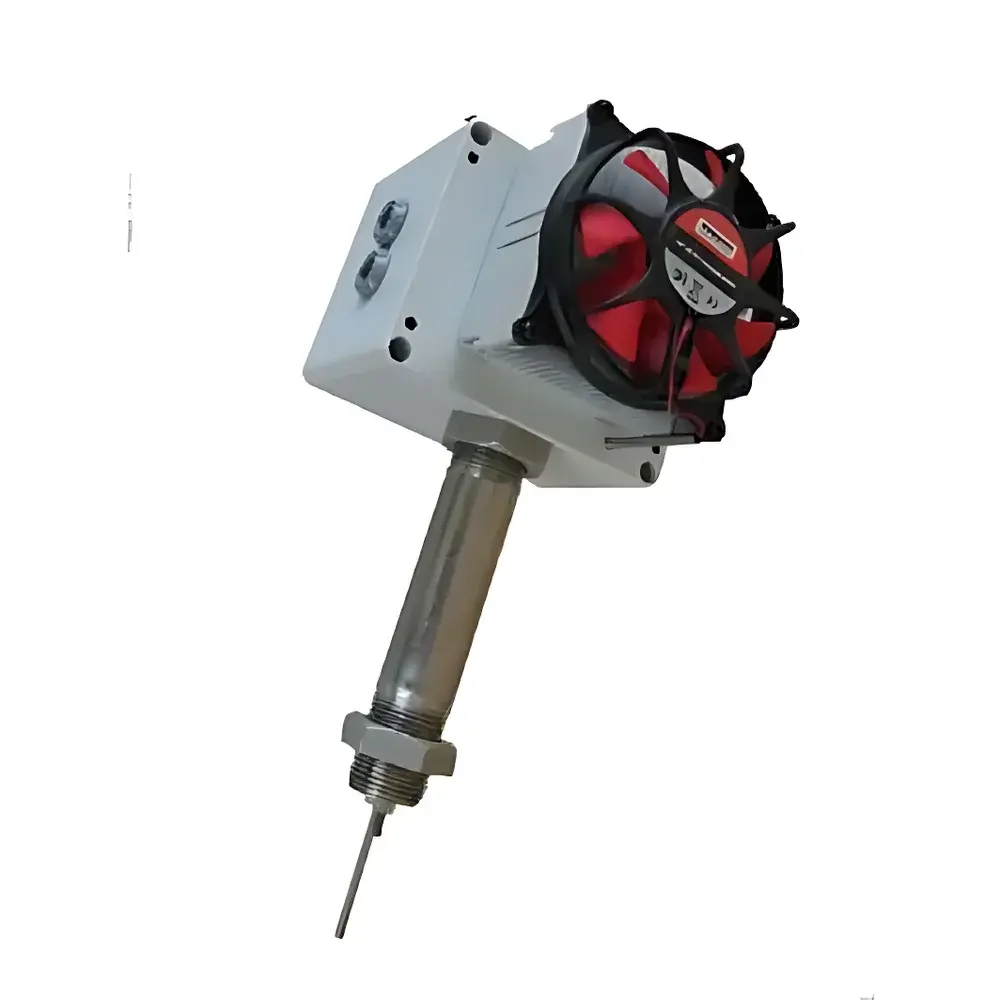
WAGNER AFT-350 High-Temperature Absolute Humidity & Temperature Sensor
| Origin | Germany |
|---|---|
| Manufacturer Type | Authorized Distributor |
| Origin Category | Imported |
| Model | AFT-350 |
| Product Type | In-Line Dew Point Sensor |
| Operating Principle | Chilled-Mirror-Based Electrothermal Dew Point Measurement |
| Operating Temperature Range (Electronics) | −20 °C to +60 °C |
| Accuracy | ±3.5% of reading at 20 vol% H₂O |
| Humidity Range | 20–100 vol% (at process temperatures >100 °C) |
| Response Time (20→100 vol%) | ≤10 s |
| Response Time (100→20 vol%) | ≤60 s |
| Warm-up Time | ~10 min |
| Temperature Range (Probe Tip) | 0–350 °C |
| Temp. Accuracy | ±0.5 °C ± 0.75% of measured value |
| Recommended Gas Velocity | ≤0.5 m/s |
| Output Signals | Dual 4–20 mA (humidity + temperature, load ≤600 Ω each) |
| Power Supply | 12 VDC @ 8.5 A |
| Probe Dimensions | Humidity Sensing Element: 10 mm L × 3 mm Ø |
| Temperature Sensing Element | 50 mm L × 4 mm Ø |
| Housing Material | Engineering Plastic |
| Humidity Sensor Material | Nickel-Plated Copper |
| Temperature Sensor Material | AISI 316 (1.4301 / V4A) |
| IP Rating | IP67 (sensing head), IP65 (housing) |
Overview
The WAGNER AFT-350 is a high-temperature in-line absolute humidity and process temperature sensor engineered for continuous, real-time monitoring in demanding industrial thermal processes. Unlike conventional capacitive or polymer-based hygrometers, the AFT-350 employs a thermally stabilized, mirror-cooled electrothermal dew point measurement principle—adapted for elevated process temperatures up to 350 °C. Its dual-sensing architecture integrates an absolute humidity probe and a separate Pt100-class temperature sensor within a single compact housing, enabling simultaneous, co-located measurements without cross-interference. The sensing head is hermetically sealed and constructed with corrosion-resistant materials (nickel-plated copper for humidity detection; AISI 316 stainless steel for temperature sensing), ensuring long-term stability in aggressive, particulate-laden, or condensate-prone environments such as kiln exhaust streams, ceramic tunnel furnaces, and cement preheater ducts. Designed for direct insertion into process ducts or chambers, the AFT-350 eliminates the need for sample extraction, bypass lines, or external conditioning systems—reducing maintenance burden and measurement lag.
Key Features
- High-temperature operation: Measures absolute humidity directly at process temperatures up to 350 °C (sensor tip), with electronics rated for −25 °C to +60 °C ambient
- Dual 4–20 mA analog outputs: Independent, linearized signals for both humidity (20–100 vol%) and temperature (0–350 °C)
- Two cooling configurations: Passive cooling (recommended for heavily contaminated or high-dust applications) and active cooling (for enhanced response consistency under variable thermal loads)
- Hermetically sealed sensing head: IP67-rated humidity measurement element ensures immunity to ingress of dust, moisture, and chemical vapors
- Rapid dynamic response: ≤10 s rise time (20 → 100 vol%), ≤60 s fall time (100 → 20 vol%), supporting closed-loop control of drying and thermal treatment cycles
- Minimal installation footprint: Compact probe geometry (10 mm × 3 mm humidity element; 50 mm × 4 mm temperature element) enables retrofitting into existing flanges or ports ≥ DN25
- Robust mechanical construction: Engineering plastic housing (IP65) with chemically inert wetted parts compliant with ISO 8502-3 and ASTM D1748 for industrial exposure conditions
Sample Compatibility & Compliance
The AFT-350 is validated for use in non-explosive, non-corrosive gas matrices typical of thermal processing industries—including air, nitrogen, flue gas (with low SOₓ/NOₓ), and inert carrier streams. It is not intended for use in hydrogen-rich, chlorine-containing, or highly acidic environments without prior validation. The sensor meets CE marking requirements per Directive 2014/30/EU (EMC) and 2014/35/EU (LVD). Its analog output architecture supports integration into legacy PLC-based control systems compliant with IEC 61131-3 and ISA-88 standards. While not intrinsically safe, it may be deployed in Zone 2 hazardous areas when installed with appropriate barrier systems meeting ATEX/IECEx requirements. Calibration traceability follows DIN EN ISO/IEC 17025 via WAGNER’s accredited service laboratory, with optional factory calibration certificates issued per ISO 17025 Annex A.
Software & Data Management
The AFT-350 operates as a standalone field device with no embedded firmware or digital interface; all signal conditioning, linearization, and temperature compensation are performed internally using factory-trimmed analog circuitry. This architecture ensures deterministic behavior, zero latency, and immunity to cyber vulnerabilities—critical for SIL-2-capable safety interlocks in drying ovens or kiln overheat protection systems. For data logging and trending, the dual 4–20 mA outputs integrate seamlessly with SCADA platforms (e.g., Siemens WinCC, Rockwell FactoryTalk), DCS historians (e.g., Honeywell Experion, Yokogawa CENTUM VP), or cloud-based IIoT gateways. When paired with a certified analog input module supporting HART or Foundation Fieldbus passthrough, basic diagnostics (e.g., sensor health flag, open-circuit detection) can be accessed via host system configuration tools. All calibration records and certificate metadata adhere to FDA 21 CFR Part 11 audit trail requirements when stored in validated electronic quality management systems (eQMS).
Applications
- Ceramic & refractory manufacturing: Real-time humidity monitoring in tunnel kilns and roller hearth furnaces to optimize binder burnout and prevent cracking
- Cement production: Moisture feedback control in raw mill exhaust and precalciner ducts to stabilize thermal efficiency and reduce NOₓ formation
- Food & feed processing: Inline verification of final moisture content in extruders, fluidized bed dryers, and rotary drum coolers for compliance with ISO 712 and AOAC 950.46
- Wood drying & biomass treatment: Dew point-based control of kiln humidity profiles to minimize case hardening and ensure uniform moisture distribution (ASTM D143, ISO 3130)
- Pharmaceutical lyophilization support: Monitoring of chamber purge gas dryness during primary drying phase to maintain residual moisture <1.0% w/w (USP & Ph. Eur. Chapter 2.2.48)
- Recycled aggregate drying: Closed-loop humidity regulation in thermal desorption units treating contaminated soil or demolition waste
FAQ
Can the AFT-350 measure dew point directly at 350 °C?
No—the AFT-350 measures absolute humidity (vol%) and process temperature simultaneously; dew point is derived mathematically from these two values using the Magnus formula and validated water vapor saturation tables (IAPWS-95). Direct chilled-mirror dew point measurement above 100 °C is physically unfeasible due to condensation thermodynamics.
Is recalibration required after installation?
Factory calibration is stable for ≥12 months under nominal operating conditions. Recalibration is recommended annually—or after exposure to thermal shock (>50 °C/min ramp rate), mechanical impact, or condensate immersion—and must be performed using traceable NIST-certified humidity generators per ISO 8655-5.
What is the minimum gas flow velocity for accurate measurement?
The sensor requires ≥0.1 m/s for representative sampling but is optimized for ≤0.5 m/s. Higher velocities may induce convective cooling of the sensing head, introducing systematic offset; flow straighteners or laminar flow elements are advised above 0.8 m/s.
Does the AFT-350 support digital communication protocols?
No—it provides only analog 4–20 mA outputs. For Modbus RTU, HART, or Ethernet/IP integration, a compatible signal conditioner or gateway (e.g., Phoenix Contact VALVE, Siemens SINAMICS GSDML converter) must be used externally.




