
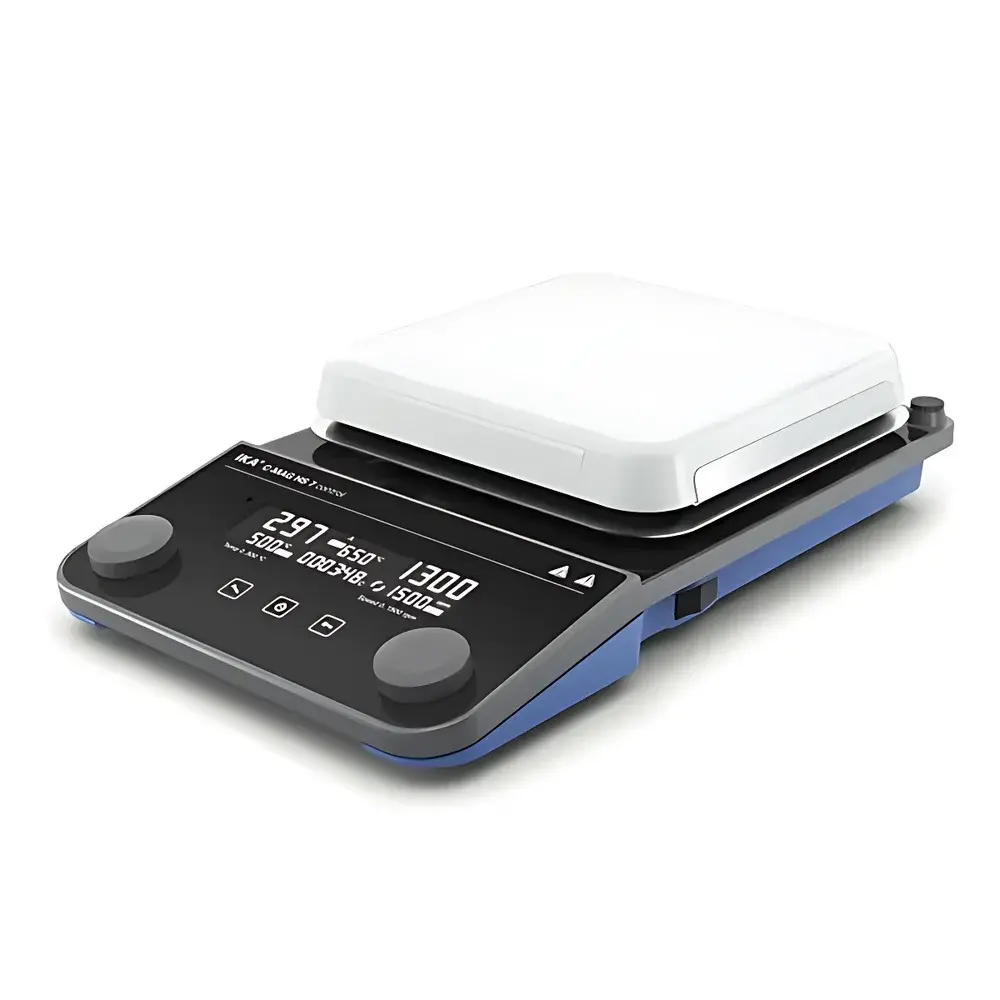

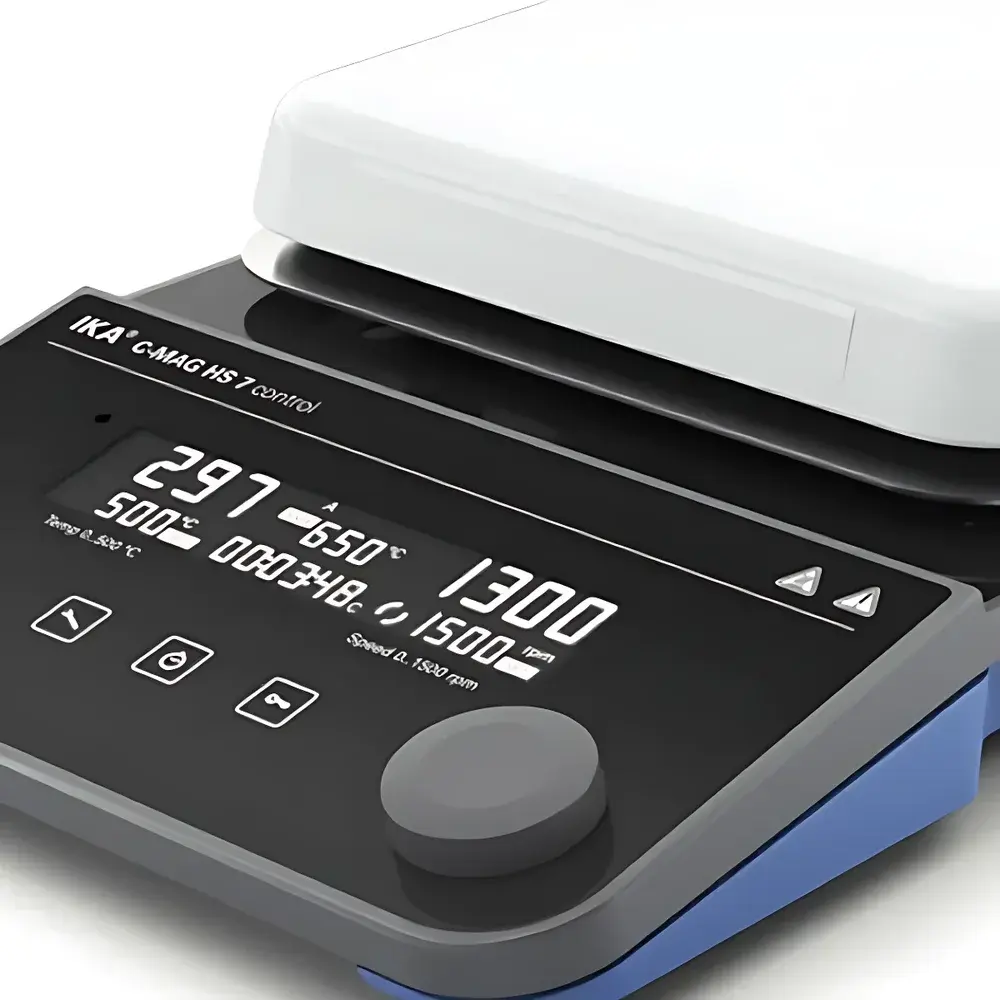
IKA C-MAG HS 7 control Heating Magnetic Stirrer
| Brand | IKA |
|---|---|
| Origin | Germany |
| Model | C-MAG HS 7 control |
| Instrument Type | Heating Magnetic Stirrer |
| Max. Stirring Volume (H₂O) | 20 L |
| Speed Range | 50 – 1500 rpm |
| Heating Temperature Range | Ambient to 500 °C |
| Heating Power | 1000 W |
| Motor Output | 9 W |
| Plate Material | Ceramic Glass |
| Plate Dimensions | 180 × 180 mm |
| Interface | RS232, USB |
| Safety Features | Adjustable Safety Temperature Circuit (100–650 °C), SmartTemp® Technology, Stir Bar Detection (Error 5), Automatic Reverse Rotation, Intermittent Mode |
| Compliance | DIN EN 60529 IP21, CE, RoHS |
Overview
The IKA C-MAG HS 7 control is a high-performance heating magnetic stirrer engineered for precision, safety, and long-term reliability in demanding laboratory environments. Designed around Couette flow principles, it employs a rotating magnetic field to drive PTFE- or glass-coated stirring bars within vessels—enabling homogeneous mixing of low- to medium-viscosity liquids without mechanical shaft penetration. Its integrated ceramic glass plate (180 × 180 mm) offers exceptional thermal stability, chemical resistance to acids, bases, and solvents, and mechanical robustness against thermal shock and accidental impact. With a maximum heating capacity of 500 °C and precise temperature regulation via SmartTemp®—a proprietary algorithm that dynamically adjusts power output based on real-time thermal load—the instrument maintains consistent thermal profiles across diverse vessel geometries and volumes up to 20 L (water). The device complies with DIN EN 60529 (IP21) for protection against vertically falling drips and solid objects >12.5 mm, meeting baseline requirements for general laboratory use under GLP-aligned operational conditions.
Key Features
- Ceramic glass heating plate with seamless, chemically inert surface—resistant to HCl, NaOH, acetone, and ethanol; eliminates crevices where contaminants accumulate
- SmartTemp® active temperature management: continuously monitors plate and medium temperatures (via optional external PT1000, ETS-D5, or ETS-D6 sensors) to minimize overshoot and stabilize setpoints within ±0.2 K (with ETS-D6 under standardized 500 mL water test)
- Dual-display LCD interface showing simultaneous setpoint and actual values for both speed (50–1500 rpm, ±2% deviation at full load) and temperature (resolution: 1 K for medium, 5 K for plate)
- Programmable safety temperature circuit (adjustable 100–650 °C) with automatic shutdown and visual alarm—critical for unattended operation and regulatory traceability
- Automatic reverse rotation and intermittent mode support controlled crystallization, particle suspension, and viscosity-sensitive reactions
- Stir bar detection (Error 5) prevents motor overload and ensures reproducible torque delivery by verifying magnetic coupling integrity before ramp-up
- Lifetime warranty backed by IKA’s ISO 9001-certified manufacturing and service infrastructure in Staufen, Germany
Sample Compatibility & Compliance
The C-MAG HS 7 control accommodates standard laboratory glassware (e.g., beakers, flasks, reaction vials) with nominal diameters from 40 mm to 150 mm. Compatible stir bars range from 30 mm to 80 mm in length and are optimized for viscosities up to 10,000 mPa·s (tested with glycerol/water mixtures). It supports external temperature feedback per ASTM E2465-22 (Standard Practice for Calibration of Temperature Measurement Devices Used in Thermal Analysis), enabling validation of thermal uniformity across the plate surface. The unit meets CE marking requirements under the EU Machinery Directive 2006/42/EC and Low Voltage Directive 2014/35/EU. Its RS232 and USB interfaces allow integration into lab-wide data logging systems compliant with FDA 21 CFR Part 11 when paired with validated software platforms—supporting audit trails, electronic signatures, and secure parameter archiving.
Software & Data Management
While the C-MAG HS 7 control operates as a standalone instrument, its embedded firmware supports over-the-air updates via USB connection, ensuring continued compatibility with evolving regulatory expectations. Real-time speed and temperature values are transmitted serially (RS232) at configurable baud rates (9600–115200), permitting direct acquisition into LabVIEW, MATLAB, or custom Python-based SCADA frameworks. Timestamped event logs—including safety cutoffs, sensor disconnects, and mode transitions—are retained in non-volatile memory for post-run forensic analysis. No proprietary software is required; ASCII-formatted data streams enable seamless ingestion into LIMS or ELN systems without middleware licensing constraints.
Applications
This instrument is routinely deployed in synthetic chemistry (Grignard reactions, esterifications), pharmaceutical formulation (buffer preparation, excipient dispersion), materials science (nanoparticle suspension, polymer solution homogenization), and quality control laboratories performing USP compounding verification. Its high-temperature capability supports solvent reflux setups, while intermittent mode enables gentle agitation during enzyme-catalyzed assays where shear stress must be minimized. The adjustable safety circuit and SmartTemp® make it suitable for applications requiring strict thermal accountability—such as stability studies governed by ICH Q1A(R3) guidelines.
FAQ
Does the C-MAG HS 7 control support external temperature probes?
Yes—it accepts PT1000, ETS-D5, and ETS-D6 sensors via dedicated analog input, enabling medium-temperature feedback with accuracy up to ±0.2 K.
What is the minimum and maximum vessel size compatible with this stirrer?
Optimal performance is achieved with vessels 40–150 mm in diameter; smaller vessels may require shorter stir bars (≥30 mm), while larger volumes (>10 L) benefit from dual-point stirring configurations.
Is the firmware upgrade process validated for GxP environments?
Firmware updates are version-controlled and documented in IKA’s Technical Information Bulletin TIB-007-2023; users are advised to perform change control assessments per internal SOPs prior to deployment in regulated workflows.
Can the instrument operate unattended overnight?
Yes—provided the safety temperature limit is configured, a compatible stir bar is verified, and environmental conditions remain within 5–40 °C and ≤80% RH.
What maintenance is required to sustain calibration integrity?
Annual verification using NIST-traceable temperature and tachometer standards is recommended; no user-serviceable parts require replacement under normal operation due to brushless motor design and sealed electronics architecture.



