
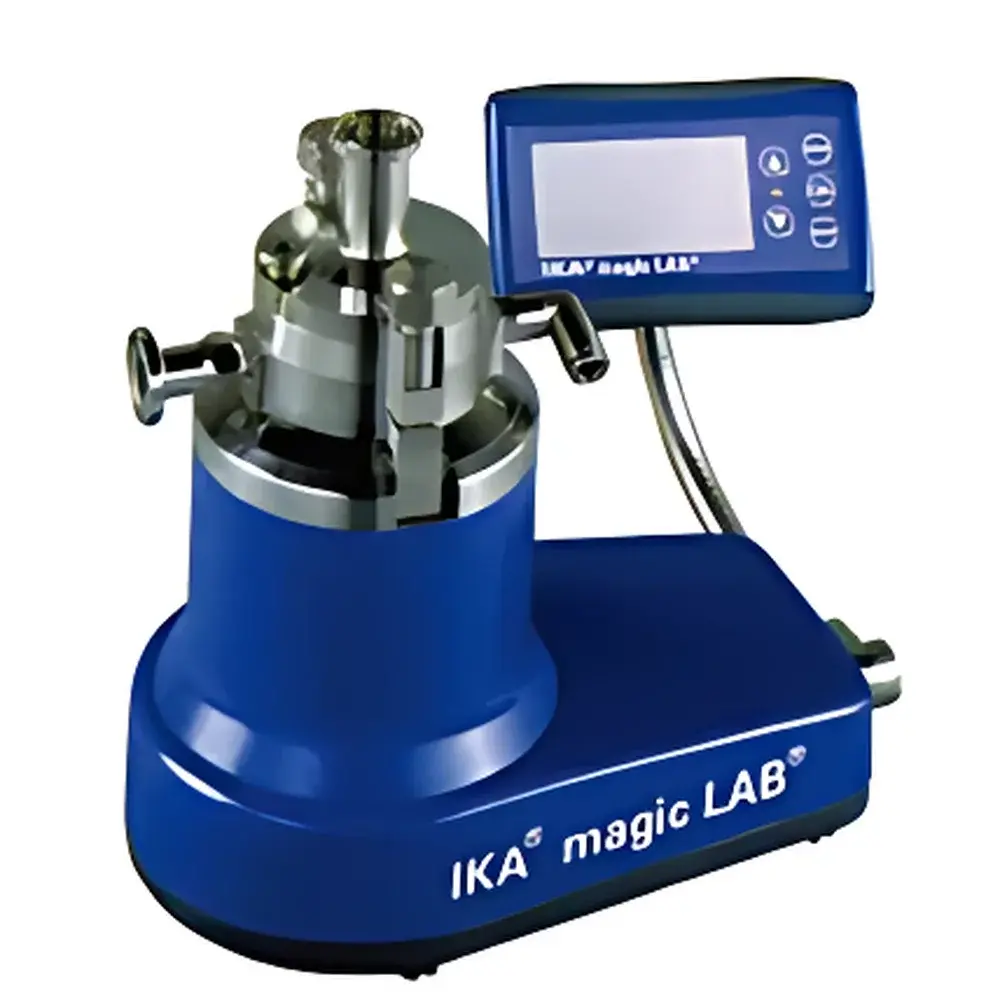
IKA magicLAB High-Shear Homogenizer System
| Brand | IKA |
|---|---|
| Origin | Germany |
| Model | magicLAB |
| Application | Laboratory-to-Pilot-to-Production Scale-Up Homogenization, Wet Milling, and Dispersion |
| Operation Modes | Batch, Circulation, and Continuous |
| Rotor-Stator Tip Speed | Up to 40 m/s |
| Temperature Control | Integrated Heating & Cooling in All Modules |
| Controller | magicLAB® Touchscreen Interface (Standard) |
| Compliance | Designed for GLP/GMP-Ready Environments |
| Module Expansion | Standardized Modular Architecture |
Overview
The IKA magicLAB is a modular, high-shear homogenization system engineered for seamless scale-up from early-stage laboratory formulation to pilot-scale process validation and industrial production. Based on the proven rotor-stator principle—where intense hydrodynamic shear, cavitation, and turbulent mixing occur at the narrow gap between a rotating stator and a stationary rotor—the magicLAB delivers reproducible particle size reduction, emulsification, dispersion, and cell disruption across diverse material classes. Its architecture bridges the methodological gap between R&D and manufacturing: identical operating parameters—including tip speed, residence time, temperature profile, and flow dynamics—can be maintained across scales, eliminating requalification efforts when transitioning protocols from benchtop to production lines. This traceable scalability is critical for pharmaceutical suspension development, nanomaterial synthesis, battery slurry formulation, and food-grade emulsion optimization where regulatory consistency and process robustness are non-negotiable.
Key Features
- Modular Scalability: Interchangeable processing modules—from 50 mL lab-scale chambers to 20 L pilot vessels—share identical geometry, shear zone design, and thermal management interfaces, ensuring direct parameter translation without empirical recalibration.
- Precision Tip Speed Control: Digital speed regulation maintains rotor-stator tip speeds from 1 to 40 m/s with ±0.5% repeatability, enabling systematic study of shear-dependent phenomena such as droplet breakup kinetics or nanoparticle deagglomeration thresholds.
- Integrated Thermal Management: Each module incorporates dual-channel Peltier-based heating/cooling with ±0.3 °C stability, supporting temperature-sensitive applications including protein emulsification, thermosensitive polymer dispersion, and cryogenic milling.
- Intuitive Operation Interface: The standard magicLAB® touchscreen controller provides real-time monitoring of speed, torque, temperature, flow rate (when paired with optional peristaltic or gear pumps), and cumulative energy input (kWh/kg), all logged with timestamped metadata.
- GLP/GMP-Ready Architecture: Audit-trail-enabled firmware supports user-level access control, electronic signatures, and configurable data export (CSV, PDF, XML) compliant with FDA 21 CFR Part 11 requirements for regulated environments.
Sample Compatibility & Compliance
The magicLAB accommodates viscous suspensions (up to 10,000 mPa·s), heat-labile biologics, abrasive slurries (e.g., ceramic precursors), and volatile organic solvents. Its wetted parts—constructed from chemically resistant stainless steel 1.4404 (316L), PTFE-coated rotors, and borosilicate glass chambers—are compatible with cleaning-in-place (CIP) protocols and withstand repeated sterilization cycles (SIP up to 121 °C). The system meets CE marking requirements under the Machinery Directive 2006/42/EC and Electromagnetic Compatibility Directive 2014/30/EU. For pharmaceutical use, it supports IQ/OQ documentation packages aligned with ISO 9001 and ASTM E2500-13 guidelines for equipment qualification.
Software & Data Management
Data acquisition and analysis are managed via the embedded magicLAB® software suite, which records all operational parameters at 10 Hz resolution. Raw datasets include torque transients, thermal drift profiles, and real-time power consumption—enabling post-hoc calculation of specific mechanical energy (SME) and shear rate distribution models. Exported files are structured for integration into LIMS platforms or statistical process control (SPC) tools such as JMP or Minitab. Optional cloud synchronization enables remote monitoring and multi-site protocol harmonization, while local database encryption ensures confidentiality during collaborative development projects.
Applications
- Development and optimization of nanoemulsions for topical drug delivery
- Dispersion of carbon black, graphene, or metal oxide nanoparticles in polymer matrices
- Homogenization of vaccine adjuvant suspensions under controlled thermal conditions
- Continuous wet milling of active pharmaceutical ingredients (APIs) to achieve D90 < 1 µm
- Stabilization of pigment dispersions for high-performance coatings and inks
- Cell lysis and organelle isolation in bioprocessing workflows
FAQ
Can the magicLAB be validated for GMP manufacturing environments?
Yes—when configured with audit-trail firmware, electronic signature capability, and calibrated sensors traceable to NIST standards, the system supports full 21 CFR Part 11 compliance and can be qualified per ASTM E2500-13 for installation, operation, and performance.
What is the maximum allowable viscosity for continuous circulation mode?
The system supports continuous operation with viscosities up to 5,000 mPa·s using the optional high-torque circulation pump; batch-mode operation extends to 10,000 mPa·s with appropriate rotor-stator geometry selection.
Are third-party analytical instruments (e.g., inline particle sizers) compatible?
Yes—the magicLAB features analog and digital I/O ports (0–10 V, 4–20 mA, RS485) for synchronized triggering and data fusion with PAT tools such as FBRM, PVM, or laser diffraction analyzers.



