
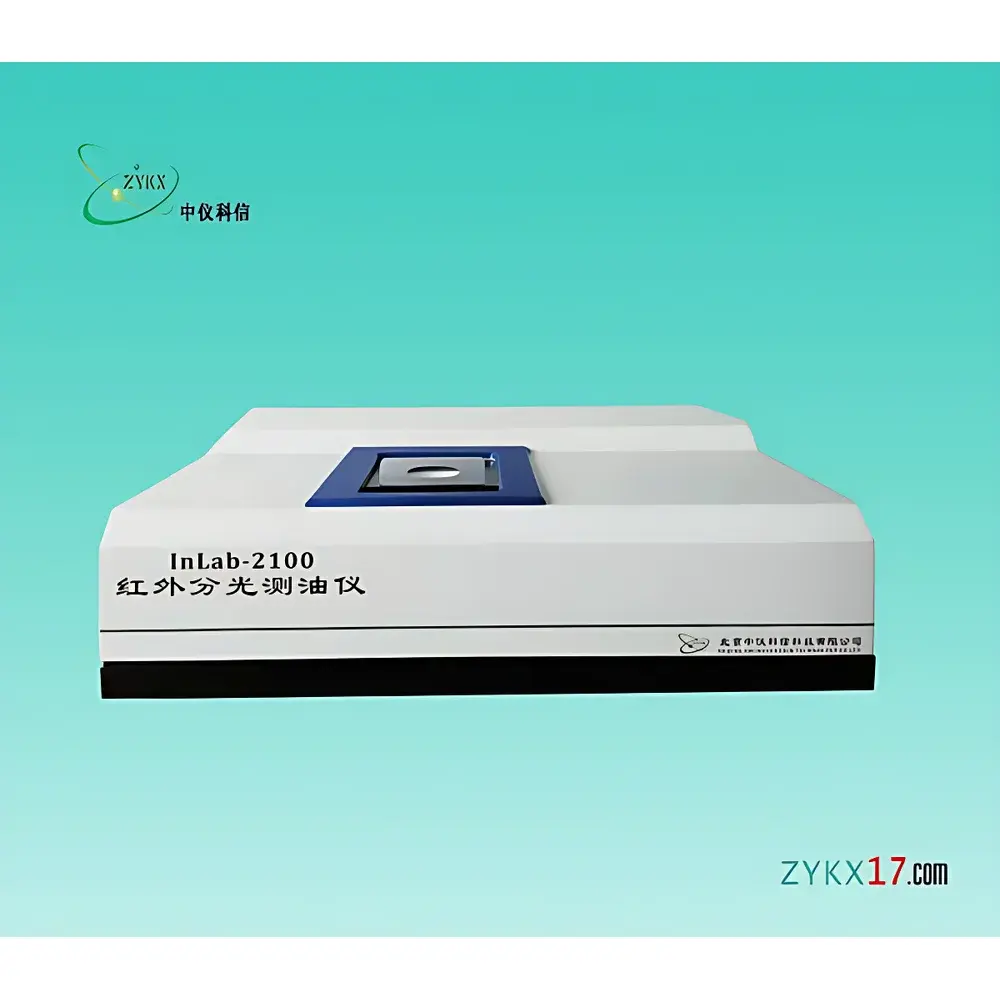
InLab-2100 Infrared Spectrophotometric Oil Content Analyzer
| Brand | ZYKX |
|---|---|
| Origin | Beijing, China |
| Model | InLab-2100 |
| Instrument Type | Laboratory Benchtop Analyzer |
| Measurement Principle | Infrared Spectrophotometry (C–H Bond Absorption at 2930 cm⁻¹, 2960 cm⁻¹, and 2850 cm⁻¹) |
| Measurement Range | 0.00–100 mg/L (water sample, 4 cm cell, direct analysis) |
| Detection Limit | <0.12 mg/L (water sample) |
| Accuracy | ±0.5 mg/L (for C < 10 mg/L) |
| Resolution | 0.1 ppm (0.001 mg/L) |
| Measurement Frequency | 10 samples per minute |
| Wavenumber Range | 3400–2400 cm⁻¹ |
| Spectral Resolution | 1 cm⁻¹ |
| Absorbance Range | 0.0000–2.000 AU |
| Baseline Drift | <0.001 AU/60 min |
| Cell Compatibility | 0.5–5 cm pathlength cuvettes (standard: 4 cm) |
| Interface | RS-232 or USB |
| Power Supply | 220 V ±22 V, 50 Hz ±1 Hz, 40 VA |
| Dimensions | 550 × 380 × 160 mm |
| Weight | ~14 kg |
Overview
The InLab-2100 Infrared Spectrophotometric Oil Content Analyzer is a laboratory-grade benchtop instrument engineered for precise quantification of total petroleum hydrocarbons (TPH), animal and vegetable oils, and total oil content in aqueous and semi-solid matrices. It operates on the principle of mid-infrared absorption spectroscopy—specifically targeting the asymmetric and symmetric C–H stretching vibrations of aliphatic hydrocarbons at characteristic wavenumbers (2960 cm⁻¹, 2930 cm⁻¹, and 2850 cm⁻¹)—in accordance with the foundational physics of Beer–Lambert law. The instrument complies fully with China’s national environmental monitoring standards HJ 637–2012 and HJ 637–2018 (“Determination of Petroleum and Animal/Vegetable Oils in Water by Infrared Spectrophotometry”), which are harmonized with ISO 9377-2:2000 (Water quality — Determination of hydrocarbon oil index — Part 2: Infrared spectrometric method). Its dual-mode capability supports both full-spectrum scanning (≈90 s) and rapid non-dispersive single-wavelength measurement (≤2 s), enabling method flexibility without cross-interference.
Key Features
- Modular optical architecture: Detachable integrated optics with post-dispersion absorption design ensures long-term wavelength stability and high signal-to-noise ratio (SNR).
- Electrically modulated IR source: Eliminates mechanical chopper components, reduces thermal load, enhances system thermal stability, and extends source lifetime.
- Phase-sensitive lock-in amplifier circuitry: Optimizes low-level signal recovery, directly contributing to sub-0.12 mg/L detection limit performance.
- Real-time solvent purity verification: Built-in diagnostic function evaluates spectral integrity of extraction solvents (e.g., tetrachloroethylene or legacy carbon tetrachloride) prior to analysis.
- Full-spectrum scanning mode: Generates absorbance vs. wavenumber plots (3400–2400 cm⁻¹, 1 cm⁻¹ resolution), enabling identification and assessment of spectral interferences (e.g., surfactants, humic substances).
- Dual operational modes: Functions as both a dedicated oil analyzer and a general-purpose mid-IR spectrophotometer for qualitative and quantitative organic analysis.
- Universal cell holder: Accommodates standard quartz or IR-transparent cells with pathlengths from 0.5 cm to 5 cm; shipped with 4 cm matched pair.
- High-integration design: Optomechanical and electronic subsystems are co-packaged in a rigid chassis, minimizing alignment drift and simplifying field maintenance.
- Automated baseline correction: Real-time zero-point adjustment compensates for thermal and electronic drift, ensuring <0.001 AU/60 min baseline stability.
- Intuitive software-driven workflow: One-click measurement initiation, auto-calibration, linear regression fitting (R > 0.999), and immediate result export.
Sample Compatibility & Compliance
The InLab-2100 is validated for use across diverse environmental and industrial sample types—including surface water, groundwater, seawater, wastewater, leachate, soil extracts (via solvent extraction per HJ 637), and cooking fume condensates (per HJ/T 62–2001). It supports quantification of total extractable hydrocarbons, as well as speciated estimation of aliphatic vs. aromatic contributions when coupled with multi-band calibration models. All measurements adhere to GLP-aligned data integrity practices: audit-trail-enabled software logs user actions, method parameters, calibration history, and raw spectral files. While not FDA 21 CFR Part 11-certified out-of-the-box, its data export architecture (CSV, ASCII, .spc) facilitates integration into LIMS environments compliant with ISO/IEC 17025 and EPA Method 1664B workflows.
Software & Data Management
The proprietary InLab Analysis Suite provides native support for method development, calibration curve generation (single- or multi-point), spectral overlay, interference diagnostics, and report generation. Raw interferograms and processed absorbance spectra are stored in vendor-neutral formats compatible with third-party chemometric tools (e.g., MATLAB, Unscrambler). All measurement metadata—including date/time stamp, operator ID, cell pathlength, solvent batch ID, and peak area integrals—is embedded in each dataset. Export options include PDF reports with embedded spectra, Excel-compatible tables, and spectral archives for retrospective reprocessing. USB and RS-232 interfaces enable bidirectional communication with external PCs running Windows 10/11; no proprietary drivers required.
Applications
- Regulatory compliance testing for wastewater discharge permits (e.g., municipal treatment plants, petrochemical facilities, metal finishing operations).
- Environmental site assessment: screening and quantification of hydrocarbon contamination in groundwater monitoring wells and soil core extracts.
- Food processing effluent characterization: monitoring grease trap overflow and pretreatment efficiency.
- Research applications: kinetic studies of oil biodegradation, solvent recovery efficiency, and emulsion stability assessment.
- Quality control of organic solvents: verification of hydrocarbon impurity profiles in analytical-grade tetrachloroethylene or cyclohexane.
- Method validation support: serving as reference instrumentation during cross-platform comparison studies involving GC-FID or fluorescence-based oil analyzers.
FAQ
Does the InLab-2100 comply with international standards beyond Chinese HJ methods?
Yes—it implements the same fundamental IR absorption principles defined in ISO 9377-2:2000 and ASTM D7066-04 (Standard Test Method for Determination of Oil and Grease in Water by Infrared Spectrophotometry), making it suitable for laboratories seeking globally aligned methodology.
Can tetrachloroethylene fully replace carbon tetrachloride without recalibration?
Yes—the instrument’s spectral library and calibration algorithms accommodate both solvents; users must select the appropriate solvent-specific calibration curve and confirm baseline flatness in the 3000–2800 cm⁻¹ region prior to analysis.
Is the 0.1 ppm resolution achievable across the full 0–100 mg/L range?
Resolution refers to digital display granularity (0.001 mg/L); actual quantitative precision depends on sample matrix, extraction efficiency, and adherence to HJ 637 procedural controls—repeatability is ≤1% for mid-range standards (20–40 mg/L).
What maintenance is required for long-term optical stability?
Annual verification of wavelength accuracy (using polystyrene film standard) and absorbance linearity (neutral density filters) is recommended; no routine lamp replacement is needed due to solid-state modulation design.
Can the instrument be operated without a connected PC?
No—PC connectivity is mandatory for instrument control, data acquisition, and report generation; embedded display is limited to status indicators only.
Related Products







