
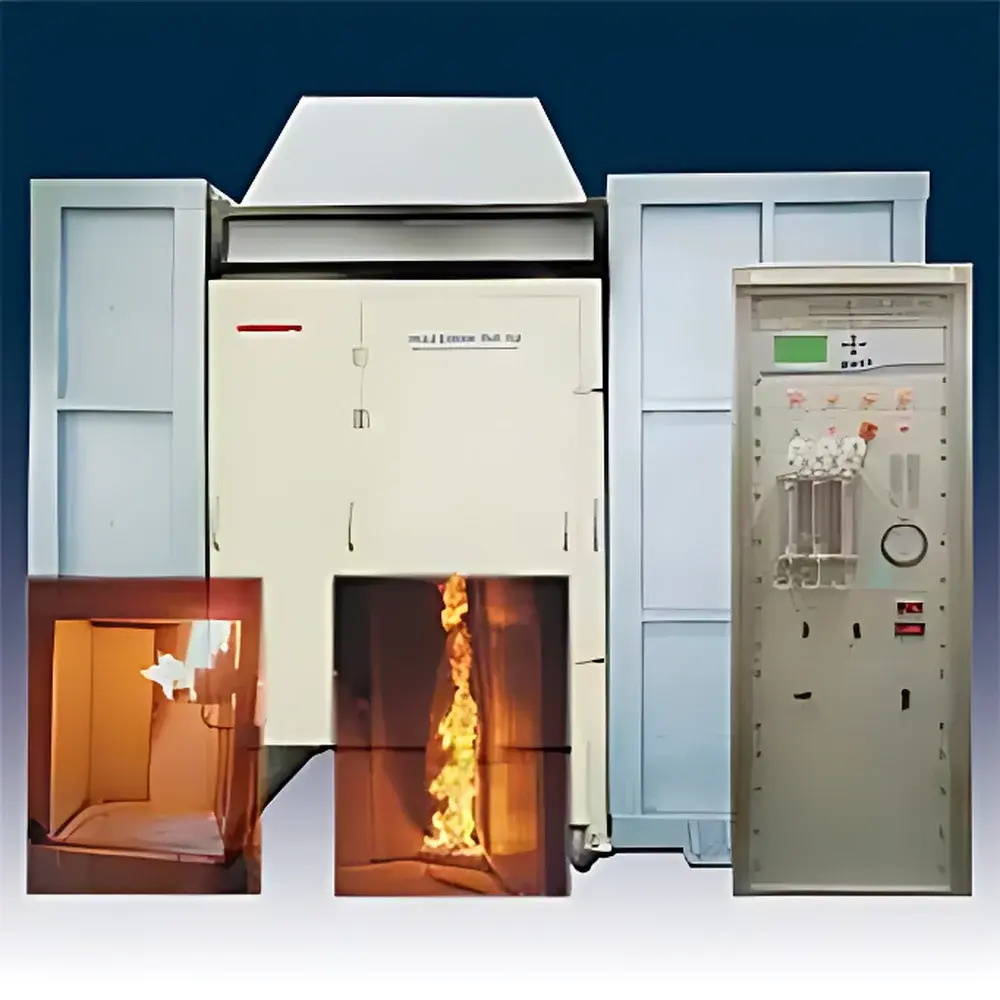
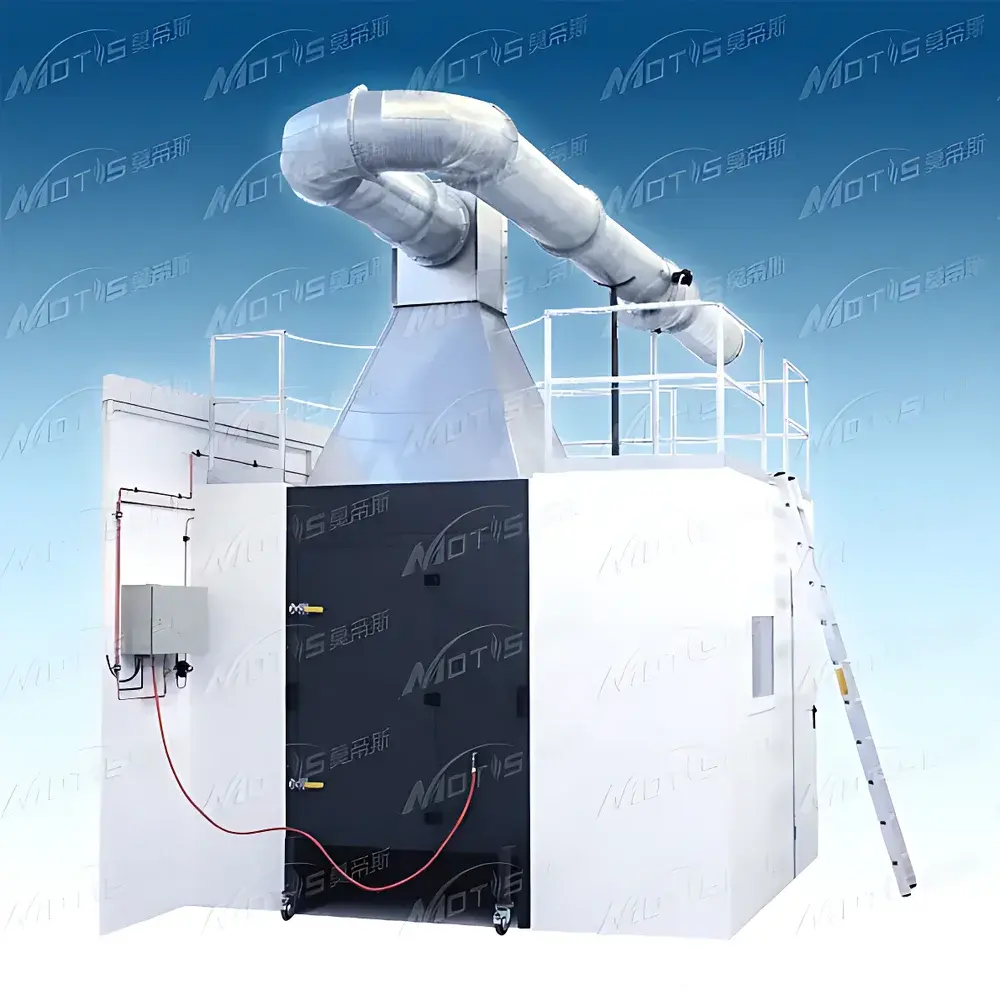
MOTIS SBI Single Burning Item Fire Test System
| Brand | MOTIS |
|---|---|
| Origin | Jiangsu, China |
| Manufacturer Type | Authorized Distributor |
| Country of Origin | China |
| Model | SBI |
| Pricing | Available Upon Request |
| Standards Compliance | EN 13823, GB/T 20284 |
| Core Measurement Principles | Oxygen depletion calorimetry, optical smoke density analysis, flame spread observation, droplet collection |
| Key Outputs | FIGRA, THR, SMOGRA, TSP, LFS, flaming droplets/particles |
Overview
The MOTIS SBI Single Burning Item Fire Test System is a fully integrated, standards-compliant apparatus engineered for the quantitative assessment of fire reaction behavior of building products and construction materials under controlled, intermediate-scale fire exposure. Based on the principle of oxygen depletion calorimetry—where heat release rate (HRR) is calculated from the measured oxygen concentration drop in exhaust gases—the system delivers traceable, reproducible fire performance data essential for regulatory classification and material development. Unlike small-scale bench tests, the SBI method simulates realistic fire growth conditions by subjecting vertically mounted specimens (up to 1.5 m × 1.0 m) to a defined 31 kW propane corner burner located at the base of two perpendicular non-combustible mineral boards. The test chamber (3 m × 3 m × 2.4 m) features a ceiling-mounted exhaust hood connected to a dedicated sampling duct, enabling real-time quantification of thermal, chemical, and optical fire parameters—including heat release, smoke production, flame spread, and flaming droplet formation.
Key Features
- Full EN 13823 / GB/T 20284 compliance with hardware and software architecture validated for regulatory submission
- Dual-channel gas analysis subsystem: Siemens OXYMAT 61 paramagnetic oxygen analyzer (0–25% O₂, ±1% FS weekly drift, <3 s response) and U23 NDIR analyzers for CO (0–1%) and CO₂ (0–10%) with identical metrological specifications
- Integrated data acquisition platform supporting synchronized logging of thermocouple signals (K-type), differential pressure (for mass flow calculation), optical attenuation (smoke density), and gas concentration outputs
- Corrosion-resistant sampling train: PTFE-lined probe assemblies, chilled dehumidification cold trap, gas conditioning modules (flow/pressure stabilization), and chemically inert peristaltic sampling pumps
- Calibrated 31 kW propane burner assembly with precision mass flow controllers, flashback arrestors, and dual-stage pressure regulation
- Standardized steel trolley with fixed specimen mounting geometry, auxiliary burner for pre-heating, and integrated thermal insulation to minimize conductive losses
- Real-time calculation engine embedded in proprietary software for automatic derivation of FIGRA (Fire Growth Rate Index), THR (Total Heat Released), SMOGRA (Smoke Growth Rate Index), TSP (Total Smoke Produced), and LFS (Lateral Flame Spread)
Sample Compatibility & Compliance
The SBI system accommodates rigid and semi-rigid flat products used in wall cladding, ceiling systems, insulation panels, and façade components. Specimens are mounted vertically on the standardized trolley between two non-combustible mineral boards, replicating typical installation configurations. All measurement methodologies and calibration protocols adhere strictly to EN 13823 Annexes A–F and GB/T 20284 technical requirements. The system supports GLP-aligned operation through audit-trail-enabled software, user-access-level controls, and electronic signature-capable reporting—facilitating readiness for ISO/IEC 17025-accredited laboratory audits and EU Construction Products Regulation (CPR) CE marking documentation.
Software & Data Management
The embedded SBI Control & Analysis Suite provides instrument control, real-time visualization, automated parameter computation, and report generation in PDF and CSV formats. Calibration routines include zero/span verification for all gas analyzers, thermocouple linearity checks, and optical path validation using certified neutral density filters. Raw data files are timestamped, digitally signed, and stored with full metadata (operator ID, ambient conditions, calibration history). The software architecture complies with FDA 21 CFR Part 11 requirements for electronic records and signatures when configured with appropriate IT infrastructure and procedural controls.
Applications
- Classification of construction products according to Euroclass B–D (EN 13501-1) and Chinese fire performance grades (GB 8624)
- Development and optimization of fire-retardant coatings, intumescent systems, and mineral wool composites
- Comparative evaluation of façade system fire safety under realistic ignition scenarios
- Supporting fire safety engineering analyses (e.g., zone modeling input validation)
- Third-party certification testing for CE marking, CCC, and other national/regional conformity schemes
FAQ
What fire parameters does the SBI system directly measure?
Oxygen concentration, CO/CO₂ concentrations, exhaust gas temperature, optical smoke density (via light extinction), and volumetric exhaust flow rate—all measured continuously in the sampling duct.
Is the system suitable for testing composite or multi-layer materials?
Yes; the standard specimen configuration supports layered assemblies up to 100 mm total thickness, provided they maintain structural integrity during the 20-minute test duration.
Can the system be integrated into an existing fire test laboratory infrastructure?
The SBI unit is delivered as a modular system with standardized electrical (220 VAC ±10%, 50–60 Hz), pneumatic (propane supply), and exhaust interface specifications, enabling integration with client-built test rooms and abatement systems.
Does the software support multi-language interfaces and customizable reporting templates?
The base software operates in English; localized UI and report templates (including bilingual EN/CN options) are available upon request and subject to configuration validation.
What maintenance intervals are recommended for gas analyzers and flow sensors?
Oxygen and IR analyzers require bi-weekly zero/span verification and annual factory recalibration; differential pressure transducers and thermocouples should be verified before each test series per EN 13823 Section 7.3.



