
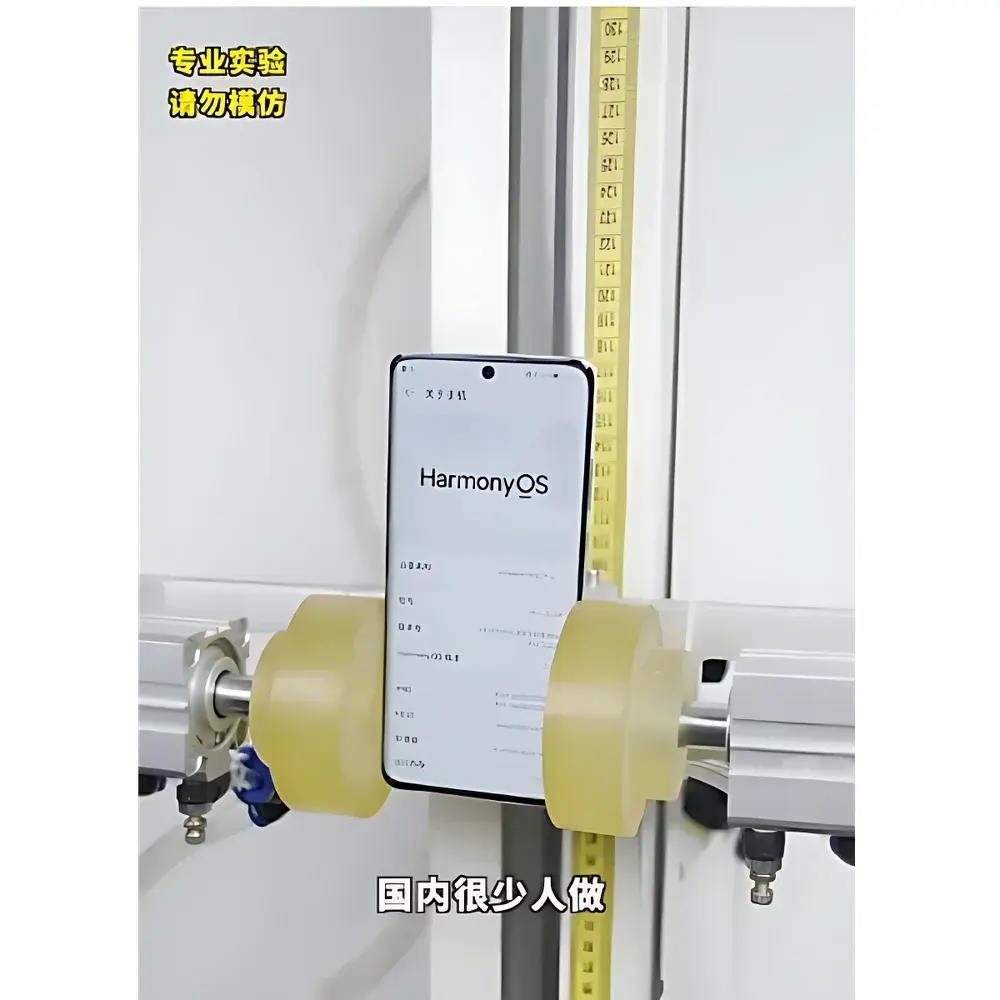
JianHu JH-Series Drop Testing Machine
| Brand | JianHu |
|---|---|
| Origin | Shanghai, China |
| Manufacturer Type | Authorized Distributor |
| Product Category | Domestic |
| Model | JH-Series Drop Testing Machine |
| Price Range | USD 140 – 4,200 (FOB Shanghai) |
| Adjustable Drop Height | Customizable from 300 mm to 2,000 mm |
| Maximum Test Specimen Weight | Up to 50 kg (standard configuration) |
| Drop Surface | Standard marble base (20 mm thick, ASTM E1718-compliant) |
| Control System | Microprocessor-based digital height positioning with ±1 mm repeatability |
| Safety Compliance | EN ISO 12100, IEC 61000-6-2/6-4, CE-marked mechanical safety enclosure |
Overview
The JianHu JH-Series Drop Testing Machine is an electromechanically actuated, height-programmable impact tester engineered for standardized free-fall simulation of packaged products and electronic devices under controlled laboratory conditions. It operates on the principle of gravitational acceleration (9.81 m/s²), delivering repeatable kinetic energy impulses to evaluate structural integrity, packaging performance, and mechanical robustness against accidental drops during handling, transportation, or end-user operation. Designed in strict alignment with international drop test standards—including ISTA 1A/2A/3A, ASTM D5276, ISO 2248, and MIL-STD-810H Method 516.8—the system enables precise reproduction of real-world drop scenarios across six primary orientations (face, edge, corner) and variable heights (300–2000 mm). Its modular architecture supports integration into full reliability test sequences—such as accelerated life testing (ALT) workflows—where drop events are synchronized with thermal shock, humidity exposure, and vibration profiles per IPC-J-STD-002 and JEDEC JESD22-B111 protocols.
Key Features
- Digitally calibrated height adjustment with motorized lift mechanism and optical position feedback, ensuring ±1 mm vertical repeatability across all drop heights.
- Interchangeable drop platforms: standard 20 mm-thick polished marble base (ASTM E1718 compliant), optional steel, concrete, or custom-surface fixtures for material-specific impact response analysis.
- Dual-mode release mechanism: pneumatic solenoid actuation for zero-jerk specimen release; optional electromagnetic latch for ultra-low inertia triggering (<5 ms response time).
- Integrated safety interlock system with light curtain (IEC 61496-1 Class 3), emergency stop circuitry, and hinged acrylic enclosure meeting EN 954-1 Category 3 requirements.
- Real-time impact velocity monitoring via high-speed photogate array (sampling rate ≥10 kHz), enabling post-test kinetic energy calculation (E = ½mv²) and correlation with failure thresholds.
- Modular load cell interface (up to 50 kN full scale, optional) for quantitative force-time profile acquisition during impact event—compatible with third-party DAQ systems (e.g., National Instruments PXI).
Sample Compatibility & Compliance
The JH-Series accommodates specimens ranging from small consumer electronics (smartphones, wearables, IoT sensors) to mid-sized industrial enclosures and logistics packaging (cartons, pallets, molded trays). Standard payload capacity is 50 kg at 2,000 mm drop height; extended configurations support up to 100 kg with reinforced guide columns and dual-brake deceleration. All mechanical components conform to ISO 2768-mK general tolerances; structural frame is fabricated from stress-relieved Q345B steel with powder-coated corrosion-resistant finish. The system meets mandatory CE machinery directive (2006/42/EC), EMC Directive (2014/30/EU), and RoHS 2011/65/EU compliance. Calibration traceability follows ISO/IEC 17025:2017 through accredited third-party laboratories; factory calibration certificate includes uncertainty budget per GUM (JCGM 100:2008).
Software & Data Management
Equipped with JianHu TestControl v3.2 firmware (Windows 10/11 compatible), the system provides intuitive GUI-based test sequencing, parameter logging, and pass/fail evaluation against user-defined criteria. Each test record stores timestamp, drop height, specimen ID, orientation, impact velocity, and operator annotation. Export formats include CSV, PDF test reports (with embedded digital signatures), and XML for LIMS integration. Audit trail functionality complies with FDA 21 CFR Part 11 requirements: electronic signatures, role-based access control (admin/operator modes), immutable event logs, and automatic backup to network drives. Optional API support enables synchronization with enterprise quality management systems (e.g., ETQ Reliance, MasterControl) and automated report generation within CAPA workflows.
Applications
The JH-Series serves critical roles across product development, quality assurance, and regulatory validation stages. In consumer electronics, it validates smartphone chassis rigidity, display lamination adhesion, and button retention after 1.5 m corner-drop per IEC 60529 IPX2 and GB/T 2423.8. For automotive suppliers, it verifies infotainment module housing durability under SAE J2340-defined transport drop profiles. Packaging engineers use it to optimize corrugated box design per ASTM D642 compression-to-drop correlation models. Medical device manufacturers apply it to assess sterile barrier integrity of Class IIa/III packaging per ISO 11607-1 Annex B. Academic researchers employ its programmable multi-cycle mode for fatigue studies—e.g., micro-drop endurance (20,000 cycles at 10 mm height) simulating pocket carry wear in wearable biosensors.
FAQ
What drop height ranges does the JH-Series support?
Standard configuration covers 300 mm to 2,000 mm in 1 mm increments; extended travel options up to 3,000 mm are available for aerospace component validation.
Can the system perform sequential multi-orientation drops without manual repositioning?
Yes—optional rotary specimen fixture (JH-RF1) enables automated 6-face, 8-edge, and 12-corner sequencing per ISO 2248 Annex A, reducing operator intervention and measurement variability.
Is third-party calibration documentation provided with shipment?
Each unit ships with a UKAS-accredited calibration certificate (ref. CAL-JH-XXXXX) covering height encoder linearity, release timing jitter, and base surface flatness per ISO 10360-2.
Does the machine meet requirements for ISTA certification testing?
Fully compliant with ISTA 1A, 2A, and 3A protocols; optional add-ons include tilt-table integration for ISTA 3E and environmental chamber synchronization for ISTA 3H.
What maintenance intervals are recommended for long-term operational stability?
Lubrication of linear guides every 500 operating hours; annual verification of brake torque and solenoid response latency by certified JianHu Field Service Engineer (FSR) using traceable metrology tools.



