
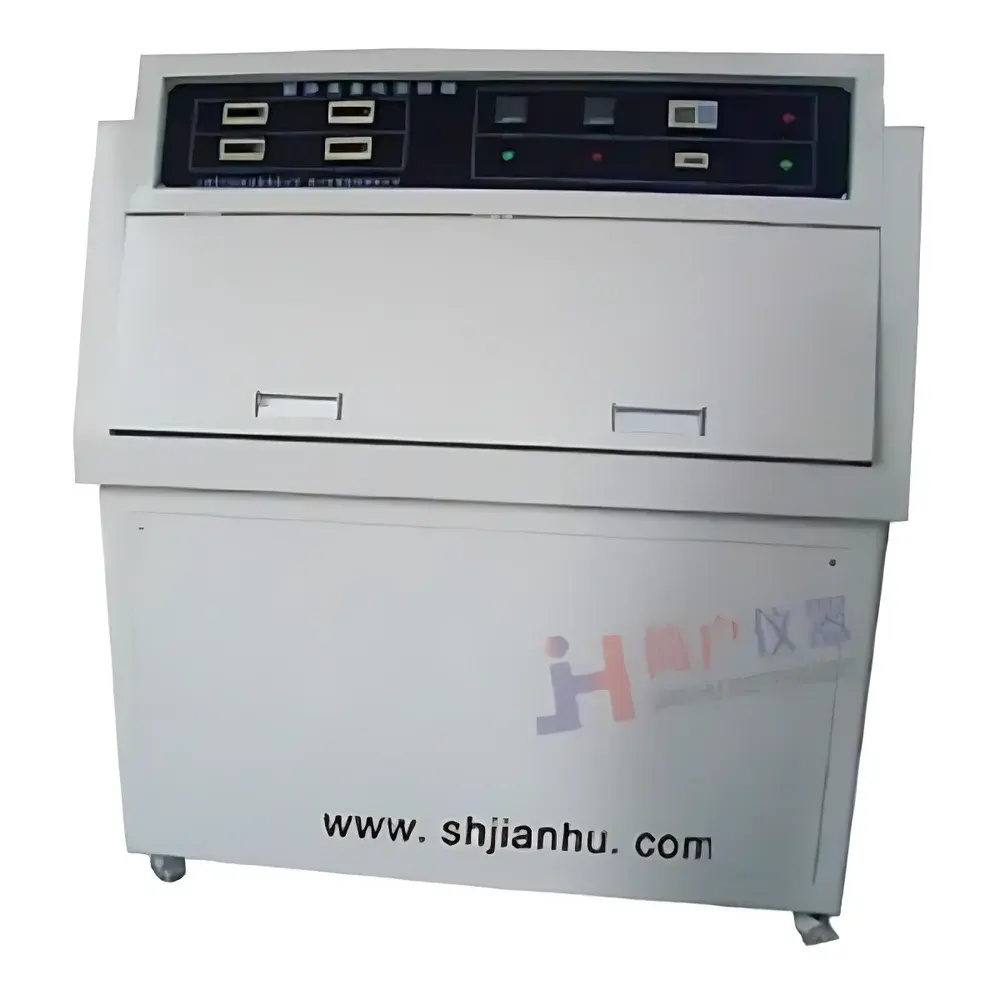
JianHu JH-UV Aging Test Chamber
| Brand | JianHu |
|---|---|
| Origin | Shanghai, China |
| Manufacturer Type | Authorized Distributor |
| Product Category | Domestic |
| Model | JH-UV Aging Test Chamber |
| Price Range | USD 140 – 2,800 |
| Humidity Range | ≥95% RH (in-chamber actual value) |
| UV Lamp Power | 40 W per lamp |
| Irradiance Range | 0.72 W/m² (at 340 nm) |
| Exposure Time Setting | 1–9999 hours (adjustable) |
Overview
The JianHu JH-UV Aging Test Chamber is an engineered environmental test system designed to accelerate material degradation under controlled ultraviolet (UV) radiation exposure—mimicking long-term solar weathering in a condensed timeframe. Based on the fundamental principle of photochemical degradation, the chamber employs fluorescent UV lamps (typically UVA-340 or UVB-313 spectral output) to replicate the most damaging portion of terrestrial sunlight (295–400 nm). This enables precise simulation of photolysis, polymer chain scission, oxidation, and pigment fading mechanisms observed in real-world outdoor exposure. The system integrates tightly regulated temperature and humidity control alongside programmable irradiance intensity and exposure cycles—supporting both continuous UV irradiation and alternating UV/dark condensation phases per ASTM G154 and ISO 4892-3 standards. Its architecture prioritizes thermal stability, uniform UV flux distribution across the specimen plane (±15% spatial uniformity), and repeatable chamber environment reproducibility—critical for comparative aging studies, QC validation, and materials qualification in R&D laboratories.
Key Features
- Stable UV irradiance output calibrated to 0.72 W/m² at 340 nm—aligned with ASTM G154 Cycle 1 reference intensity for xenon-corrected UVA-340 simulation
- High-humidity capability (≥95% RH during condensation phase), enabling realistic moisture-driven degradation mechanisms such as hydrolysis and blistering
- Precision black-panel temperature control (ambient +10°C to 70°C) with PID-regulated heating and forced-air circulation for uniform thermal distribution
- Modular UV lamp array (40 W per lamp) with standardized G13 base sockets—compatible with industry-standard UVA-340, UVB-313, or UVC lamps per test protocol requirements
- Intuitive touchscreen HMI interface supporting multi-step program scheduling, real-time parameter logging, and password-protected user access levels
- Robust stainless-steel interior chamber (304 SS) with quartz UV-transmissive viewing window and corrosion-resistant hardware for long-term operational integrity
Sample Compatibility & Compliance
The JH-UV chamber accommodates flat-panel specimens up to 150 mm × 300 mm × 20 mm (W×L×H) on standard sample racks, supporting rigid plastics, coated metals, textiles, elastomers, automotive trim, architectural coatings, and photovoltaic encapsulants. It meets core regulatory and industry-standard requirements including ASTM G154 (Standard Practice for Operating Fluorescent Ultraviolet (UV) Lamp Apparatus for Exposure of Non-Metallic Materials), ISO 4892-3 (Plastics — Methods of Exposure to Laboratory Light Sources — Part 3: Fluorescent UV Lamps), and GB/T 14522 (Chinese national standard for mechanical testing of non-metallic materials under UV exposure). While not inherently 21 CFR Part 11 compliant, its data logging functionality supports GLP/GMP-aligned documentation when paired with validated external software and audit-trail procedures. Calibration certificates traceable to NIM (National Institute of Metrology, China) are available upon request.
Software & Data Management
The embedded controller records time-stamped values for irradiance (via integrated UV sensor), chamber temperature, black-panel temperature, and relative humidity at user-defined intervals (1–60 min). Data exports in CSV format via USB port for post-processing in Excel or statistical analysis platforms (e.g., JMP, Minitab). Optional RS485/Modbus RTU communication enables integration into centralized lab monitoring systems (SCADA/LIMS). Firmware supports firmware version tracking, event logging (lamp-on/off, door open, alarm triggers), and configurable alarm thresholds with visual and audible alerts. No cloud connectivity or proprietary SaaS platform is included—ensuring full data sovereignty and compatibility with air-gapped laboratory networks.
Applications
This chamber serves as a primary tool for predictive durability assessment across multiple sectors: In automotive R&D, it evaluates UV resistance of interior trims, exterior clearcoats, and headlamp polycarbonate lenses per OEM specifications (e.g., GMW14124, Ford CETP 00.00-L-467); in construction materials science, it validates color retention and gloss loss of acrylic-based façade sealants and silicone roof membranes; in electronics manufacturing, it qualifies UV stability of conformal coatings and LED encapsulants under accelerated yellowing tests; in academic research, it supports polymer photostability studies, photocatalytic material screening, and biodegradable film degradation kinetics. Its repeatability makes it suitable for internal specification development, supplier qualification audits, and pre-compliance screening prior to outdoor Florida or Arizona exposure trials.
FAQ
What UV lamp types are compatible with the JH-UV chamber?
Standard G13-base fluorescent UV lamps—including UVA-340 (340 nm peak), UVB-313 (313 nm peak), and UVC (254 nm)—can be installed based on test standard requirements.
Does the chamber support condensation cycling per ASTM G154?
Yes—it includes a water reservoir and controlled condensation mode that maintains ≥95% RH at elevated temperatures to simulate dew formation during nighttime cooling periods.
Is temperature calibration traceable to international standards?
Calibration reports referencing NIM (China) or third-party accredited labs (e.g., CNAS-certified providers) are available as optional add-ons.
Can exposure time be paused or interrupted without resetting the program?
Yes—the controller retains elapsed time and resumes from the exact point of interruption upon restart, preserving test continuity.
What maintenance is required for long-term reliability?
Recommended quarterly tasks include UV sensor cleaning, lamp replacement every 1,600–2,000 operational hours, and verification of chamber seal integrity and drain line clearance.



