
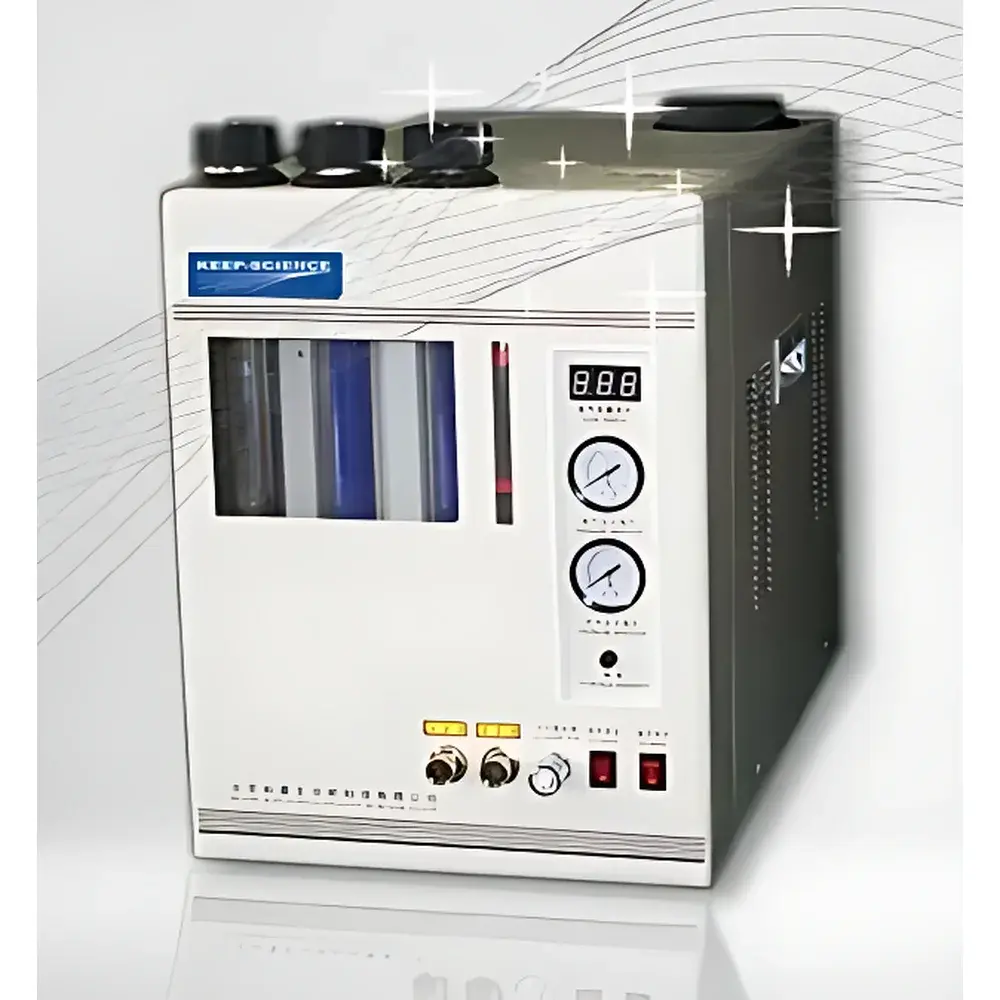
JIAYUAN HA-300 Hydrogen & Air Integrated Gas Generator
| Brand | JIAYUAN |
|---|---|
| Model | HA-300 |
| Hydrogen Purity | 99.999% |
| Hydrogen Flow Rate | 0–300 mL/min |
| Hydrogen Pressure | 0–0.4 MPa (factory-set at 0.3 MPa) |
| Air Flow Rate | 0–2000 mL/min |
| Air Pressure | 0–0.4 MPa |
| Operating Noise | <40 dB(A) |
| Ambient Humidity | ≤85% RH |
| Power Supply | AC 220 V ±10%, 50 Hz |
| Dimensions (W×D×H) | 500 × 300 × 380 mm |
| Weight | 20 kg |
Overview
The JIAYUAN HA-300 Hydrogen & Air Integrated Gas Generator is an engineered solution for laboratories requiring reliable, on-demand supply of high-purity hydrogen and compressed air from a single compact platform. Designed for analytical instrumentation—including gas chromatographs (GC), GC detectors (e.g., FID, TCD), and laboratory combustion systems—the HA-300 eliminates dependence on high-pressure gas cylinders while maintaining strict gas quality specifications. Its dual-output architecture employs membrane-based hydrogen generation via proton exchange membrane (PEM) electrolysis and oil-free, brushless rotary vane compression for air, ensuring continuous, stable delivery without cross-contamination. The system operates fully automatically: flow and pressure are dynamically regulated in real time to match instrument demand, minimizing waste and maximizing operational efficiency. With a footprint of only 500 × 300 × 380 mm and a mass of 20 kg, the HA-300 integrates seamlessly into benchtop workflows in QC labs, research facilities, and clinical testing environments.
Key Features
- Fully automated operation with intelligent demand-sensing control—hydrogen and air outputs respond independently to real-time instrument requirements.
- Integrated dual-gas architecture: PEM electrolysis cell for hydrogen generation (99.999% purity, trace O2 & H2O removed via catalytic purifier) and oil-free air compressor delivering clean, dry air (dew point ≤ −40 °C).
- Independent pressure and flow regulation: hydrogen output adjustable from 0–300 mL/min at 0–0.4 MPa; air output controllable from 0–2000 mL/min at 0–0.4 MPa—both factory preset at 0.3 MPa for optimal GC compatibility.
- Low-noise design (<40 dB[A] at 1 m) suitable for shared laboratory spaces and ISO 17025-accredited environments where acoustic interference must be minimized.
- Robust safety architecture including overpressure shutoff, electrolyte level monitoring, temperature cutoff, and automatic leak detection via integrated pressure decay test sequence during startup.
- Front-panel digital interface with LED indicators for status, fault codes, and real-time flow/pressure readouts—no external software required for basic operation.
Sample Compatibility & Compliance
The HA-300 is compatible with all major GC platforms requiring hydrogen fuel gas (FID) or carrier/support gas (TCD, HID), as well as air-driven detectors (e.g., NPD, PFPD) and auxiliary combustion systems. Hydrogen purity meets ASTM D7606-22 Grade 5 specification for instrumental analysis, with total hydrocarbon content <0.1 ppmv and moisture <1 ppmv (determined by cavity ring-down spectroscopy verification). Air output complies with ISO 8573-1:2010 Class 2:2:2 for particulate, water, and oil content—validated per manufacturer’s internal QA protocol. The unit is CE-marked and conforms to IEC 61010-1:2010 for electrical safety in laboratory equipment. While not certified to FDA 21 CFR Part 11, its firmware supports audit-ready event logging (power cycles, pressure deviations, maintenance alerts) for GLP/GMP-aligned documentation.
Software & Data Management
The HA-300 operates autonomously without mandatory PC connectivity; however, optional RS-232 or USB-to-serial interface enables integration with lab information management systems (LIMS) or building automation protocols. Logged data—including cumulative operating hours, hydrogen purity validation timestamps, pressure deviation events, and maintenance reminders—is stored in non-volatile memory and exportable as CSV. Firmware updates are performed via secure signed binary upload through the serial interface, with version rollback capability. All critical operational parameters are timestamped and retained for ≥12 months, supporting traceability requirements under ISO/IEC 17025 Clause 7.7 and EU Annex 11 principles.
Applications
- Hydrogen fuel gas supply for flame ionization detectors (FID) in environmental, petrochemical, and pharmaceutical GC analysis.
- Carrier or make-up gas for thermal conductivity detectors (TCD) and helium-replacement applications where hydrogen’s superior efficiency is leveraged.
- Clean, oil-free compressed air source for nitrogen-phosphorus detectors (NPD), pulsed flame photometric detectors (PFPD), and GC oven cooling systems.
- On-site hydrogen generation for small-scale hydrogenation reactors, fuel cell testing rigs, and calibration gas blending stations.
- Backup or primary gas supply in regulated environments where cylinder logistics pose contamination, scheduling, or safety risks (e.g., hospital core labs, forensic toxicology units).
FAQ
What is the expected service life of the PEM electrolysis cell?
Under normal operating conditions (≤8 h/day, ambient humidity ≤85% RH), the PEM stack is rated for ≥15,000 hours of operation, equivalent to approximately 5–6 years of typical lab use.
Does the HA-300 require deionized water or special electrolyte?
Yes—it uses ultra-pure deionized water (resistivity ≥15 MΩ·cm) as the sole consumable; no KOH or acidic electrolytes are required.
Can hydrogen and air outputs be used simultaneously at maximum flow?
Yes—the system’s thermal management and power regulation allow concurrent full-load operation (300 mL/min H₂ + 2000 mL/min air) without derating or overheating.
Is remote monitoring supported out of the box?
Basic remote status interrogation (via Modbus RTU over RS-232) is built-in; Ethernet or Wi-Fi modules are available as configurable add-ons.
What maintenance is required, and how often?
Annual replacement of the air intake filter and desiccant cartridge; biannual inspection of PEM cell integrity and pressure relief valve function—documented in the included maintenance logbook.
Related Products



