
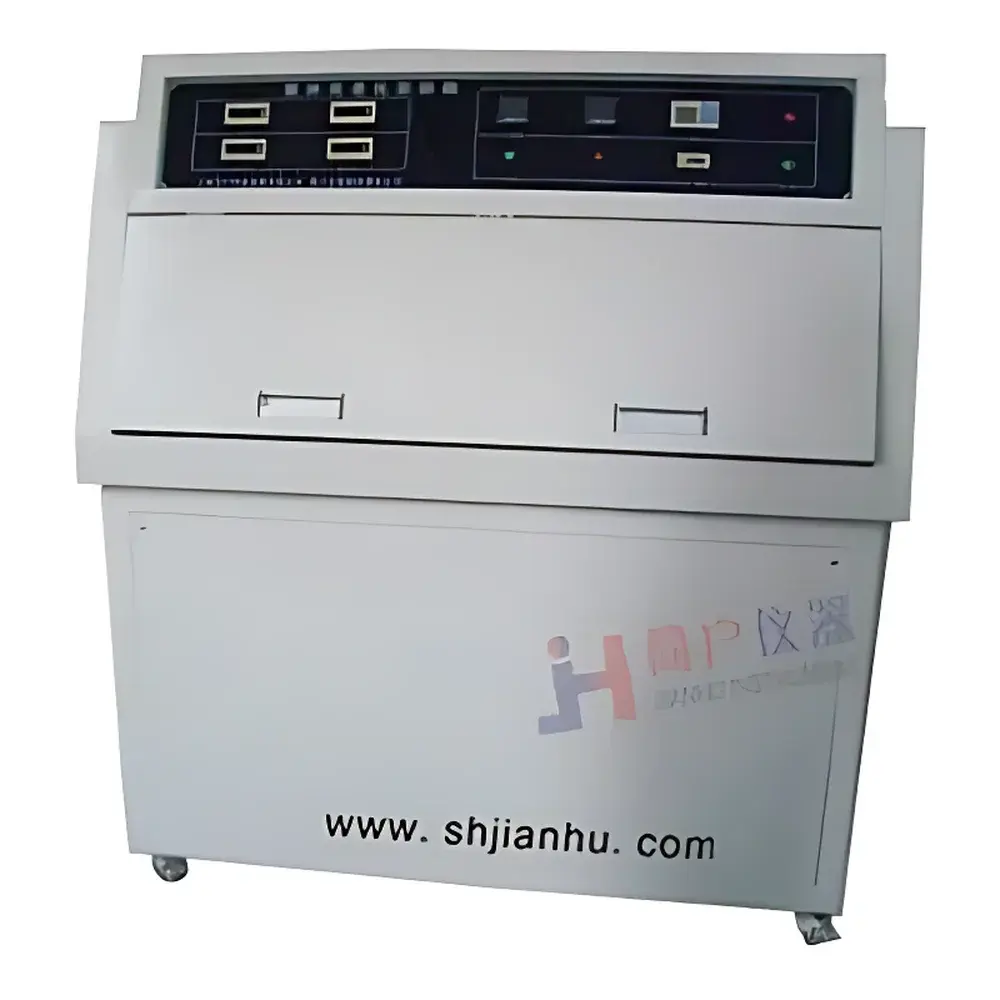
Jinhoo JH-PS UV Aging Test Chamber
| Brand | Jinhoo |
|---|---|
| Model | JH-PS |
| Origin | Shanghai, China |
| Construction | SUS304 stainless steel interior and chamber walls (optional aluminized painted outer shell) |
| Temperature Range | RT+10°C to 70°C |
| Humidity Range | 85–98% RH |
| UV Wavelength Range | 280–400 nm (UV-A/UV-B) |
| UV Lamp Type | Fluorescent UV-A and UV-B lamps |
| Distance from Sample Surface to Lamp Center | 50 ± 2 mm |
| Lamp Spacing (center-to-center) | 70 ± 2 mm |
| Sample Holder Dimensions | 150 × 75 × 1.5 mm |
| Heating Method | Air-heated resistive elements |
| Humidification Method | Steam-based humidifier with stainless steel boiler |
| Control System | Imported programmable temperature/humidity/time controller |
| Compliance | GB/T 14522–1993, GB/T 2423.24–2013 |
Overview
The Jinhoo JH-PS UV Aging Test Chamber is an engineered environmental simulation system designed for accelerated photochemical degradation testing of polymeric materials, coatings, elastomers, adhesives, and finished components under controlled ultraviolet irradiation, temperature, and humidity conditions. It operates on the principle of artificial solar radiation exposure using calibrated fluorescent UV-A (315–400 nm) and UV-B (280–315 nm) lamps to replicate the photodegradative effects of natural sunlight—particularly the short-wavelength UV component responsible for bond scission, chromophore degradation, and surface oxidation. Unlike broad-spectrum xenon arc or carbon arc systems, this chamber delivers high-intensity, spectrally stable UV output within a narrow band optimized for rapid assessment of yellowing, chalking, gloss loss, cracking, and color shift. Its thermal and hygrothermal control architecture enables reproducible cycling between irradiation, condensation (simulated dew formation), and dark storage phases—mimicking diurnal weathering patterns in compliance with internationally recognized accelerated aging protocols.
Key Features
- Stainless steel chamber construction (SUS304 grade) ensures long-term corrosion resistance against UV-induced ozone, humidity, and acidic byproducts generated during polymer degradation.
- Precisely spaced UV lamp array (70 ± 2 mm center-to-center) with fixed sample-to-lamp distance (50 ± 2 mm) guarantees uniform irradiance distribution across the test plane per ISO 4892-3 Annex B requirements.
- Independent PID-controlled heating and steam-based humidification system maintains tight regulation of temperature (RT+10°C to 70°C) and relative humidity (85–98% RH) during both irradiation and condensation cycles.
- Programmable digital controller with data logging capability supports multi-step test profiles—including UV exposure, condensation hold, and dark soak—each with adjustable duration, setpoint, and ramp rate.
- UV-A and UV-B fluorescent lamp configuration allows method-specific selection per ASTM G154 Class I–IV or ISO 4892-3 Cycle 1–6, enabling correlation to real-world service life in automotive, architectural, and outdoor industrial applications.
- Sample holder design accommodates standardized flat specimens (150 × 75 × 1.5 mm), compatible with ISO 11341, ASTM D4329, and GB/T 14522–1993 specimen mounting conventions.
Sample Compatibility & Compliance
The JH-PS chamber accepts rigid and semi-rigid planar samples up to 1.5 mm thickness, including thermoplastics (e.g., ABS, PC, PP), thermosets (epoxy, polyester), organic coatings (acrylic, polyurethane), rubber compounds, and composite laminates. It does not support volatile, low-melting-point, or highly reflective substrates without pre-validation. The system meets the functional and performance criteria outlined in GB/T 14522–1993 (“Artificial Climate Accelerated Testing Methods for Plastics, Paints and Rubber Used in Mechanical Industry”), GB/T 2423.24–2013 (“Environmental Testing – Part 2: Tests – Test SD: Simulated Solar Radiation with UV and Condensation”), and aligns with the operational parameters referenced in ISO 4892-3:2013 and ASTM G154–22. While not certified to IEC 60068-2-5 or MIL-STD-810H out-of-the-box, its control fidelity and repeatability support internal qualification for GLP-compliant material screening workflows.
Software & Data Management
The embedded controller provides real-time monitoring of chamber temperature, humidity, UV irradiance (via optional calibrated sensor input), and elapsed cycle time. All setpoints, actual values, and alarm events are timestamped and stored internally for up to 30 days. Data export is supported via USB interface in CSV format for traceability and post-test statistical analysis (e.g., ΔE* color difference, gloss retention %, tensile strength decay). The system supports audit trail functionality—recording operator ID, parameter changes, and manual overrides—enabling alignment with basic 21 CFR Part 11 principles where electronic records are retained and reviewed as part of quality documentation.
Applications
- Accelerated weathering validation of automotive exterior trim, headlamp lenses, and under-hood polymers.
- Quality control of architectural coatings and façade sealants exposed to subtropical or desert climates.
- Comparative durability ranking of UV-stabilized versus non-stabilized polyolefin films used in agricultural mulch.
- Pre-qualification of printed electronics substrates prior to outdoor deployment.
- R&D-stage screening of novel photostabilizers and HALS (hindered amine light stabilizers) in formulation development.
- Supporting failure analysis investigations where UV-induced embrittlement or surface microcracking is suspected.
FAQ
What UV spectral output does the JH-PS chamber deliver?
It utilizes standard fluorescent UV-A (340 nm peak) and UV-B (313 nm peak) lamps compliant with ISO 4892-3 spectral classes; irradiance is not actively monitored unless an optional radiometer is integrated.
Can the chamber perform cyclic tests with alternating UV and condensation phases?
Yes—programmable sequences allow independent definition of UV exposure duration, condensation hold time (via saturated air cooling), and dark periods, replicating ASTM G154 Cycle 4 or ISO 4892-3 Cycle 3.
Is calibration certification included with shipment?
Factory calibration of temperature and humidity sensors is performed prior to dispatch; NIST-traceable UV irradiance calibration requires third-party service and is not supplied standard.
What maintenance intervals are recommended for UV lamps?
Lamps should be replaced after 1600–2000 hours of cumulative operation or when spectral output degrades beyond ±10% of initial irradiance, as verified by spectroradiometric measurement.
Does the chamber support remote monitoring or Ethernet connectivity?
No native Ethernet or cloud interface is provided; remote access requires external PLC integration or serial-to-Ethernet gateway deployment.



