
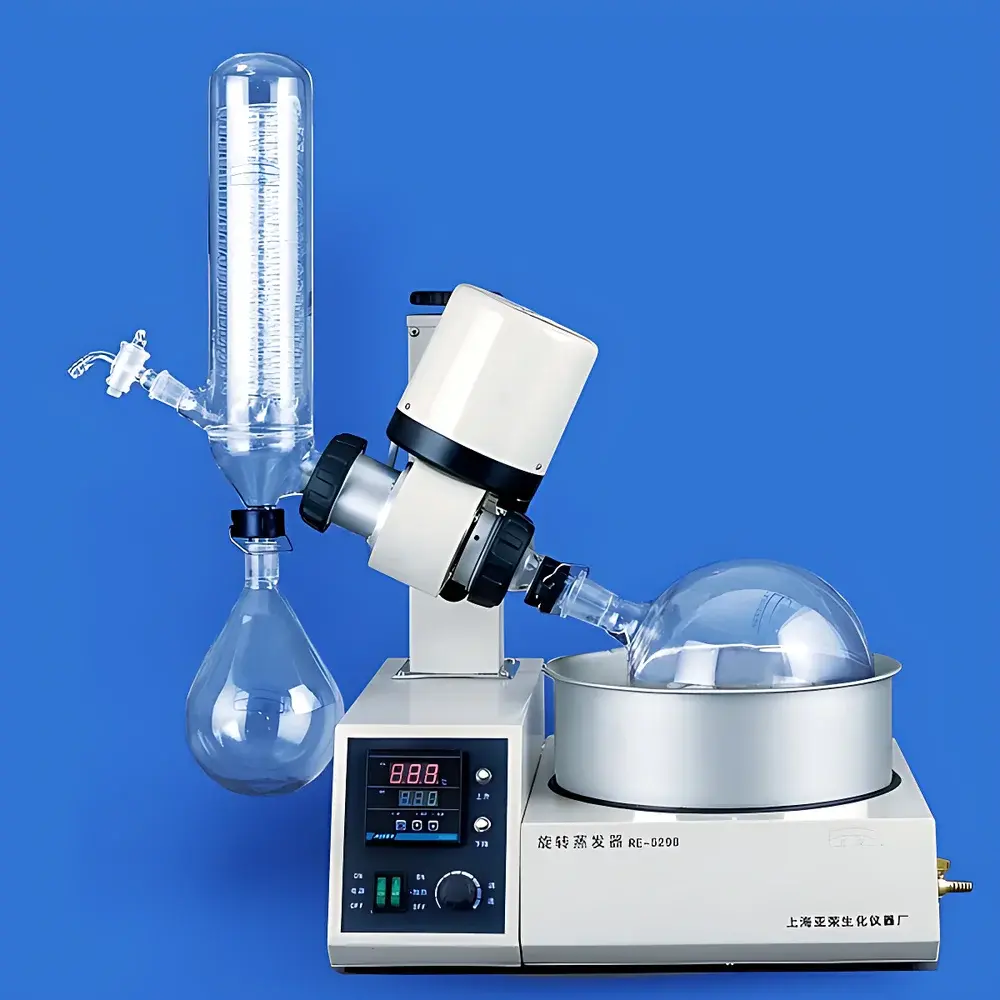
Jinye RE-5298 Rotary Evaporator
| Brand | Jinye |
|---|---|
| Origin | Shanghai, China |
| Manufacturer Type | Direct Manufacturer |
| Region of Origin | Domestic (China) |
| Model | RE-5298 |
| Capacity | 3 L |
| Rotational Speed | Electronically Controlled, 0–100 rpm |
| Temperature Control Range | Digital Thermostatic Control, Ambient to 99 °C |
| Temperature Accuracy | ±1 °C |
| Condenser Type | Dual-Return Standard-Ground-Joint Condenser |
| Condensing Area | 0.15 m² |
Overview
The Jinye RE-5298 Rotary Evaporator is an engineered solution for efficient solvent removal, concentration, and purification under reduced pressure in research laboratories and pilot-scale production environments. Based on the principle of vacuum-assisted rotary distillation—where evaporation rate is enhanced by lowering boiling points via vacuum application while maintaining thermal stability through precise bath temperature control—the RE-5298 delivers reproducible performance across diverse organic and aqueous systems. Its design integrates a robust glassware train with standardized 24/40 ground joints, enabling seamless compatibility with auxiliary vacuum controllers, chiller units, and trapping systems. The unit is widely deployed in pharmaceutical process development, natural product isolation, polymer synthesis, and quality control workflows where controlled thermal exposure and high recovery yields are critical.
Key Features
- 3-liter evaporation flask capacity optimized for medium-scale batch processing without compromising rotational stability or film uniformity.
- Electronically regulated rotation drive offering continuous speed adjustment from 0 to 100 rpm with low-vibration motor architecture—ensuring consistent thin-film formation and minimizing bumping or foaming during volatile solvent removal.
- Digital thermostatic heating bath with LED display and ±1 °C accuracy across ambient to 99 °C range, supporting both water and silicone oil media for broad thermal applicability.
- Dual-return standard-ground-joint condenser (24/40 taper) featuring 0.15 m² effective condensing surface area; engineered to maximize heat exchange efficiency and minimize vapor bypass under dynamic vacuum conditions (typically 10–100 mbar).
- Integrated vertical condenser orientation and balanced mechanical support structure reduce stress on glass joints and enhance long-term operational safety during extended runs.
- All wetted components—including flask, condenser, and receiving flask—are constructed from borosilicate 3.3 glass (DIN/ISO 3585 compliant), ensuring chemical resistance to common solvents such as acetone, ethanol, dichloromethane, and ethyl acetate.
Sample Compatibility & Compliance
The RE-5298 accommodates a wide range of sample matrices including heat-sensitive biomolecules (e.g., peptides, enzymes), thermolabile APIs, plant extracts, and synthetic intermediates. Its modular design supports adaptation to GMP-aligned workflows when paired with validated vacuum pumps, cold traps, and data logging accessories. While the base unit itself does not carry CE or UL certification, its construction adheres to ISO 7207-1 (rotary evaporator safety requirements) and conforms to general laboratory equipment design principles referenced in ISO/IEC 17025:2017 Annex A.2 for equipment suitability assessment. Users implementing the system in regulated environments should perform IQ/OQ protocols per internal SOPs and document calibration of the digital temperature controller against traceable NIST-certified references.
Software & Data Management
The RE-5298 operates as a standalone analog-digital hybrid instrument without embedded firmware or network connectivity. Temperature setpoint and rotation speed are adjusted manually via front-panel controls, and real-time values are displayed on dedicated LED readouts. For laboratories requiring audit-ready records, integration with external data acquisition systems (e.g., LabVIEW, WinWedge, or custom Python-based SCADA interfaces) is supported via optional analog voltage output modules (0–5 V or 4–20 mA) for bath temperature and RPM signals. Such configurations enable compliance with FDA 21 CFR Part 11 when combined with electronic signature-capable software platforms and appropriate access controls.
Applications
- Concentration of dilute solutions in natural product chemistry and phytochemical analysis.
- Solvent exchange and residue drying in small-molecule API purification prior to crystallization.
- Removal of low-boiling solvents (e.g., hexane, diethyl ether) following column chromatography fractions.
- Preparative-scale dehydration of hygroscopic compounds under inert atmosphere (when fitted with nitrogen inlet adapter).
- Process optimization studies involving evaporation kinetics, heat transfer coefficients, and vacuum-dependent volatility profiles.
- Educational demonstrations of phase equilibria, Raoult’s law deviations, and thin-film evaporation dynamics in university teaching labs.
FAQ
What vacuum level is recommended for optimal operation of the RE-5298?
For most organic solvents, a stable vacuum between 10 and 30 mbar is ideal—achievable using a diaphragm or scroll vacuum pump equipped with a vacuum regulator and gauge. Excessive vacuum (100 mbar) reduces evaporation efficiency.
Can the RE-5298 be used with corrosive solvents such as concentrated HCl or HF?
No. Although borosilicate glass resists many organics and mild acids, hydrofluoric acid and fuming sulfuric acid will etch or degrade the glassware. Use only chemically compatible solvents per ASTM D2622 and manufacturer-specified compatibility charts.
Is the heating bath compatible with silicone oil up to 99 °C?
Yes—the bath chamber is rated for continuous operation with high-flash-point silicone oils (flash point >200 °C). Ensure oil level remains above the heater element and below the bath rim to prevent overheating or overflow.
Does the unit include a vacuum controller or pressure sensor?
No. Vacuum regulation requires external instrumentation. Optional accessories include digital vacuum controllers with feedback loops and programmable ramping profiles for advanced process repeatability.
How often should the PTFE sealing rings and gaskets be replaced?
Under normal use (daily operation, 8 h/day), inspect seals every 3 months and replace annually—or immediately upon observing cracking, hardening, or compression set—to maintain vacuum integrity and prevent cross-contamination.



