
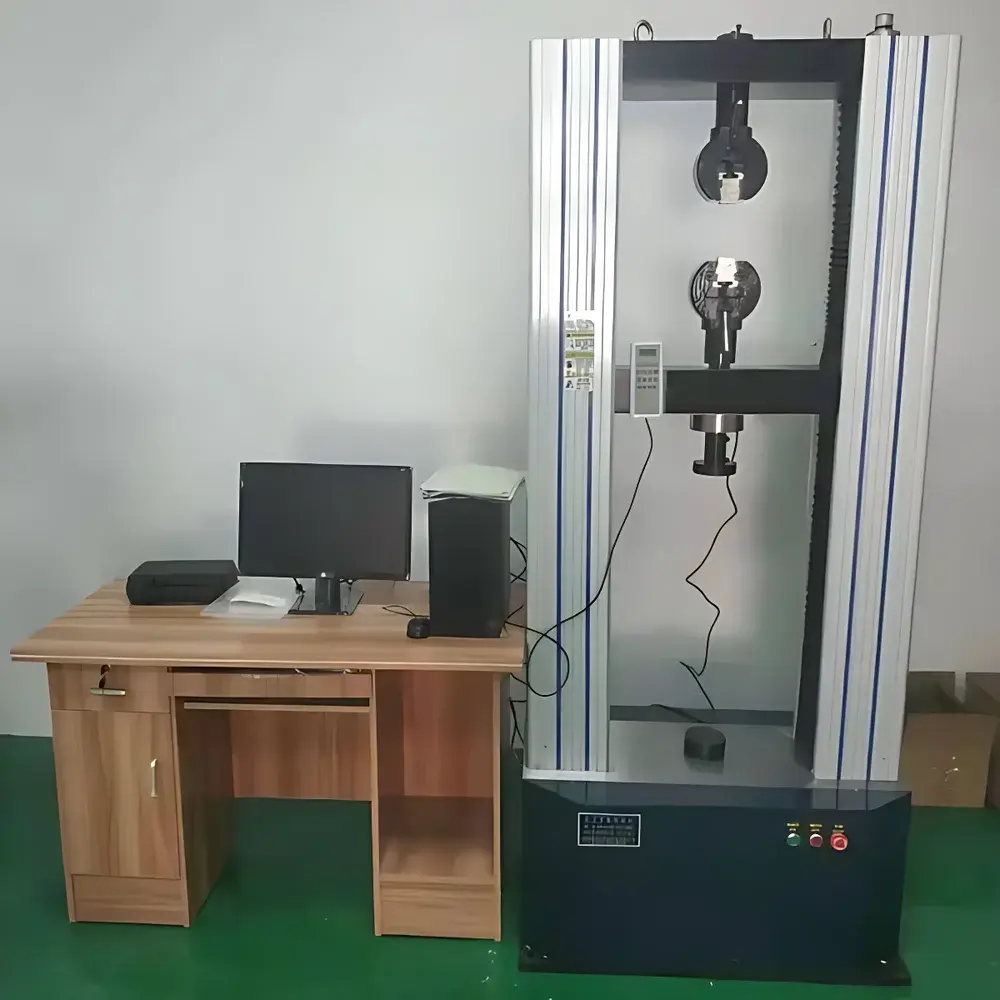
Jiubin JB-117A Fabric Seam Slippage Tester
| Brand | Jiubin |
|---|---|
| Model | JB-117A |
| Type | Electronic Universal Testing Machine |
| Max Load Capacity | 10 kN |
| Load Accuracy Class | 0.5 |
| Effective Test Width | 380 mm |
| Effective Stroke | 900 mm |
| Test Speed Range | 0.01–500 mm/min |
| Speed Accuracy | ±0.5% of indicated value |
| Load Resolution | 500,000 counts (full-scale, no range switching) |
| Displacement & Strain Measurement Accuracy | ±0.5% of indicated value |
| Sensor Origin | USA |
| Controller | Panasonic Full-Digital AC Servo System |
| Control Mode | Fully Digital Closed-Loop (Constant Load, Constant Strain, Constant Displacement) |
| Safety Protection | Software Diagnostics, Electronic Limit Switches, Overload Protection at 110% FS |
| Fixture Customization | Available per sample requirements |
| Power Supply | 2–5 kW |
| Net Weight | ~145 kg |
Overview
The Jiubin JB-117A Fabric Seam Slippage Tester is a precision-engineered electronic universal testing machine specifically configured for standardized mechanical evaluation of woven textile seams in accordance with ASTM D434, ISO 13936-1/-2, GB/T 13772.1–2008, and other internationally recognized textile test protocols. Unlike general-purpose tensile testers, the JB-117A integrates hardware and control logic optimized for the unique loading profiles and displacement sensitivities inherent to seam slippage and seam strength measurements. It operates on the principle of controlled uniaxial tension applied to a folded, stitched fabric specimen — where seam slippage is quantified either as the force required to produce a defined gap (e.g., 6 mm) between stitch lines (constant-displacement mode), or as the displacement at a prescribed load (e.g., 100 N) (constant-load mode). Seam strength, measured as the peak load at seam rupture, is concurrently captured during the same test sequence. The system’s high-resolution load cell (500,000-count A/D conversion), sub-0.5% accuracy across full scale, and seamless speed regulation (0.01–500 mm/min) ensure repeatability essential for QC labs operating under ISO/IEC 17025 or AATCC-accredited workflows.
Key Features
- Class 0.5 load accuracy certified per ISO 7500-1 and ASTM E4 — validated across the entire 10 kN capacity without range switching
- Full-scale load resolution of 500,000 digital counts ensures detection of sub-newton force variations critical for low-load seam slippage onset analysis
- Patented dual-speed crosshead actuation (manual fast return + programmable slow approach) minimizes setup time while preserving specimen alignment integrity
- Panasonic full-digital AC servo drive delivers torque stability <±0.3% and eliminates speed drift during long-duration creep or relaxation tests
- Integrated electronic limit switches and real-time software diagnostics prevent overtravel damage and support GLP-compliant audit trails
- Modular fixture interface enables rapid interchange of textile-specific grips — including pneumatic seam clamps, self-aligning roller jaws, and ASTM D434-compliant seam holders
- Overload protection triggers automatically at 110% of full-scale load, halting motion and logging event timestamp for traceability
Sample Compatibility & Compliance
The JB-117A is validated for use with woven fabrics only, consistent with the physical basis of seam slippage mechanics (inter-yarn shear resistance along stitch lines). It accommodates specimens up to 380 mm wide and supports standard test widths per ASTM D434 (100 mm) and ISO 13936-1 (50 mm). Specimen folding, stitching, and pre-cutting follow strict geometrical tolerances defined in each standard. The system meets mechanical and metrological requirements of ISO 13936-2 (seam slippage under cyclic loading), ISO 13937-1 (seam strength), and GB/T 13772.2 (Chinese national standard for knitted fabric seam evaluation — though primary application remains woven structures). All calibration procedures align with ISO/IEC 17025 Clause 6.6; raw data files retain native timestamp, operator ID, and environmental metadata (if integrated with optional温湿度 sensor module).
Software & Data Management
The proprietary Jiubin TestMaster™ v4.2 software provides fully digital closed-loop control with configurable test profiles for seam slippage (displacement-limited or load-limited), seam strength (peak load detection), and multi-step ramp-hold sequences. Each test generates an ASCII-compatible .csv output containing time-stamped load (N), displacement (mm), strain (%), and calculated parameters (slippage force at X mm, opening distance at Y N, seam efficiency %). Audit trail functionality logs user login, method changes, calibration events, and error codes — satisfying FDA 21 CFR Part 11 requirements when paired with Windows domain authentication and electronic signature modules. Data export supports direct integration with LIMS platforms via ODBC drivers; no proprietary binary formats are used.
Applications
- Quality assurance of garment seams in apparel manufacturing (denim, shirting, workwear)
- R&D validation of new thread types, stitch densities, and seam constructions (e.g., flat-felled vs. French seams)
- Comparative assessment of fabric finish effects (resin treatment, sanforization, plasma coating) on inter-yarn cohesion
- Third-party certification testing for OEKO-TEX® Standard 100, GOTS, and bluesign® compliance documentation
- Textile supplier qualification per brand-specific technical packs (e.g., H&M Chemical Restrictions List Annex, Nike Material Sustainability Index)
- Academic research on yarn-to-yarn friction coefficients and stitch geometry–performance relationships
FAQ
Is the JB-117A suitable for knit fabric seam testing?
No. Seam slippage is a mechanically defined phenomenon exclusive to woven structures due to orthogonal yarn interlacing. Knit fabrics exhibit ladder rung propagation or unraveling, assessed via ASTM D5034 or ISO 13934-1 — requiring different fixture geometry and failure criteria.
Can the system perform both seam slippage and seam strength in a single test run?
Yes. The test sequence is programmable to first record slippage displacement up to a user-defined threshold (e.g., 6 mm), then continue loading until seam rupture — capturing both metrics without specimen repositioning.
Does the instrument comply with ISO/IEC 17025 calibration traceability requirements?
Yes. Load cell calibration certificates are issued by CNAS-accredited laboratories (certificate number embedded in firmware), with uncertainty budgets reported per ISO/IEC 17025:2017 Annex A.3.
What is the minimum resolvable force increment at 10 N full scale?
With 500,000-count resolution and 10 kN capacity, the theoretical least count is 0.02 N — verified experimentally using NIST-traceable deadweight standards.
Are ASTM D434 and ISO 13936-1 test methods preloaded in the software?
Yes. Both standards are implemented as validated templates with auto-calculated pass/fail flags based on specimen width, gauge length, and specified rate (300 mm/min per ASTM, 100 mm/min per ISO).



