
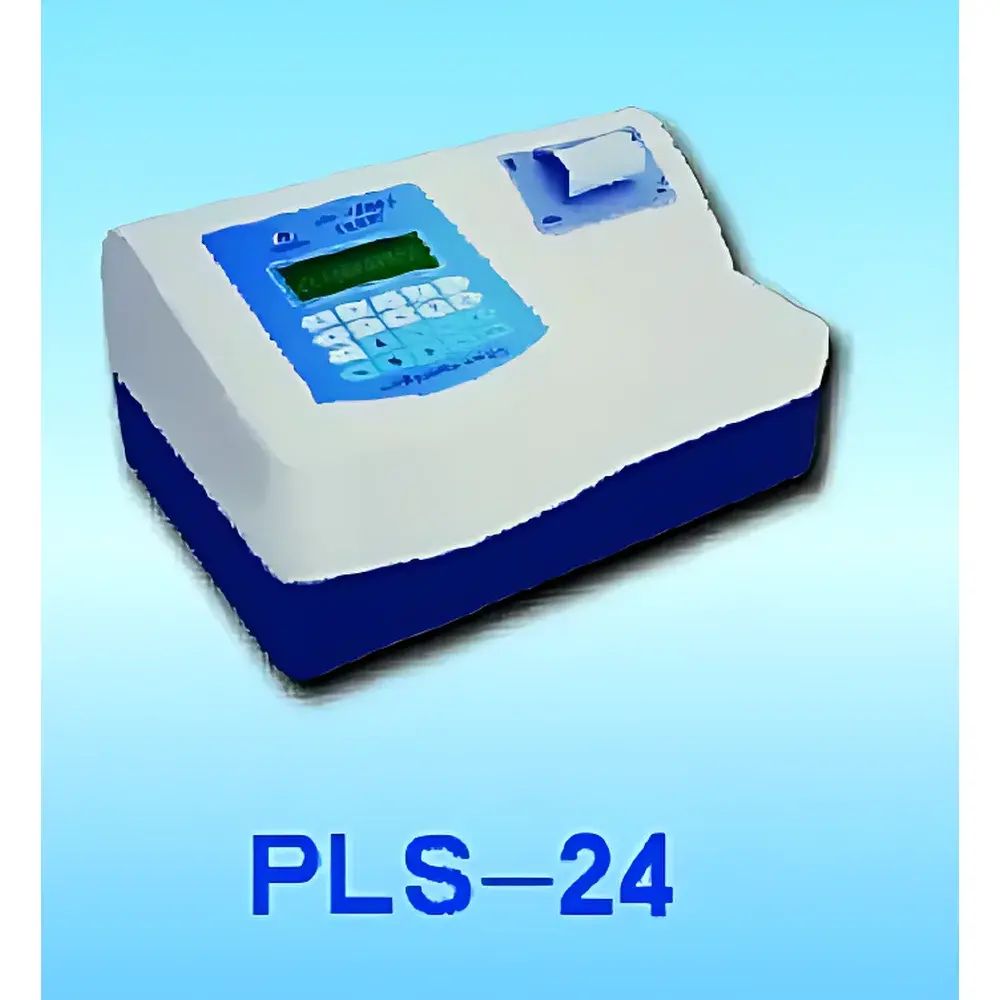
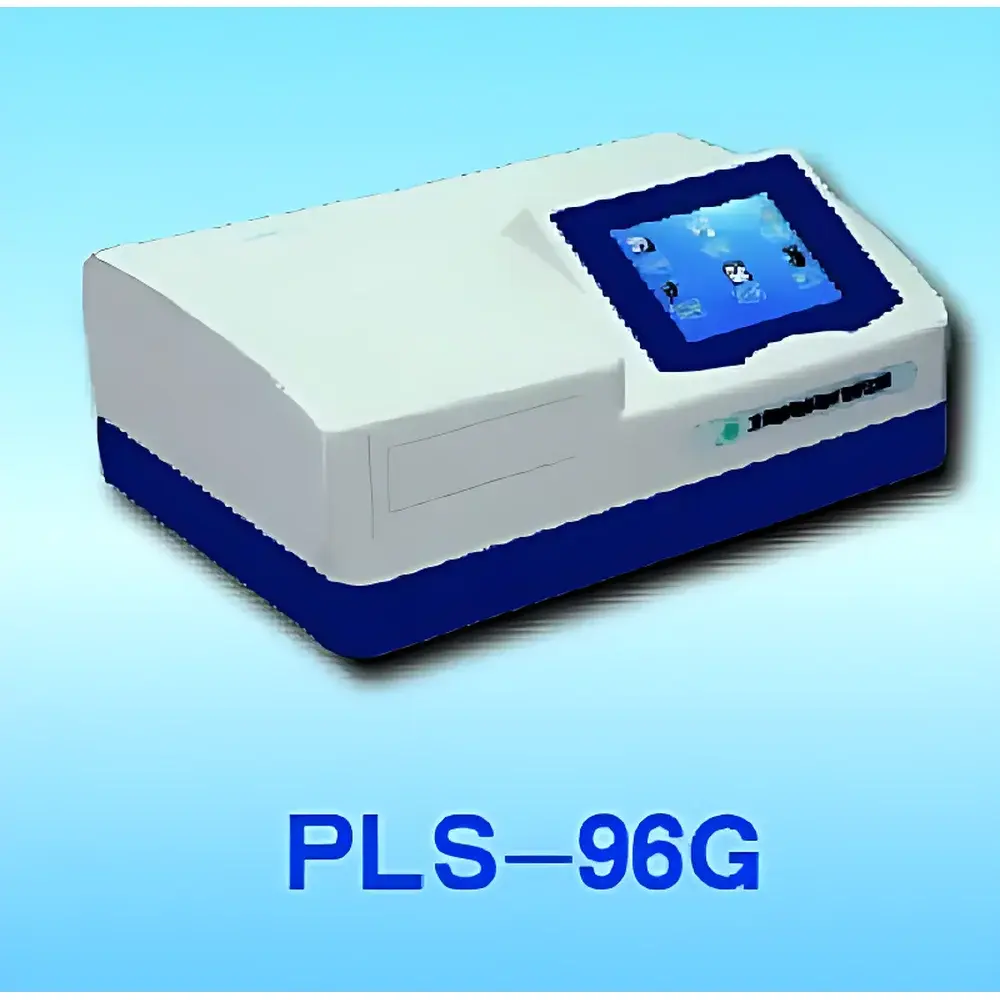
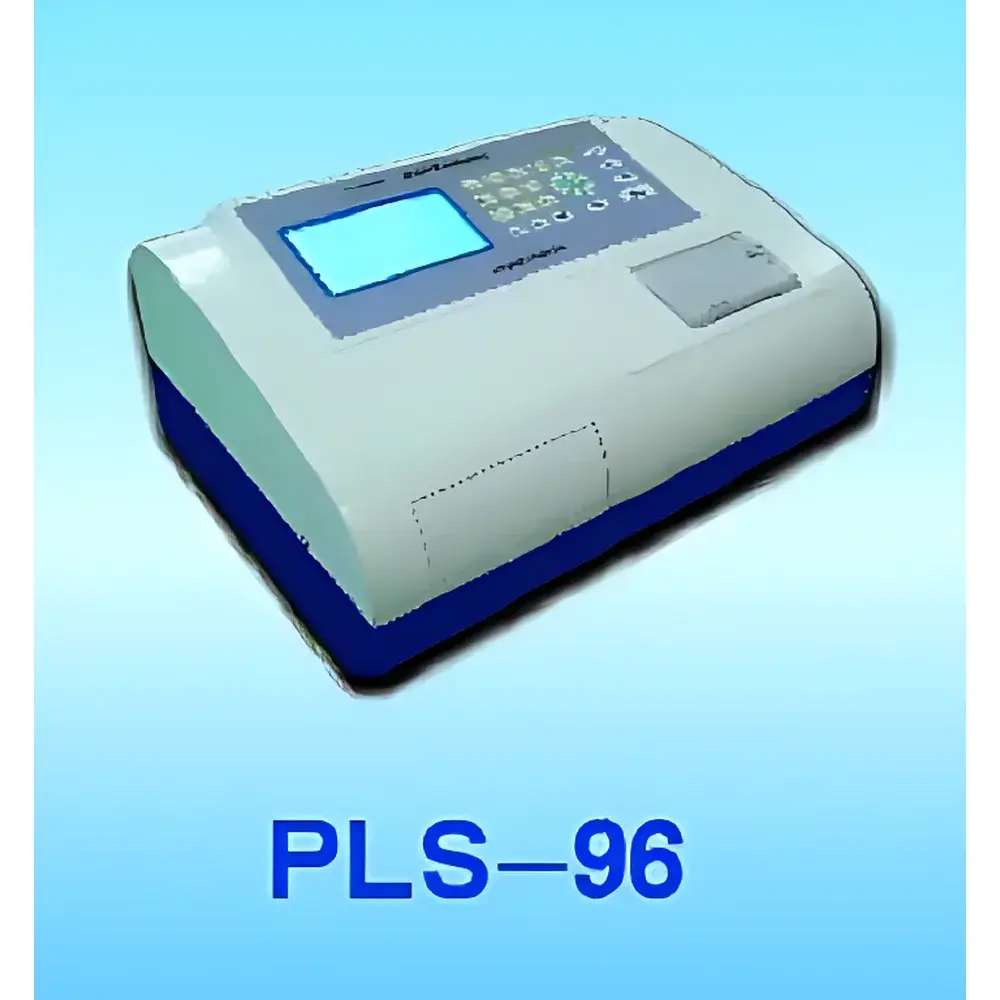
PLS-Series Food Safety Comprehensive Analyzer
| Origin | Imported |
|---|---|
| Manufacturer Type | Distributor |
| Model | PLS-24 / PLS-96G / PLS-96 |
| Measurement Range | 0.000–3.000 Abs (PLS-24), 0.000–4.000 Abs (PLS-96G/96) |
| Wavelength Range | 400–1100 nm |
| Optical Channels | 2 (PLS-24), 8 (PLS-96G/96) |
| Read Time (Single Wavelength) | 25 s (PLS-24), 5 s (PLS-96G/96) |
| Wavelength Accuracy | ±2.0 nm |
| Spectral Bandwidth | 8 ± 1.0 nm |
| Absorbance Repeatability (CV) | ≤0.5% |
| Channel Uniformity | ≤0.02 A |
| Stray Light | ≥2.0 A at 510 nm (50.0 g/L NaNO₂) |
| Absorbance Drift | ≤±0.005 A over 20 min (at 492 nm, ~1.000 A) |
| Absorbance Linearity Error | ±0.010 A (0.000–2.000 A), ±0.050 A (2.000–3.500 A) |
| Dimensions | 370 × 245 × 170 mm (PLS-24), 420 × 305 × 170 mm (PLS-96G/96) |
| Weight | 6 kg (PLS-24), 9 kg (PLS-96G/96) |
| Data Storage | 100 assay methods (PLS-24), 200 assay methods + 105 plates (10,000 results) (PLS-96G/96) |
| Interface | RS-232 serial port |
| Display | Color TFT touchscreen (PLS-96G), color TFT with membrane keypad (PLS-24/96) |
| Detection Modes | Absorbance, qualitative, quantitative, enzyme inhibition rate |
| Filter Selection | Manual (PLS-24), automatic (PLS-96G/96) |
| Built-in Thermal Printer | Yes (PLS-24/96), optional external printer support (PLS-96G) |
Overview
The PLS-Series Food Safety Comprehensive Analyzer is a dedicated microplate reader engineered for high-throughput, regulatory-compliant screening of foodborne contaminants in laboratory and field-deployable quality control environments. Based on dual-beam or multi-channel photometric absorbance measurement principles—operating across a broad spectral range (400–1100 nm)—the instrument supports standardized colorimetric and enzyme-linked immunoassay (ELISA) protocols widely adopted in food safety testing. Its optical architecture employs quartz-halogen illumination with active power management (semi-voltage standby mode), ensuring long-term photometric stability and extended lamp service life. Designed to meet the operational demands of national food inspection agencies, third-party testing laboratories, and food manufacturing QA/QC departments, the PLS-Series implements rigorous photometric calibration traceability, including wavelength accuracy (±2.0 nm), narrow spectral bandwidth (8 ± 1.0 nm), and low inter-channel variability (≤0.02 A), enabling reproducible quantification of analytes such as organophosphate pesticides, veterinary drug residues (e.g., tetracyclines, sulfonamides, β-agonists), and mycotoxins (e.g., aflatoxin B₁, ochratoxin A) when used with validated reagent kits.
Key Features
- Multi-model platform architecture: PLS-24 (2-channel, 24-well compatible), PLS-96 and PLS-96G (8-channel, full 96-well plate support) — optimized for flexibility across throughput requirements.
- High photometric fidelity: Absorbance linearity verified across 0.000–4.000 A; repeatability CV ≤0.5%; drift ≤±0.005 A over 20 minutes (492 nm, neutral density filter).
- Intelligent optical path management: Automatic filter selection (PLS-96G/96) eliminates manual intervention and reduces operator error; manual rotary filter wheel (PLS-24) offers direct physical control for method-specific validation workflows.
- Regulatory-ready data handling: Onboard storage for up to 200 pre-configured assay protocols—including user-defined cutoff thresholds aligned with national maximum residue limits (MRLs) per GB, NY/T, or SN standards.
- Robust hardware design: Integrated thermal printer (standard), RS-232 interface for bidirectional instrument control and data export, and auto-diagnostic startup sequence with real-time fault reporting on LCD.
- Ergonomic human-machine interface: High-resolution color TFT display with intuitive touch navigation (PLS-96G) or tactile membrane keypad (PLS-24/96); bilingual input capability (English, numeric, Chinese characters on PLS-96G).
Sample Compatibility & Compliance
The PLS-Series accommodates standard 96-well microplates (flat-bottom, U/V-bottom) and 24-well formats, supporting both single- and dual-wavelength measurements with configurable reference subtraction. It complies with core performance criteria defined in ISO 15197:2013 (in vitro diagnostic devices), ASTM E2517-17 (standard practice for microplate reader verification), and relevant sections of China’s JJG 861-2015 metrological verification regulation for microplate readers. All models undergo factory calibration using NIST-traceable neutral density filters and certified wavelength standards. The system supports GLP-aligned operation through audit-trail-capable parameter logging, timestamped result archiving, and user-accessible calibration history—critical for laboratories undergoing CNAS, CMA, or FDA-regulated audits. While not FDA 21 CFR Part 11–certified out-of-the-box, its RS-232 interface enables integration into validated LIMS environments where electronic signatures and secure data archiving are implemented externally.
Software & Data Management
The embedded firmware provides native support for absorbance, qualitative (positive/negative binary output), quantitative (standard curve fitting via linear, log-log, 4PL, or 5PL algorithms), and enzyme inhibition rate calculations. Up to 105 full 96-well plates (10,000 individual sample results) can be stored onboard (PLS-96G/96); PLS-24 retains 100 assay configurations but lacks plate-level result storage. Data export is facilitated via RS-232 to Windows-based desktop software (supplied separately), enabling generation of compliant reports: raw absorbance tables, concentration outputs with confidence intervals, MRL-based pass/fail flags, and QC control charts. All printed outputs include instrument ID, date/time stamp, operator ID (if configured), and assay metadata—ensuring full traceability per ISO/IEC 17025:2017 clause 7.8.2.
Applications
The PLS-Series serves as a primary analytical tool in food safety laboratories performing routine surveillance under national monitoring programs (e.g., China’s National Food Safety Risk Assessment Program). Validated applications include:
- Pesticide residue detection via acetylcholinesterase (AChE) inhibition assays (organophosphates, carbamates).
- Veterinary drug screening using competitive ELISA formats (chloramphenicol, nitrofurans, fluoroquinolones, β-lactams).
- Mycotoxin quantification (aflatoxins, deoxynivalenol, zearalenone) via direct or indirect ELISA.
- Food adulterant identification (e.g., melamine, Sudan dyes) using chromogenic reaction kinetics.
- Sanitation verification (ATP bioluminescence proxy assays via absorbance-coupled luciferase detection).
Its modular wavelength configuration (up to 10 selectable filters on PLS-96G/96) allows seamless transition between assay chemistries without hardware modification.
FAQ
What regulatory standards does the PLS-Series comply with?
It meets metrological verification requirements per China’s JJG 861-2015 and aligns with photometric performance benchmarks in ASTM E2517-17 and ISO 15197:2013. Full 21 CFR Part 11 compliance requires integration with validated third-party LIMS.
Can the instrument store and recall calibration curves for repeated assays?
Yes—each model supports saving and loading standard curves, assay parameters, and MRL thresholds. PLS-96G/96 retain up to 200 assay templates with full curve-fitting coefficients.
Is remote control possible via computer?
Yes—RS-232 serial communication enables full command-and-control functionality, including plate reading initiation, parameter upload/download, and real-time data streaming.
How is photometric accuracy maintained over time?
Built-in self-diagnostics verify lamp intensity, detector response, and optical alignment at startup. Annual recalibration using certified ND filters and wavelength standards is recommended for ISO/IEC 17025 accreditation.
Does the system support dual-wavelength correction for turbid samples?
Yes—all models support simultaneous or sequential dual-wavelength measurement (e.g., 450 nm/630 nm) to correct for background interference from particulates or matrix effects.






