
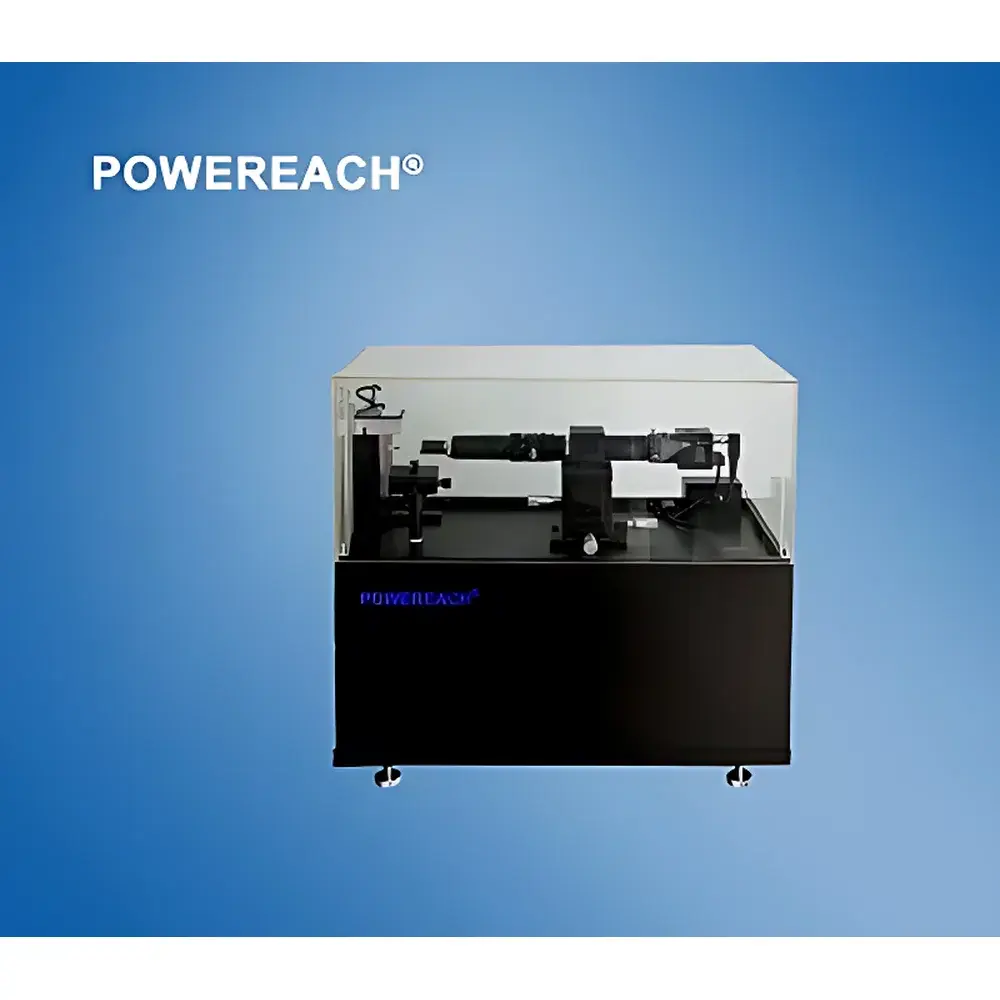
JQ03D Single-Fiber Tensile-Compression-Bending Tester
| Origin | Beijing, China |
|---|---|
| Manufacturer Type | Authorized Distributor |
| Origin Category | Domestic (China) |
| Model | JQ03D |
| Price Range | USD 7,000 – 14,000 |
Overview
The JQ03D Single-Fiber Tensile-Compression-Bending Tester is an integrated mechanical characterization system engineered for high-precision evaluation of individual fibers across three fundamental deformation modes: uniaxial tension, axial compression, and three-point bending. Designed specifically for microscale and sub-micron fiber specimens—including natural fibers (e.g., cashmere, spider silk), biomedical filaments (e.g., nerve guidance conduits), synthetic nanocomposites, and regenerated cellulose fibers—the instrument operates on a dual-module architecture: a calibrated tensile actuation module and a dedicated bending fixture with adjustable span and indenter geometry. Its measurement principle is grounded in precision force-displacement transduction via high-resolution load cells (sub-mN resolution) and linear displacement encoders (≤100 nm step resolution), enabling direct acquisition of full stress–strain curves under controlled strain rates (0.01–100 mm/min). The system supports quasi-static and low-speed dynamic loading protocols compliant with ASTM D3822, ISO 5079, and GB/T 14337 standards for single-filament mechanical testing.
Key Features
- Dual-function modular design integrating independent tensile and bending test stations within a single compact platform
- Bending module optimized for micron-scale fibers (diameter range: 1–100 µm), featuring motorized span adjustment (5–20 mm), interchangeable stainless-steel indenters (radius: 0.1–1.0 mm), and real-time curvature feedback
- Tensile module equipped with pneumatic micro-grippers (adjustable clamping pressure: 0.1–0.6 MPa) and optional manual vise grips for brittle or short-length specimens (≥1 mm)
- In-situ optical monitoring via dual-path microscope integration: one path for real-time diameter/length measurement (resolution: ±0.5 µm), second path for high-magnification fracture morphology observation (up to 500×)
- Programmable strain-rate control with closed-loop feedback; velocity accuracy ±0.5% of setpoint over full range
- Thermally stabilized sample stage (ambient ±0.5 °C) to minimize thermal drift during extended creep or relaxation tests
Sample Compatibility & Compliance
The JQ03D accommodates monofilaments ranging from 1 mm to 50 mm in length and 0.5 µm to 200 µm in diameter. It is validated for use with natural protein fibers (wool, silk, collagen), regenerated biopolymers (viscose, lyocell), synthetic polymers (PET, nylon 6, PTFE), carbon-based filaments (CNT yarns, graphene oxide fibers), and biohybrid constructs (electrospun PCL/gelatin scaffolds). All mechanical outputs—including tensile modulus, breaking tenacity, elongation at break, bending stiffness (flexural rigidity EI), and recovery ratio after cyclic bending—are traceable to NIST-calibrated reference weights and displacement standards. The system supports GLP-compliant data recording per ISO/IEC 17025 requirements, with audit-trail-enabled test logs, user authentication, and electronic signature capability for regulated environments.
Software & Data Management
The proprietary FiberMechanics™ v3.2 software provides synchronized acquisition of force, displacement, image metadata, and environmental parameters (temperature, humidity). It enables automated calculation of 12+ mechanical descriptors directly from raw curves: Young’s modulus (initial slope), toughness (area under curve), yield point (0.2% offset method), hysteresis loss (energy dissipation ratio), bending modulus (via Euler–Bernoulli beam theory), and cyclic fatigue index. Data export formats include CSV, XML, and HDF5; all files embed EXIF-style metadata (operator ID, calibration date, environmental conditions, instrument serial number). Software complies with FDA 21 CFR Part 11 for electronic records and signatures when configured with role-based access control and encrypted local storage.
Applications
- Quantitative comparison of mechanical anisotropy between natural and engineered biomimetic fibers
- Structure–property correlation studies linking electrospinning parameters to tensile/bending performance
- Quality control of high-value specialty fibers (e.g., medical-grade sutures, aerospace-grade aramid monofilaments)
- Fatigue life assessment of neural interface filaments under repeated flexural loading
- Validation of computational models (e.g., finite element simulations of fiber buckling behavior)
- Supporting R&D for ISO/ASTM standard development in advanced textile mechanics
FAQ
What fiber diameters can the JQ03D accurately measure during tensile testing?
The system supports reliable gripping and force transmission for fibers between 1 µm and 150 µm in diameter using its adaptive pneumatic gripper system.
Is the bending module compatible with non-circular cross-sections (e.g., ribbon-shaped or flattened fibers)?
Yes—bending stiffness calculations account for cross-sectional geometry via user-input aspect ratio; default assumes circular symmetry but allows custom moment-of-inertia entry.
Can test data be exported in formats suitable for statistical process control (SPC) software?
All raw and processed datasets export to CSV with timestamped headers, fully compatible with JMP, Minitab, and Python pandas workflows.
Does the instrument support temperature-controlled testing beyond ambient conditions?
The base configuration maintains ambient stability; optional Peltier-cooled stage (-10 °C to +60 °C) is available as a field-upgradeable module.
How is calibration verified between scheduled maintenance intervals?
Built-in self-diagnostic routines perform daily zero-load verification and periodic reference-load validation using certified traceable weights (included with shipment).



