
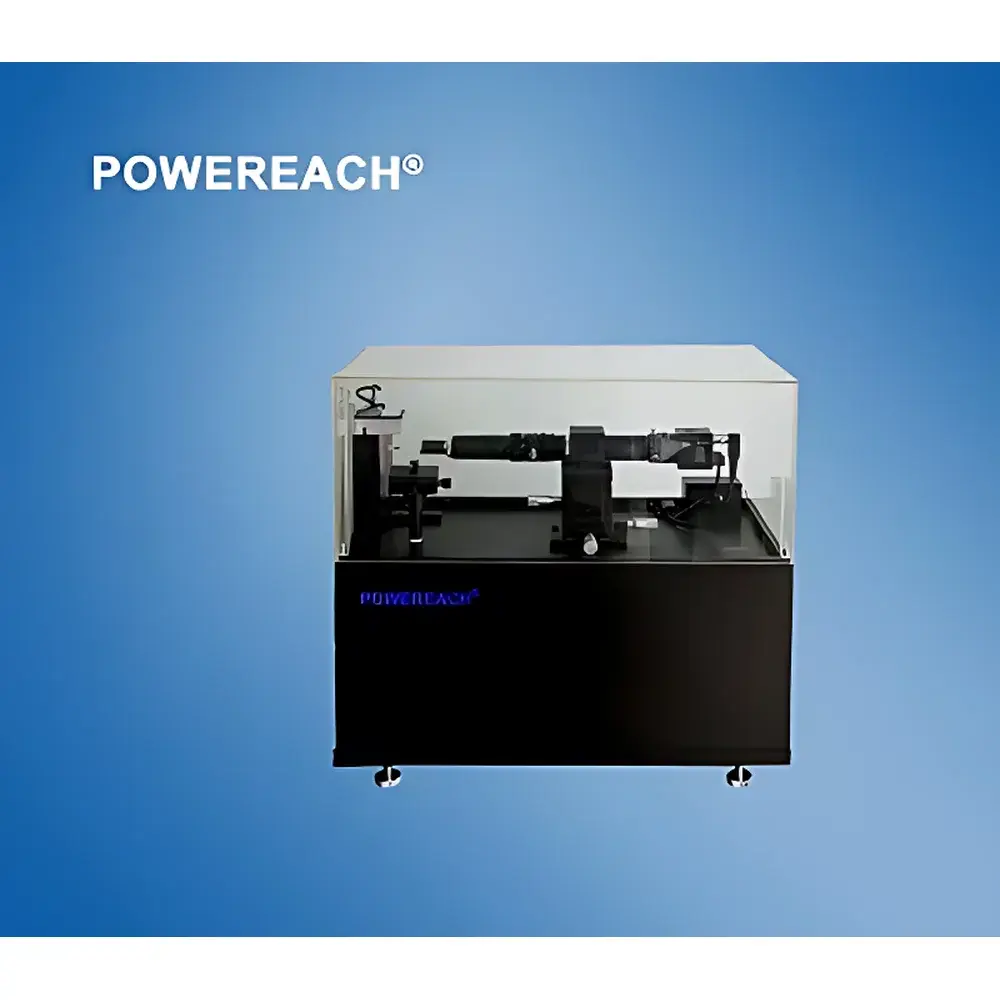
JQN04C Nanofiber Tensile Tester
| Origin | Shanghai, China |
|---|---|
| Manufacturer Type | Authorized Distributor |
| Origin Category | Domestic (China-made) |
| Model | JQN04C |
| Price Range | USD 7,000 – 14,000 |
Overview
The JQN04C Nanofiber Tensile Tester is a precision-engineered mechanical characterization system designed specifically for the quasi-static uniaxial tensile and compressive testing of individual micro- to sub-micron-scale fibers—including electrospun nanofibers, polymer nanocomposites, regenerated cellulose filaments, and elastic biopolymer fibers. It operates on the fundamental principle of force-displacement transduction via high-resolution load cell and linear actuation, enabling direct acquisition of stress–strain behavior under controlled gauge length, strain rate, and environmental conditions. Unlike general-purpose universal testers, the JQN04C integrates fiber-specific mechanical handling protocols—such as low-force actuation (down to 1 µN resolution), sub-millimeter gauge length adjustment (1 mm minimum), and synchronized optical imaging—to address the unique challenges of handling fragile, ultra-thin specimens prone to buckling, slippage, or electrostatic adhesion. Its architecture supports ASTM D3822, ISO 5079, and GB/T 14337-compliant test configurations for single-filament tensile analysis, making it suitable for R&D laboratories, quality control departments in advanced textile manufacturing, and academic institutions engaged in nanofiber structure–property correlation studies.
Key Features
- Ultra-low-force measurement capability with ±0.001 mN force resolution and <0.5% full-scale linearity error
- Adjustable gauge length from 1 mm to 25 mm, optimized for short-length nanofiber segments and staple fibers
- Programmable crosshead speed range: 30–150 mm/min, supporting both slow creep and quasi-static rupture tests
- Integrated high-magnification optical module with 24 pixels/µm spatial resolution and real-time image capture (up to 60 fps)
- Dual-mode control: strain-controlled (constant extension rate) and stress-controlled (load-hold or creep mode) operation
- Modular夹具 interface accommodating pneumatic micro-grippers, V-groove ceramic jaws, and manual micro-tweezer fixtures for brittle or electrostatic-sensitive fibers
- Thermally stable aluminum alloy frame with vibration-damped base, minimizing environmental drift during long-duration tests
Sample Compatibility & Compliance
The JQN04C accommodates monofilaments with diameters ranging from 100 nm to 50 µm, including but not limited to polyacrylonitrile (PAN), polylactic acid (PLA), chitosan, carbon nanotube (CNT)-reinforced composites, and spider-silk mimetics. It supports standardized specimen preparation per ISO 5079 Annex A (single-filament mounting) and enables compliance with textile testing requirements outlined in ASTM D3822-22 (Tensile Properties of Single Textile Fibers) and USP (Mechanical Testing of Biomaterials). Data traceability meets GLP audit requirements through timestamped metadata embedding and user-accessible calibration logs. While not FDA 21 CFR Part 11–certified out-of-the-box, the system’s software architecture allows integration with validated electronic lab notebook (ELN) platforms for regulated environments.
Software & Data Management
The proprietary JQ-TestSuite v3.2 software provides real-time force–displacement curve visualization, automatic yield point detection, and post-test calculation of key mechanical descriptors—including initial modulus, breaking tenacity (cN/dtex), elongation at break (%), work of rupture (mJ/g), and recovery ratio after cyclic loading. All raw data are saved in .csv and .jqs binary formats with embedded instrument configuration parameters. Export options include PDF reports compliant with ISO/IEC 17025 documentation standards, and API support enables batch data ingestion into LIMS or MATLAB-based custom analysis pipelines. Audit trail functionality records operator ID, test date/time, calibration status, and parameter modifications—critical for ISO 9001 and GMP-aligned workflows.
Applications
- Quantitative evaluation of nanofiber reinforcement efficacy in hybrid nonwovens
- Correlation of electrospinning parameters (voltage, flow rate, collector distance) with mechanical robustness
- Creep and stress-relaxation profiling of thermoplastic elastomer fibers for smart textiles
- Interfacial debonding analysis in core–shell nanofibers via in situ imaging during tensile loading
- Validation of fiber surface modification strategies (e.g., plasma treatment, silanization) on tensile integrity
- Reference-standard development for ISO TC 38/WG 24 working group on nanofiber metrology
FAQ
What is the minimum measurable fiber diameter supported by the JQN04C?
The system is validated for fibers ≥100 nm in diameter when used with optional high-NA objective lenses and anti-vibration optical tables.
Can the JQN04C perform compression testing on short nanofiber bundles?
Yes—via interchangeable compression platens and force-reversal firmware mode; maximum compressive load capacity is 50 mN.
Is third-party calibration certification included with delivery?
Each unit ships with NIST-traceable calibration certificate for load cell and displacement encoder, valid for 12 months.
Does the system support automated batch testing of multiple fibers?
Not natively—but programmable macro scripting in JQ-TestSuite enables semi-automated sequential testing with manual reloading.
Are replacement grips and optical components available as spares?
Yes—standardized gripper sets (pneumatic, V-groove, manual tweezer), LED illumination modules, and objective lenses are stocked globally.




