
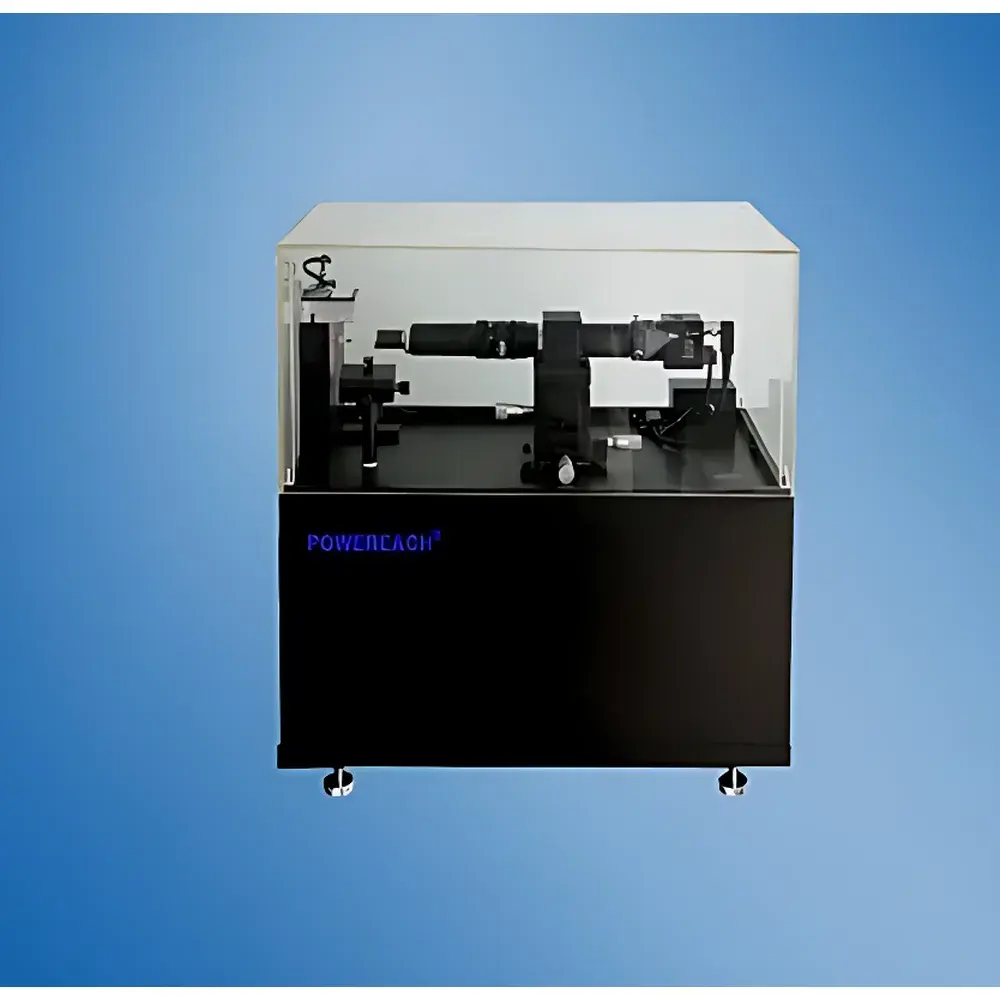
JQN04C Nanofiber Tensile Tester
| Origin | Beijing, China |
|---|---|
| Manufacturer Type | Distributor |
| Origin Category | Domestic |
| Model | JQN04C |
| Pricing | Upon Request |
Overview
The JQN04C Nanofiber Tensile Tester is a precision-engineered instrument designed for quantitative mechanical characterization of individual nanoscale and sub-micron fibers under controlled uniaxial tension. It operates on the fundamental principle of force–displacement transduction combined with high-resolution optical imaging, enabling simultaneous acquisition of mechanical response (load, elongation, modulus) and morphological evolution (fiber diameter, necking behavior, fracture morphology) during tensile deformation. Unlike macro-scale universal testing machines, the JQN04C is specifically optimized for specimens with diameters ranging from ~100 nm to several micrometers—where surface-to-volume ratio dominates mechanical behavior and conventional clamping introduces significant artifacts. Its architecture integrates a micro-force sensor (resolution: 1 µN), motorized precision stage (position resolution: 0.1 µm), continuous zoom optical system, and synchronized CCD imaging (24 pixels/µm), all coordinated via real-time control firmware. The system supports both displacement-controlled and force-controlled test modes, including constant-stress creep and constant-strain relaxation protocols—critical for evaluating time-dependent viscoelasticity in electrospun polymers, carbon nanotube assemblies, and biopolymer nanofibers.
Key Features
- High-sensitivity micro-force measurement with ≤0.001 mN resolution and calibrated linearity across multiple sensor ranges (e.g., ±5 mN, ±50 mN)
- Motorized axial stage with programmable crosshead speed (30–150 mm/min) and minimum gauge length down to 1 mm
- Optical subsystem comprising collimated LED illumination, continuous zoom lens (6.5×–45×), and monochrome CCD camera delivering 24 pixels per micrometer spatial sampling
- Real-time synchronization of force, displacement, and image streams via embedded single-board controller and USB 2.0 video capture interface
- Modular夹具 system accommodating diverse fiber geometries—including conductive, hydrophilic, and brittle nanofibers—via interchangeable micro-grippers and vacuum-assisted holders
- Fully automated test sequencing: auto-focusing, pre-tensioning, ramp-hold cycles, and post-fracture image capture
- Compliance with ISO 527-4 (plastics—determination of tensile properties of films and sheets) and ASTM D3822 (tensile properties of single textile fibers) for method traceability
Sample Compatibility & Compliance
The JQN04C accommodates single filaments, electrospun mats (isolated strands), carbon nanotube yarns, silk fibroin nanofibers, PVA/PVP nanowebs, and elastomeric polyurethane nanofibers. It is validated for specimens with diameters from 100 nm to 5 µm and lengths ≥2 mm. Environmental operation is specified at 23 ± 2 °C and 50 ± 5% RH to minimize hygroscopic drift in polymer systems. All mechanical data outputs comply with GLP documentation standards, supporting audit-ready test reports with timestamped metadata, operator ID, calibration certificate references, and raw binary data export (.csv, .tif, .tdms). Software includes electronic signature capability aligned with FDA 21 CFR Part 11 requirements for regulated laboratories.
Software & Data Management
The Windows-based control software provides intuitive GUI navigation in English, with configurable test templates (tensile, creep, cyclic loading), live stress–strain curve overlay, and automated parameter extraction—including Young’s modulus (initial slope), breaking stress (σb), breaking strain (εb), toughness (area under curve), and recovery ratio (post-unloading residual strain). Image analysis modules quantify diameter profiles along the gage length using edge-detection algorithms and report standard deviation across ≥10 measurement points. All datasets are stored in hierarchical project folders with versioned backups; raw force/displacement logs support third-party analysis in MATLAB or Python (NumPy/Pandas). Audit trail logging records every user action, parameter change, and calibration event with immutable timestamps.
Applications
- Mechanical benchmarking of electrospun scaffolds for tissue engineering (e.g., collagen–PCL blends)
- Structure–property correlation studies in stimuli-responsive nanofibers (pH-, thermo-, or photo-active systems)
- Quality control of industrial nanofiber filters (HEPA/Ulpa-grade media) under dynamic loading
- Fundamental investigation of size effects on strength and ductility in metallic glass nanowires
- Validation of finite element models for nanoscale fiber composites
- Regulatory submission support for medical device nanomaterials (ISO 10993-1, USP )
FAQ
What is the minimum measurable fiber diameter supported by the JQN04C?
The system reliably characterizes fibers with diameters as low as 100 nm, contingent upon sufficient contrast in optical imaging and stable mounting.
Can the instrument perform creep tests at constant load?
Yes—users may define hold periods at specified force levels (±0.1% setpoint stability) for durations up to 24 hours, with continuous displacement logging.
Is the software compliant with 21 CFR Part 11 for pharmaceutical labs?
Yes—electronic signatures, role-based access control, and full audit trail functionality are enabled and validated.
Are calibration certificates provided with the system?
Each unit ships with NIST-traceable calibration reports for force sensor and stage position encoder, valid for 12 months.
Does the system support third-party automation integration (e.g., LabVIEW)?
Yes—DLL-based API and TCP/IP command protocol enable integration into automated material screening platforms.



