
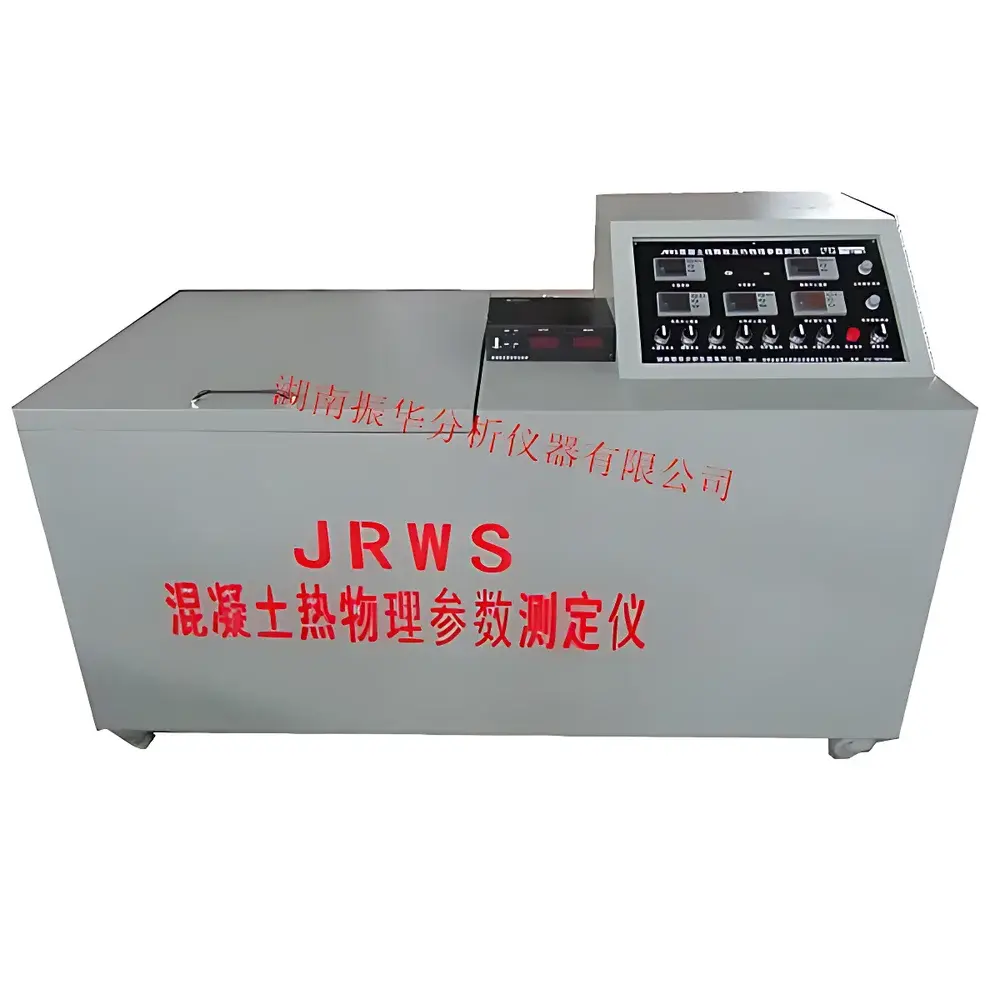
JRWS Concrete Thermal Physical Properties Analyzer
| Origin | Hunan, China |
|---|---|
| Manufacturer Type | Distributor |
| Origin Category | Domestic |
| Model | JRWS |
| Price Range | USD 7,000–14,000 |
| Instrument Type | Transient Hot Wire Method |
| Dimensions (L×W×H) | 190 × 95 × 140 mm |
| Accuracy | ±3% |
| Thermal Conductivity Range | 0.01–10 W/m·K |
| Repeatability | ±2% |
| Temperature Control Range | 5–85 °C |
| Temperature Measurement Error | ≤±0.1 °C |
| Resolution | 0.01 °C |
| Thermal Diffusivity Stability Requirement | ≤±1 °C (entire test), ≤±0.5 °C (steady-state phase) |
| Specific Heat Capacity Range | 0.5–5.0 kJ/(kg·K) |
| Specimen Geometry | Ø200 mm × 400 mm cylinder with central Ø40 mm through-hole |
| Water Bath Temp Range | 10–80 °C |
| Heating Rate | 0.5–1.0 °C/min |
| Strain Measurement | Resistance strain gauge, 250 mm gauge length, resolution 0.1 με |
| Power Supply | AC 220 V ±10%, 50–60 Hz, ≤6 kW |
Overview
The JRWS Concrete Thermal Physical Properties Analyzer is a dedicated laboratory instrument engineered for the precise, multi-parameter characterization of thermal behavior in fresh and hardened concrete. Based on the transient hot wire (THW) principle—a standardized method for measuring thermal conductivity and thermal diffusivity—the system integrates controlled water-bath temperature regulation, high-resolution thermometry, and synchronized strain monitoring to deliver concurrent measurements of thermal conductivity (λ), thermal diffusivity (α), specific heat capacity (cp), and adiabatic temperature rise. These parameters are foundational to predicting early-age thermal cracking, optimizing mass concrete pour sequencing, modeling heat transfer in dams and nuclear containment structures, and validating thermo-mechanical simulation inputs per international design codes. The analyzer complies with key national standards including JG/T 329–2011 “Test Method for Thermal Physical Parameters of Concrete”, GB/T 50081–2019 “Standard for Test Methods of Physical and Mechanical Properties of Concrete”, and SL 352–2006 “Hydraulic Concrete Test Procedures”.
Key Features
- Multi-parameter thermal testing platform supporting simultaneous determination of thermal conductivity, thermal diffusivity, specific heat capacity, and adiabatic temperature rise under controlled boundary conditions.
- High-stability water bath system with programmable temperature ramping (0.5–1.0 °C/min) and tight thermal regulation (±0.5 °C during steady-state diffusion phase).
- Integrated resistance strain gauge system (250 mm gauge length, 0.1 με resolution) for concurrent measurement of autogenous deformation and linear expansion coefficients during thermal cycling.
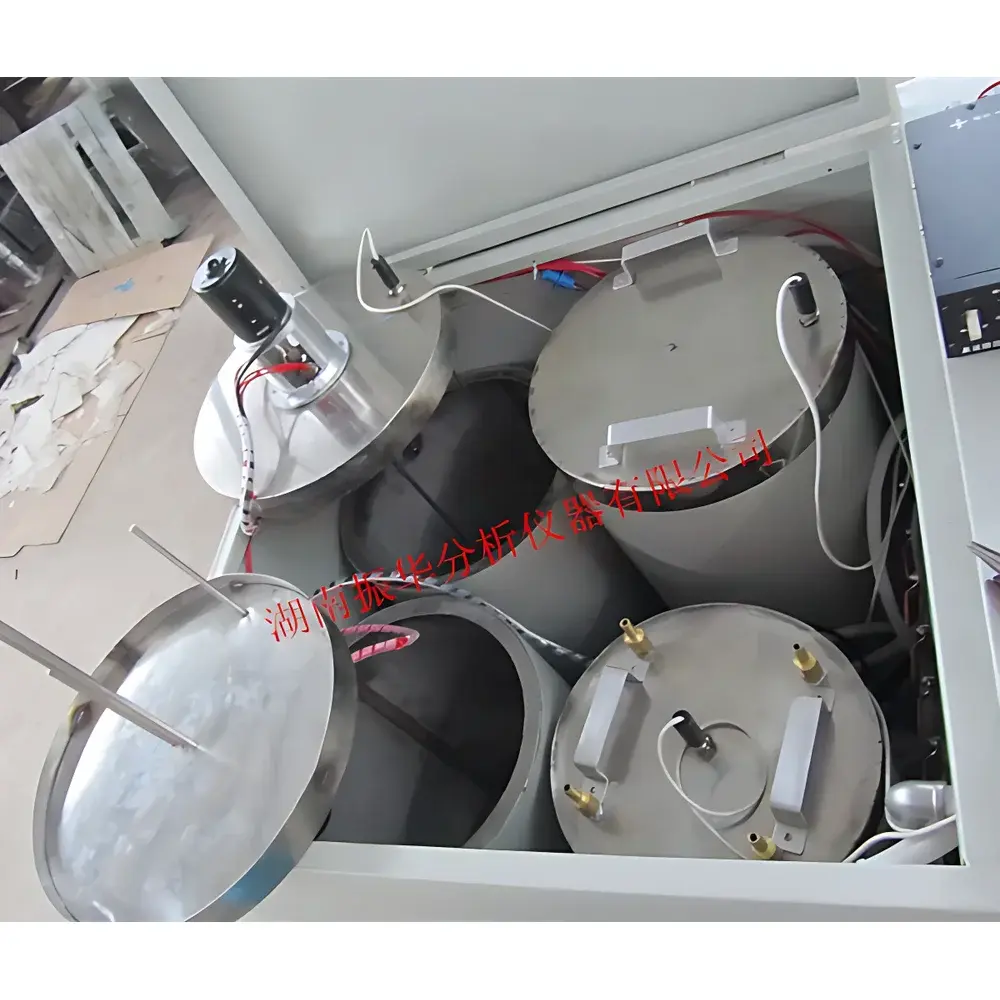
- Dual-mode specimen configuration: cylindrical molds (Ø200 mm × 400 mm) with standardized central bore geometries—Ø40 mm through-hole for thermal conductivity tests and Ø10 mm × 200 mm recessed hole for thermal diffusivity via hot-wire insertion.
- Embedded precision thermometry with ±0.1 °C absolute error and 0.01 °C digital resolution across the full 5–85 °C operating range.
- Modular hardware architecture comprising main test unit, dedicated control cabinet, and industrial-grade power supply (AC 220 V ±10%, 50–60 Hz, ≤6 kW).
Sample Compatibility & Compliance
The JRWS analyzer accommodates standard cylindrical concrete specimens per ASTM C109/C39 and ISO 1920-2 geometry requirements. Specimens are cast into reusable white-iron molds (Ø200 mm × 500 mm with lid) or sealed stainless-steel test cylinders (Ø200 mm × 400 mm). The system supports both low-conductivity insulating concretes (e.g., aerated or lightweight aggregates, λ ≈ 0.01–0.3 W/m·K) and high-density structural mixes (λ up to 10 W/m·K). All test protocols align with regulatory frameworks applicable to infrastructure QA/QC: JG/T 329–2011 mandates traceable calibration against NIST-traceable reference materials; GB/T 50081–2019 requires documented environmental control logs and operator verification signatures; SL 352–2006 specifies minimum data sampling intervals (≤30 s) and thermal homogeneity thresholds across the specimen cross-section.
Software & Data Management
The included automated test software provides real-time acquisition, visualization, and post-processing of thermal and deformation time-series data. It supports configurable test sequences—including stepwise isothermal holds, linear ramps, and adiabatic simulations—and exports timestamped CSV/Excel files compliant with GLP documentation requirements. Audit trails record user login events, parameter modifications, calibration updates, and raw sensor outputs. Exported datasets include calculated thermal parameters with propagated uncertainty estimates based on input tolerances (±3% for λ, ±2% repeatability). Software output formats are compatible with third-party finite element pre-processors (e.g., ANSYS APDL, COMSOL MPH) and statistical analysis platforms (MATLAB, Python Pandas).
Applications
- Thermal modeling of mass concrete placements in gravity dams, lock chambers, and nuclear reactor basements.
- Validation of supplementary cementitious material (SCM) effects on hydration heat evolution and thermal restraint profiles.
- Quality assurance testing for precast concrete elements requiring controlled thermal gradients during steam curing.
- Research into alkali-silica reaction (ASR) mitigation strategies where thermal expansion mismatch drives microcracking.
- Calibration of numerical models used in ISO 2394-compliant service-life prediction of bridge decks and marine structures.
- Support for EN 1992-1-1 Annex B and ACI 207R-19 recommendations on thermal stress assessment in restrained members.
FAQ
What thermal measurement principles does the JRWS analyzer implement?
It applies the transient hot wire (THW) method per ISO 22007-1 for thermal conductivity and thermal diffusivity, combined with calorimetric integration for specific heat capacity and adiabatic temperature rise profiling.
Does the system support automated calibration verification?
Yes—software-guided calibration routines use certified reference materials (e.g., glycerol, ethanol, and stainless steel standards) with predefined thermal property tables; results are logged with pass/fail flags against JG/T 329–2011 tolerance limits.
Can test data be exported for regulatory submission?
All reports include instrument ID, operator ID, calibration dates, environmental logs, raw sensor traces, and uncertainty budgets—fully traceable for FDA 21 CFR Part 11–aligned audit readiness when deployed in GMP-certified construction materials labs.
Is the water bath system compatible with long-duration adiabatic tests (>72 h)?
Yes—the insulated bath maintains ±1 °C stability over 96-hour cycles without manual intervention, verified via independent PT100 validation probes mounted adjacent to the specimen.
What specimen preparation standards does the analyzer enforce?
Specimens must conform to GB/T 50081–2019 mold dimensions and curing protocols; air void content is measured separately per ASTM C173 prior to thermal testing to ensure representative bulk density assumptions in α and λ calculations.



