
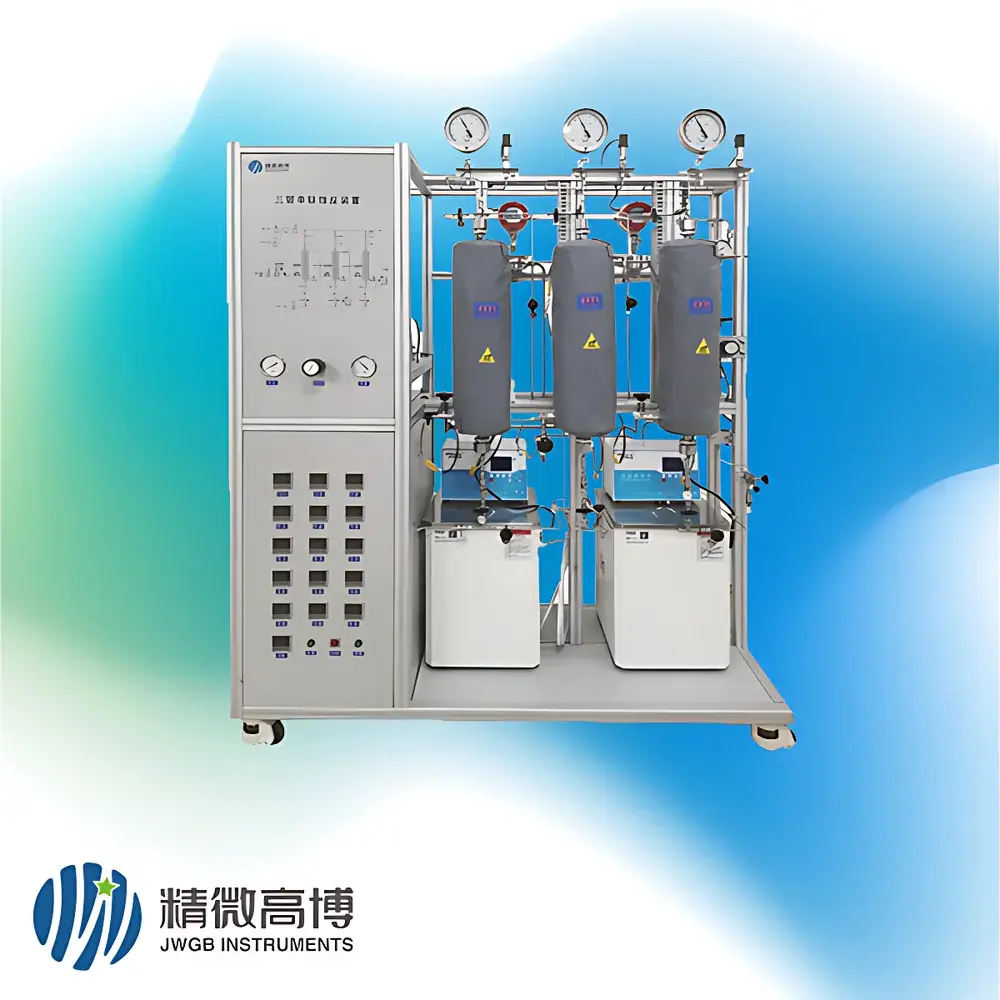
JWGB BenchCAT Custom Adsorption Breakthrough Reactor
| Brand | JWGB |
|---|---|
| Origin | Beijing, China |
| Manufacturer | JWGB Instrument Co., Ltd. |
| Type | Adsorption Breakthrough Experimental Setup |
| Reactor Type | Tubular Fixed-Bed Reactor |
| Volume Class | Small-Scale |
| Operating Pressure | High-Pressure |
| Customization | OEM/ODM Available |
Overview
The JWGB BenchCAT Custom Adsorption Breakthrough Reactor is a precision-engineered, bench-scale fixed-bed catalytic reactor system designed for quantitative dynamic adsorption studies—including breakthrough curve analysis, saturation capacity determination, mass transfer zone characterization, and cyclic adsorption-desorption performance evaluation. Built upon the foundational architecture of the AMI Instruments BenchCAT platform and manufactured under strict quality control by JWGB Instrument Co., Ltd. in Beijing, this system integrates high-pressure thermal management, gas-phase flow precision, and modular instrumentation to support rigorous kinetic and thermodynamic modeling of adsorbent materials (e.g., zeolites, activated carbons, MOFs, silica gels) under industrially relevant conditions. Its core measurement principle relies on real-time concentration monitoring—typically via integrated thermal conductivity detectors (TCD), infrared (IR) sensors, or optional mass spectrometry coupling—to track effluent composition as a function of time during continuous feed exposure.
Key Features
- Modular tubular fixed-bed reactor design with interchangeable stainless-steel or Inconel reaction tubes (ID: 6–25 mm, length up to 300 mm), rated for operation up to 10 MPa (100 bar) and 800 °C.
- Precision mass flow controllers (MFCs) for up to four independent gas streams (e.g., N₂, He, CO₂, H₂O vapor, VOC surrogates), each calibrated to ±0.8% full scale with digital RS485/Modbus output.
- Integrated temperature control via dual-zone furnace (±1 °C stability) with independently programmable heating/cooling ramps (0.1–20 °C/min).
- High-pressure back-pressure regulator (BPR) with active pressure feedback loop, enabling stable upstream pressure maintenance across variable flow rates and phase transitions.
- Standardized 1/4″ VCR fittings and ASME B16.5 flanged interfaces for seamless integration with external analyzers (GC, FTIR, QMS) or sampling loops.
- OEM/ODM flexibility: custom reactor geometry, thermocouple placement, catalyst bed support structures, and sensor port configurations per user-defined experimental protocols.
Sample Compatibility & Compliance
The BenchCAT Adsorption Breakthrough Reactor accommodates powdered, pelleted, extruded, or monolithic adsorbent samples with particle sizes ranging from 10 µm to 5 mm. Bed packing density is adjustable via calibrated settling procedures to ensure reproducible void fraction (ε = 0.35–0.45). All wetted components comply with ASTM A269 (austenitic stainless steel tubing) and ASME BPVC Section VIII Div. 1 for pressure boundary integrity. The system supports GLP-compliant operation when paired with validated data acquisition software; audit trails, electronic signatures, and instrument calibration logs meet FDA 21 CFR Part 11 requirements when implemented with appropriate IT infrastructure.
Software & Data Management
Control and data acquisition are managed through JWGB’s proprietary CatalystStudio™ software (v4.2+), a Windows-based platform supporting synchronized logging of >32 analog/digital channels at 10 Hz sample rate. Real-time visualization includes dynamic breakthrough plots (concentration vs. time), cumulative adsorbed mass calculation, and automated breakpoint detection (e.g., 5%, 50%, 95% C/C₀ thresholds). Raw data exports to CSV, HDF5, or MATLAB .mat formats; batch processing scripts enable comparative analysis across multiple runs. Software validation documentation (IQ/OQ/PQ templates) and cybersecurity configuration guidelines (firewall rules, user role permissions) are provided for regulated laboratory environments.
Applications
- CO₂ capture screening of amine-functionalized sorbents under flue gas–simulated conditions (15% CO₂, 5% O₂, balance N₂, 40–100 °C, 1–5 bar).
- Water vapor adsorption hysteresis analysis on hydrophobic mesoporous silicas for desiccant cooling cycle optimization.
- VOC removal efficiency testing of activated carbon beds exposed to ppm-level toluene or formaldehyde feeds.
- Breakthrough modeling input generation for Aspen Adsorption and gPROMS ProcessBuilder simulations.
- Accelerated aging studies of adsorbent degradation under cyclic steam purge or oxidative regeneration protocols.
FAQ
What maximum operating pressure is certified for this reactor system?
The standard configuration is ASME-certified for continuous operation up to 10 MPa (100 bar); higher-pressure variants (up to 25 MPa) are available under special engineering review.
Can the system be configured for liquid-phase breakthrough experiments?
Yes—optional high-pressure liquid delivery modules (HPLC-grade pumps, pre-saturation bubblers, and corrosion-resistant Hastelloy C-276 reactor liners) enable vapor-saturated or direct liquid feed configurations.
Is third-party analyzer integration supported?
Fully supported via analog voltage/current outputs, TTL triggers, and Ethernet-based Modbus TCP; GC, FTIR, and quadrupole mass spectrometer interfaces have been validated in multiple customer installations.
Does JWGB provide application-specific method development assistance?
Yes—application engineers offer remote or on-site protocol development, including isotherm fitting (Langmuir, Toth, Sips), mass transfer coefficient estimation (LDF, pore diffusion models), and uncertainty propagation analysis per ISO/IEC 17025 guidelines.



