
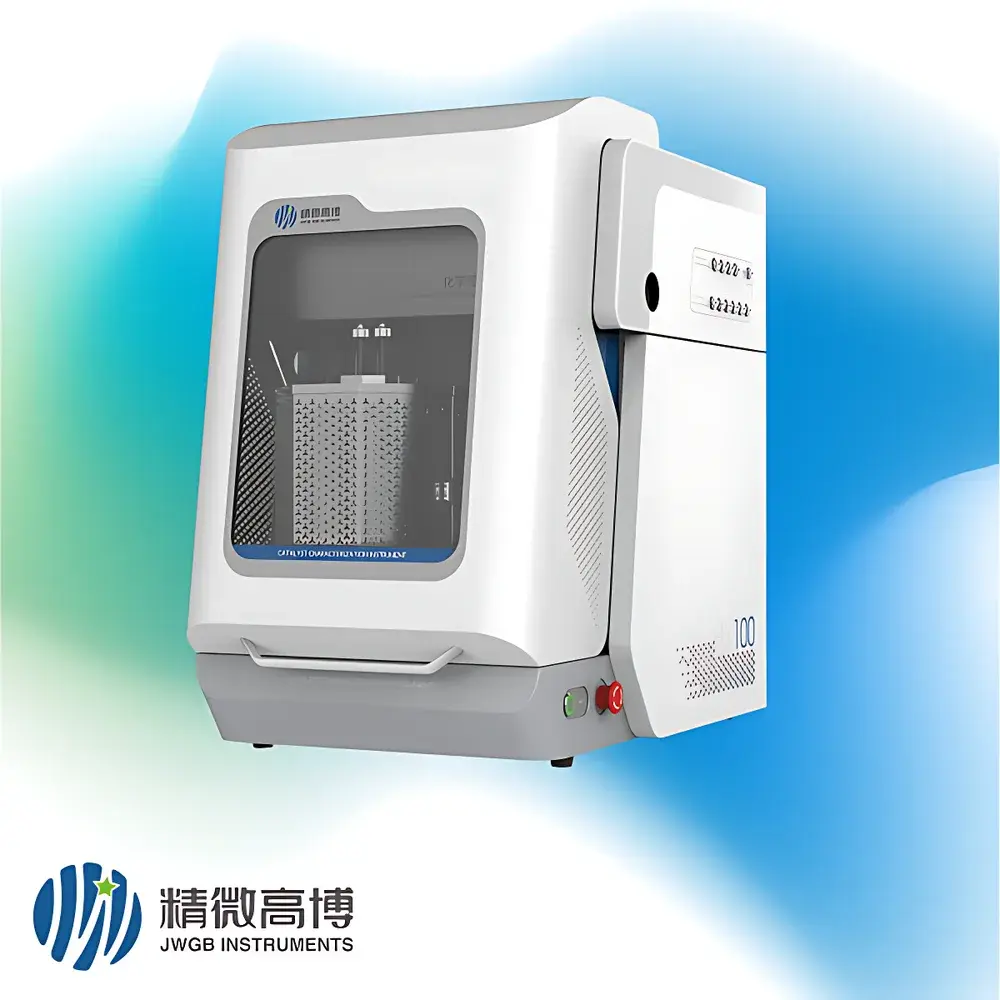
JWGB HX-100 Automated Chemisorption Analyzer
| Brand | JWGB |
|---|---|
| Origin | Beijing, China |
| Manufacturer Type | Direct Manufacturer |
| Instrument Type | Chemisorption Analyzer |
| Model | HX-100 |
| Measurement Principle | Continuous Flow Method |
| Gas Inlet Ports | Expandable to 12 |
| Heating Temperature Range | Ambient to 1200 °C |
| Isothermal Stability | ±0.01 °C |
| Ramp Rate | 1–50 °C/min |
| Pressure Range | Atmospheric to 30 bar (optional up to 100 bar) |
| Core Functions | TPR, TPO, TPD, TPSR, Pulse Chemisorption, Pulse Calibration, Dynamic BET Surface Area |
| Detector | High-Stability 4-Filament TCD (Re-W alloy, 200 °C heated) |
| Sample Tube | Quartz U-tube or bubble tube (0.1–1 g capacity) |
| Gas Flow Control | 2–100 mL/min |
| Valve & Tubing | Heated 1/16″ 316 stainless steel lines |
| Dimensions | 43 cm (W) × 64 cm (H) × 62 cm (D) |
| Optional Accessories | Cryogenic trap (–100 °C), Mass Spectrometer (MS) interface, GC integration module |
Overview
The JWGB HX-100 Automated Chemisorption Analyzer is a benchtop, continuous-flow chemisorption system engineered for rigorous catalytic surface characterization under controlled thermal and gaseous environments. It operates on the principle of temperature-programmed desorption (TPD), reduction (TPR), oxidation (TPO), and surface reaction (TPSR), enabling quantitative assessment of active site density, adsorption enthalpy, surface reactivity, and catalyst deactivation mechanisms. Designed for laboratories requiring high reproducibility without enterprise-tier capital expenditure, the HX-100 integrates precision thermal control (±0.01 °C isothermal stability), modular gas routing (expandable to 12 independent inlet streams), and real-time detection via a thermally stabilized 4-filament TCD detector. Its architecture supports both static pulse titration and dynamic flow-through analysis—making it suitable for academic research, industrial QC labs, and catalyst development workflows where trace-level quantification of chemisorbed species (e.g., H₂, CO, NH₃, O₂) is essential.
Key Features
- Thermal management system with programmable ramp rates from 1 to 50 °C/min and maximum operating temperature of 1200 °C—certified for extended high-temperature stability under inert, reducing, and oxidizing atmospheres.
- Heated gas manifold: All critical valves, fittings, and 1/16″ 316 stainless steel tubing housed within a thermostatically controlled enclosure (up to 200 °C) to prevent condensation and minimize dead volume.
- Dual-stage sample handling: Removable clamshell furnace enables rapid sample loading/unloading; quartz U-tube or bubble-type reactors accommodate 0.1–1 g of powdered, pelletized, or supported catalysts.
- Zero-station calibration port ensures precise pulse injection without sample contact—critical for accurate active metal dispersion and stoichiometric factor determination.
- Integrated cryo-trap downstream of the reactor (–100 °C optional) removes condensable vapors prior to TCD detection, enhancing signal fidelity during water- or hydrocarbon-containing experiments.
- Modular software architecture with preconfigured treatment sequences: “Treatments” (pre-conditioning), “TPD”, “Pulse”, and “Dynamic BET” modules allow users to construct multi-step protocols with up to 99 temperature/flow/pressure segments—fully scriptable and exportable per GLP audit requirements.
Sample Compatibility & Compliance
The HX-100 accommodates heterogeneous catalysts across diverse material classes—including transition metal oxides (e.g., Co₃O₄, Fe₂O₃), supported noble metals (Pt/Al₂O₃, Pd/C), zeolites, MOFs, and sulfided catalysts. Sample forms include powders, extrudates, monoliths (with custom holders), and thin films (via micro-reactor adaptation). The system complies with ASTM D7213 (BET surface area), ISO 18852 (chemisorption-based metal dispersion), and USP (residual metal quantification in pharmaceutical excipients). Full electronic records—including method parameters, raw chromatograms, calibration logs, and user annotations—are timestamped and password-protected, supporting 21 CFR Part 11 compliance when paired with validated software configuration and audit trail activation.
Software & Data Management
JWGB ChemiSoft v4.2 provides native support for real-time TCD voltage acquisition, baseline correction, peak integration (Gaussian/Lorentzian deconvolution), and kinetic modeling (e.g., Redhead plot analysis, Arrhenius fitting). All data files are stored in vendor-neutral HDF5 format with embedded metadata (instrument ID, operator, date/time, gas composition, pressure setpoints). Batch processing tools enable comparative analysis across multiple samples—exporting to CSV, Excel, or MATLAB-compatible structures. Software validation documentation (IQ/OQ/PQ templates), electronic signature workflows, and role-based access control (admin, analyst, reviewer) are available upon request for regulated environments.
Applications
- Quantification of hydrogen spillover and metal-support interaction strength in bifunctional reforming catalysts.
- Determination of acid site distribution and strength in solid Brønsted/Lewis catalysts using NH₃-TPD.
- Assessment of oxygen mobility and reducibility in perovskite-type oxidation catalysts via O₂-TPD and H₂-TPR.
- In-situ monitoring of coke formation and regeneration kinetics during cyclic TPO–TPD experiments.
- Active phase dispersion calculation for Pt, Ni, Ru, and Cu catalysts using CO or H₂ pulse chemisorption with stoichiometric ratios validated per IUPAC recommendations.
- Dynamic surface area tracking during thermal aging or sulfur poisoning studies using sequential N₂ physisorption and CO chemisorption cycles.
FAQ
What gases are compatible with the HX-100 system?
The instrument supports H₂, CO, O₂, NH₃, NO, SO₂, CH₄, C₃H₆, Ar, He, and N₂—provided appropriate gas purification (e.g., oxygen/moisture traps) and pressure-rated components are selected.
Can the HX-100 be integrated with mass spectrometry or GC detection?
Yes—standard MS and GC interfaces are available as factory-installed options, enabling evolved gas analysis (EGA) and speciated product identification during TPSR or transient response experiments.
Is remote operation and data monitoring supported?
The system includes Ethernet connectivity and optional VNC-enabled remote desktop access; all acquisition and analysis functions operate identically whether locally or remotely.
How is calibration traceability maintained?
Each unit ships with NIST-traceable TCD linearity verification report and certified volumetric pulse loop calibration certificate; annual recalibration services include full sensor drift assessment and thermal profile mapping.
Does the software support automated reporting for regulatory submissions?
Yes—customizable report templates generate PDF/HTML outputs containing raw data plots, summary tables, statistical uncertainty estimates (±2σ), and digital signatures compliant with ALCOA+ principles.



