
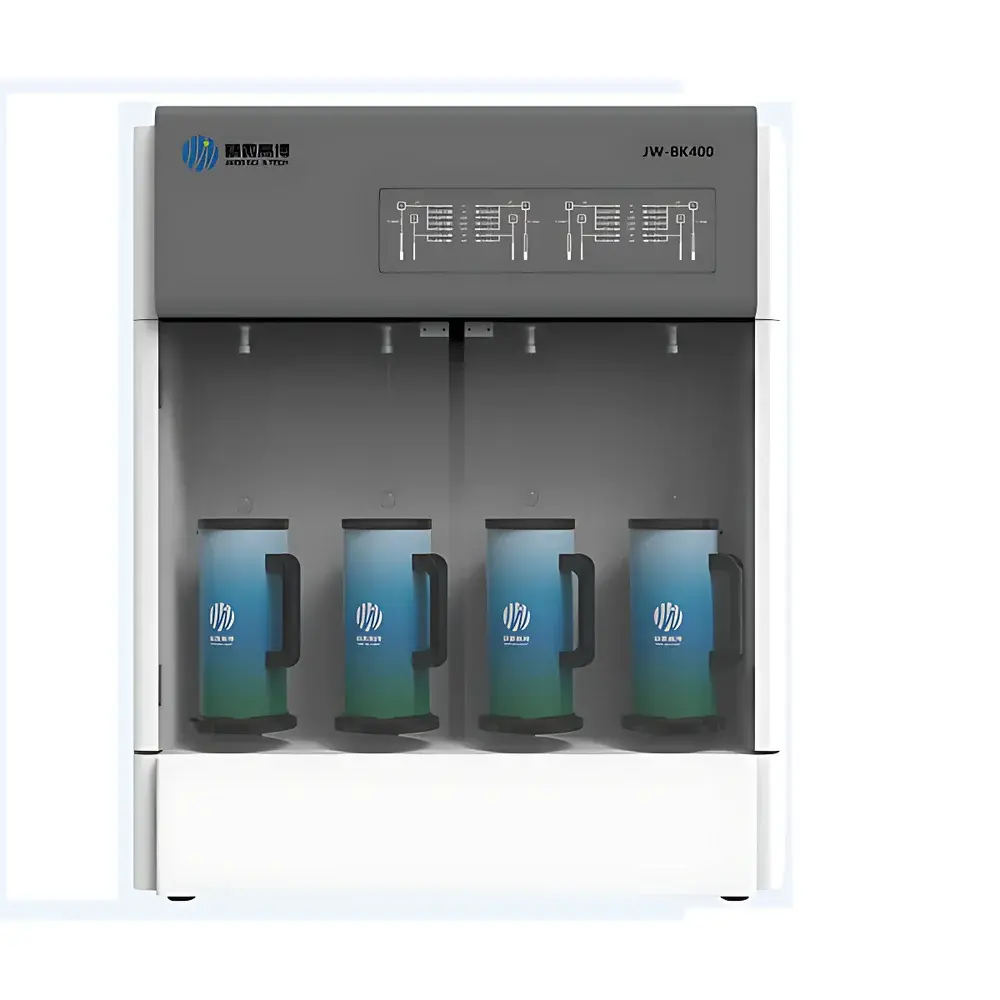
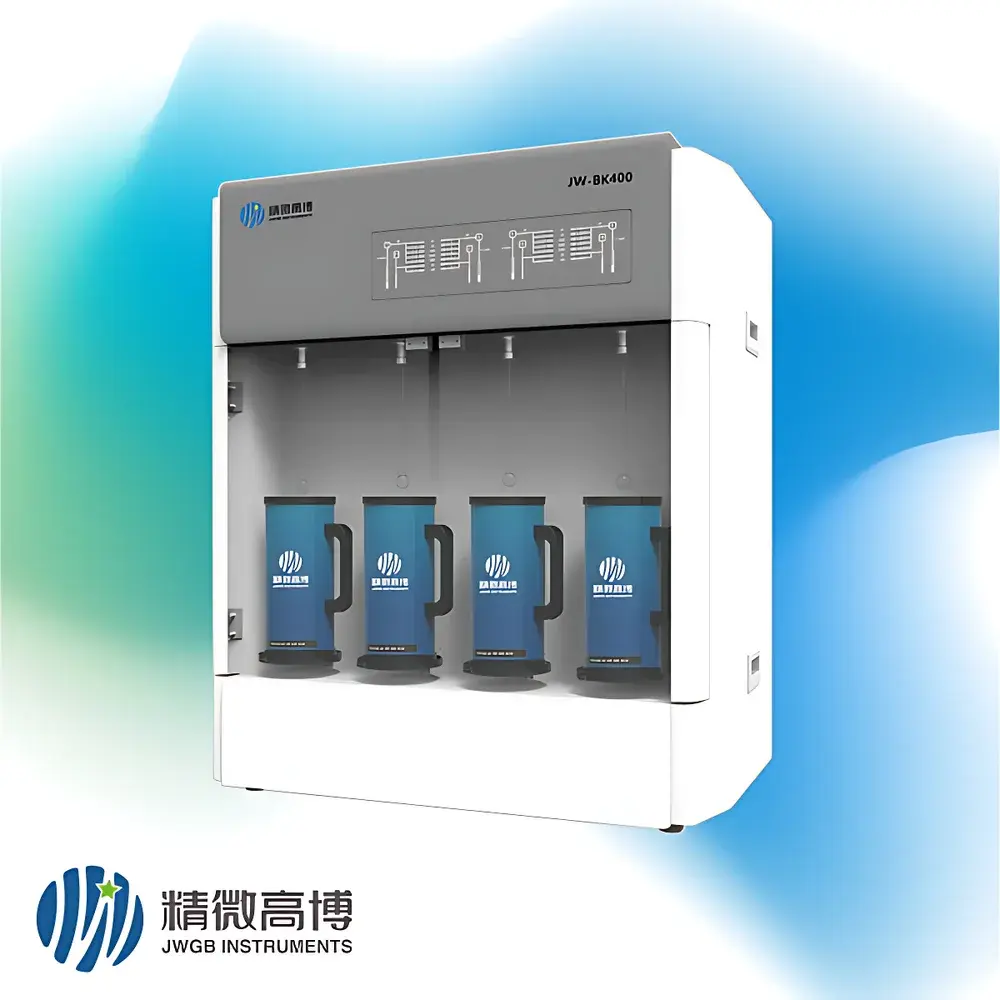
JWGB JW-BK400 Quad-Station Specific Surface Area and Pore Size Analyzer
| Brand | JWGB |
|---|---|
| Origin | Beijing, China |
| Manufacturer Type | Direct Manufacturer |
| Instrument Type | Specific Surface Area and Pore Size Analyzer |
| Model | JW-BK400 Quad-Station Specific Surface Area and Pore Size Analyzer |
| Principle | Static Volumetric Gas Adsorption Method |
| Number of Analysis Stations | 4 independent stations |
| Specific Surface Area Range | 0.005 m²/g to unlimited |
| Relative Pressure Range | P/P₀ = 10⁻⁴ to 0.99 |
| Theoretical Basis | Gas Adsorption Theory, Static Volumetric Method |
| Repeatability | ≤ ±1.5% for surface area |
| Average Analysis Time per Sample | ~10 min (BET single-point) |
| Degassing Temperature Range | Ambient to 400 °C (±1 °C accuracy) |
| Pressure Transducers | 4 imported sensors, accuracy ≤ ±0.15% FS |
| Vacuum System | Stainless-steel multi-port parallel manifold with micro-adjustable vacuum speed control (2–200 mL/s) |
| Ultimate Vacuum | 10⁻² Pa |
| Data Acquisition | Ethernet-based, Windows 7/XP (32/64-bit) compatible |
Overview
The JWGB JW-BK400 Quad-Station Specific Surface Area and Pore Size Analyzer is an engineered solution for high-throughput, precision characterization of porous and powdered materials using the static volumetric gas adsorption method. Based on the Brunauer–Emmett–Teller (BET) theory and complementary models including Langmuir, t-plot, and single-point total pore volume estimation, the instrument quantifies specific surface area (SSA), micropore/mesopore distribution, and cumulative pore volume via controlled nitrogen (or alternative adsorbate gas) uptake at cryogenic temperatures. Its quadruple independent analysis architecture enables concurrent sample conditioning and measurement—eliminating sequential bottlenecks inherent in single- or dual-station systems—while maintaining strict thermodynamic equilibrium conditions through intelligent pressure balancing and liquid nitrogen level stabilization. Designed for laboratories requiring GLP-aligned reproducibility and regulatory traceability, the JW-BK400 supports method validation under ISO 9277, ASTM D3663, and IUPAC guidelines for physisorption analysis.
Key Features
- Four fully autonomous analysis stations with individual vacuum manifolds, pressure transducers, and thermal control loops—enabling simultaneous degassing and adsorption measurement without cross-talk or interference.
- Integrated in-situ degassing module: four independent heating jackets (0–400 °C, ±1 °C), programmable 10-step temperature ramps, and real-time temperature logging compliant with 21 CFR Part 11 audit trail requirements.
- Patented stainless-steel multi-port vacuum system with digitally adjustable pumping speed (2–200 mL/s), enabling optimized evacuation profiles for fragile or ultrafine powders and minimizing particle entrainment.
- High-fidelity pressure sensing: four calibrated, temperature-compensated absolute pressure transducers (range: 0–133 kPa), each with ≤ ±0.15% full-scale accuracy and sub-0.1 kPa pressure resolution during equilibrium detection.
- Liquid nitrogen management system featuring large-capacity double-walled Dewar flasks (72-hour operational endurance), automated liquid level compensation, and thermal gradient mitigation algorithms to ensure stable isotherm acquisition across all stations.
- Modular vacuum pump configuration: dedicated mechanical pump for degassing; optional turbomolecular pump upgrade for ultra-high vacuum applications (<10⁻⁵ Pa) required for low-pressure micropore analysis.
Sample Compatibility & Compliance
The JW-BK400 accommodates a broad spectrum of solid-phase materials—including battery cathode/anode powders (e.g., LiCoO₂, graphite), catalysts (V₂O₅/WO₃/TiO₂), metal oxides (SiO₂, Al₂O₃, ZrO₂), carbon-based sorbents (activated carbon, CNTs), pharmaceutical excipients, and geological samples (shale, coal, zeolites). All sample holders are constructed from borosilicate glass or electropolished stainless steel to prevent catalytic surface reactions or metal ion leaching. The system complies with ISO/IEC 17025 calibration traceability protocols and supports IQ/OQ documentation packages. Optional GMP-compliant software modules provide electronic signatures, user access tiers, and change-controlled method templates aligned with FDA 21 CFR Part 11 and EU Annex 11 requirements.
Software & Data Management
Control and analysis are executed via JWGB’s proprietary BETware™ v5.2 platform—a Windows-native application supporting Ethernet-based multi-instrument orchestration. The interface implements guided workflow navigation, real-time isotherm visualization, automatic equilibrium validation (based on ΔP/t thresholds), and batch report generation in PDF/XLS formats with embedded metadata (operator ID, timestamp, environmental logs). Raw data files adhere to ASTM E2892-13 binary format standards and include full sensor calibration history, vacuum decay logs, and thermal drift compensation parameters. Audit trails record all user actions—including parameter edits, calibration events, and report exports—with immutable timestamps and hash-verified integrity checks.
Applications
This analyzer serves as a core characterization tool across R&D, QC, and production environments. In battery material development, it quantifies electrode-specific surface area changes induced by sintering or coating processes—directly correlating with interfacial charge-transfer resistance. For catalyst manufacturers, it validates pore structure stability after hydrothermal aging per ISO 10012. In pharmaceutical solid-state science, it detects polymorphic transitions via surface area anomalies in milled APIs. Environmental labs apply it to assess activated carbon regeneration efficiency by tracking SSA loss after repeated adsorption cycles. Geological survey teams use it to classify shale gas storage capacity based on BET surface area and BJH-derived mesopore volume distributions.
FAQ
What adsorbate gases are supported beyond nitrogen?
Nitrogen (77 K) is standard; argon (87 K), krypton (120 K), and carbon dioxide (273 K) are validated alternatives—each requiring separate calibration and cryostat configuration.
Can the instrument perform DFT or NLDFT pore size modeling?
Yes—when upgraded with the optional PoreMaster™ advanced analysis module, it supports non-local density functional theory (NLDFT) kernel libraries for carbon, silica, and alumina frameworks.
Is remote diagnostics and software update capability available?
All units include embedded Ethernet connectivity with TLS-encrypted remote access; firmware updates and spectral library patches are delivered via JWGB’s secure customer portal.
How is cross-contamination between stations prevented during ultrafine powder analysis?
Each station features a dedicated anti-splash baffle, graded vacuum throttling, and a “stepwise evacuation” protocol that progressively isolates fine particulates before full pump-down.
Does the system support automated quality control pass/fail decision logic?
Yes—the software allows configurable acceptance criteria (e.g., %RSD 0.9995) with auto-flagging of outliers and integrated SPC charting.



