
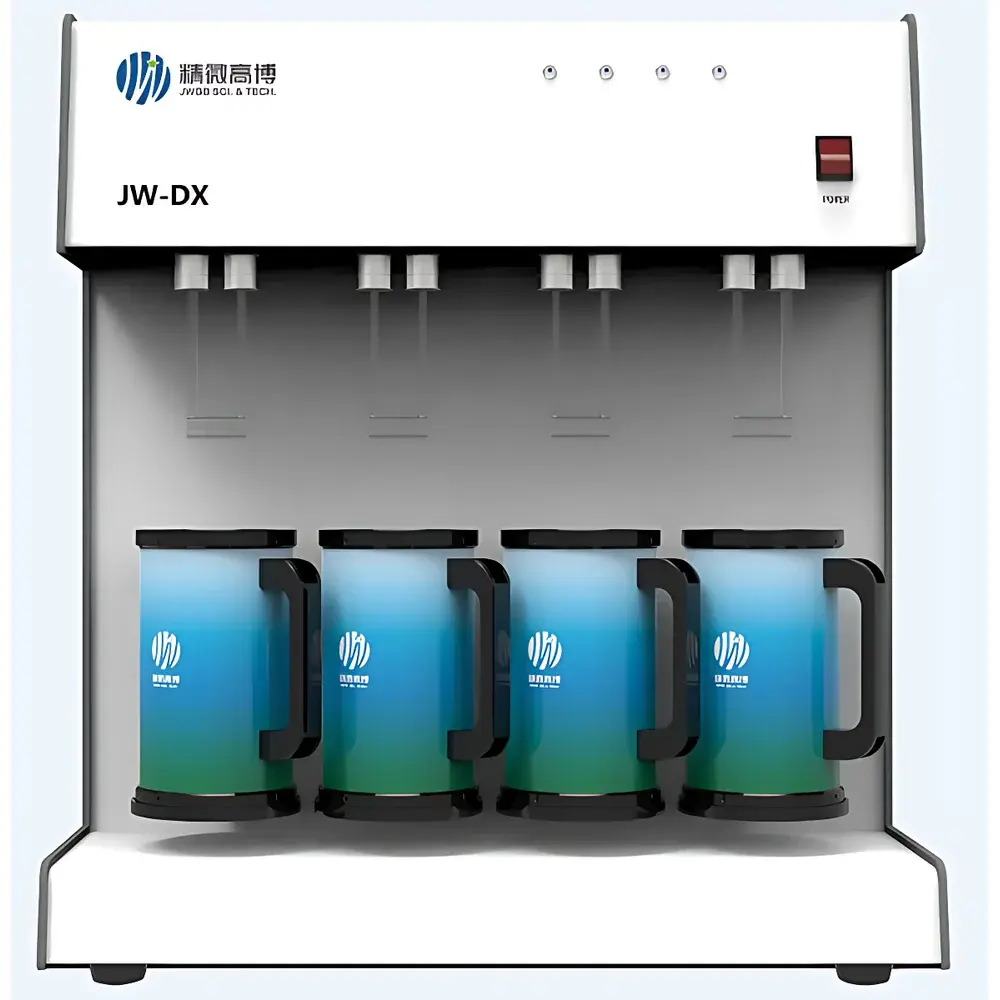
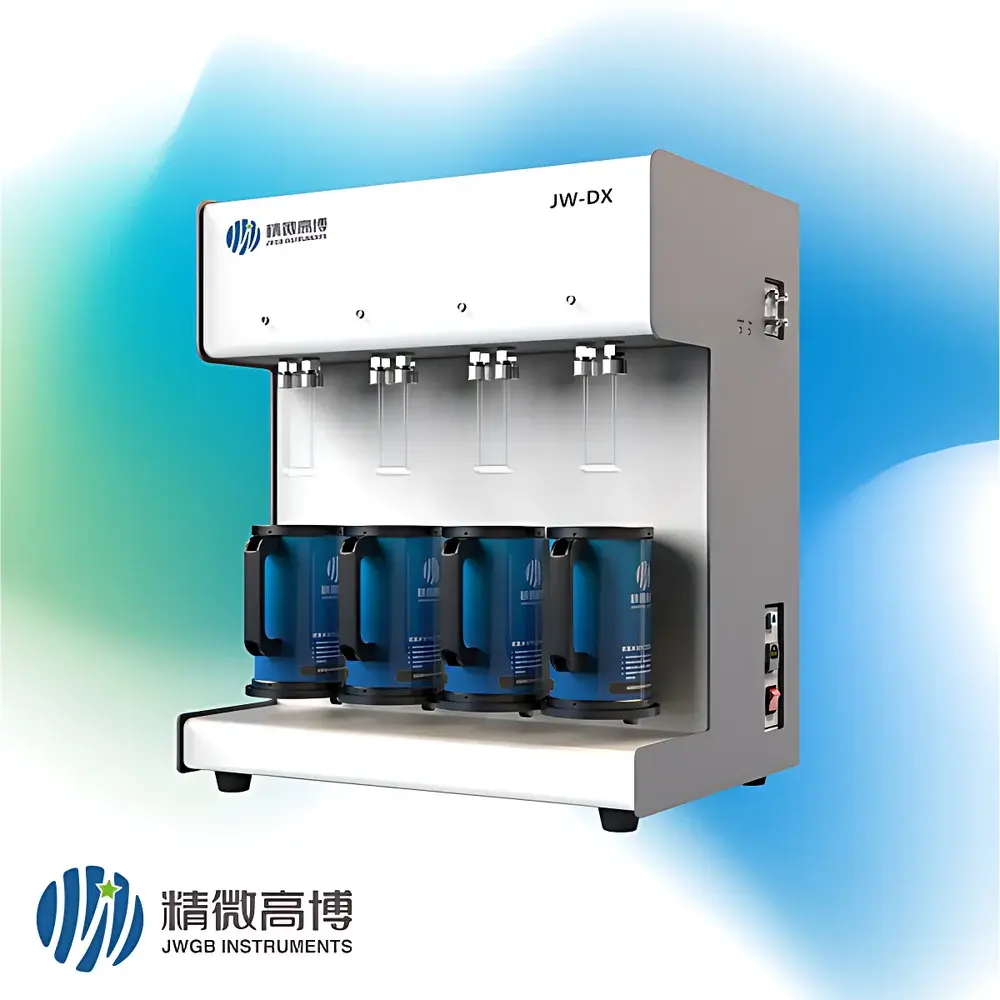
JWGB JW-DX Dynamic Specific Surface Area Analyzer
| Brand | JWGB |
|---|---|
| Origin | Beijing, China |
| Manufacturer Type | Direct Manufacturer |
| Product Category | Domestic Instrument |
| Model | JW-DX Dynamic Specific Surface Area Analyzer |
| Instrument Type | Specific Surface Area Analyzer |
| Measurement Principle | Dynamic Flow Method (Gas Chromatographic Adsorption) |
| Number of Analysis Stations | 4 |
| Specific Surface Area Range | 0.01 m²/g to unlimited |
| Relative Pressure Range (p/p₀) | 0.05–0.35 |
| Theoretical Basis | BET Multilayer Adsorption Theory |
| Carrier Gases | High-Purity N₂ (99.999%) + He (99.999%) Mixture |
| Repeatability | ≤ ±1.0% |
| Average Analysis Time per Sample | 5 min |
| Vacuum System Limit | 100 Pa |
| Degassing Temperature Range | Ambient to 400 °C ±1 °C |
| Detection Method | Constant-Temperature Thermal Conductivity Detector (TCD) |
| Data Acquisition | USB-based A/D Converter, Windows 2000/XP Compatible |
| Dimensions (Analyzer) | 610 × 360 × 690 mm |
| Weight | ~30 kg |
| Power Supply | AC 220 V ±20 V, 50/60 Hz, 300 W |
| Optional Degasser | 4-Station, Same Temp/Vacuum Specs, 400 × 300 × 550 mm, ~10 kg |
Overview
The JWGB JW-DX Dynamic Specific Surface Area Analyzer is an engineered solution for precise, high-throughput determination of specific surface area using the dynamic flow method—also known as continuous-flow gas chromatographic adsorption. Unlike static volumetric or gravimetric techniques, this instrument operates under ambient pressure and employs a constant-flow nitrogen-helium carrier gas mixture to drive physical adsorption of nitrogen onto solid surfaces at cryogenic temperature (77 K), followed by desorption at room temperature. Quantification relies on the integrated adsorption peak area detected by a thermally stabilized thermal conductivity detector (TCD), directly correlated to surface area via the Brunauer–Emmett–Teller (BET) multilayer adsorption theory. Designed specifically for materials with low surface area—such as battery electrode materials (e.g., graphite anodes, LiCoO₂ cathodes), pharmaceutical excipients, and dense ceramics—the JW-DX achieves a lower detection limit of 0.01 m²/g, one order of magnitude below conventional dynamic instruments. Its patented independent-channel architecture (Patent No. CN201410320453.2) eliminates cross-talk between analysis stations, ensuring intrinsic reproducibility without reliance on reference standards.
Key Features
- Four fully independent analysis stations, each equipped with dedicated TCD detection path, pneumatic actuation, and autonomous lift mechanism—enabling true parallel measurement without signal dilution or interference.
- Dynamic flow methodology with real-time peak integration eliminates errors associated with incomplete desorption or equilibrium lag, common in static manifold systems.
- Thermally regulated TCD system maintains detector stability over extended operation, minimizing baseline drift and enhancing long-term measurement fidelity.
- Modular, vacuum-integrated degassing module supports simultaneous pretreatment of four samples at temperatures up to 400 °C ±1 °C, with ultimate vacuum ≤100 Pa—compatible with ASTM D3663 and ISO 9277 conditioning protocols.
- Quick-connect fluidic interface ensures leak-tight, maintenance-free operation under atmospheric pressure; no high-vacuum valves or complex manifolds required.
- Embedded USB data acquisition hardware delivers high-speed, high-resolution analog-to-digital conversion synchronized with flow control and temperature monitoring.
- Compact benchtop footprint (610 × 360 × 690 mm) and low power consumption (300 W) facilitate integration into QC labs, R&D cleanrooms, and production environments.
Sample Compatibility & Compliance
The JW-DX is validated for use with non-porous and weakly microporous solids exhibiting surface areas from 0.01 m²/g to >500 m²/g. It is routinely deployed for quality control of lithium-ion battery active materials—including natural/synthetic graphite, silicon composites, NMC/NCA cathodes—and regulatory-compliant excipient characterization in pharmaceutical development. While not designed for full pore size distribution (PSD) analysis, its adherence to BET theory aligns with ISO 9277:2010 and ASTM D6567–22 for specific surface area reporting. The system supports GLP-aligned documentation through timestamped raw signal export and audit-ready calibration logs. Though not 21 CFR Part 11 certified out-of-the-box, its software architecture permits configuration for electronic signature and change control when deployed within validated IT infrastructures.
Software & Data Management
JWGB’s proprietary acquisition and analysis suite runs natively on Windows 2000/XP (32-bit) platforms and provides automated peak identification, baseline correction, and BET linear regression across user-defined p/p₀ ranges (0.05–0.35). All parameters—including flow rate, column temperature, injection timing, and integration window—are programmable and stored with each run. Raw TCD voltage vs. time traces are saved in ASCII format for third-party reprocessing. Batch reporting supports CSV and PDF export with embedded metadata (operator ID, sample ID, date/time, instrument serial number). Software updates are distributed via secure firmware loader; no cloud dependency or telemetry is implemented.
Applications
- Lithium-ion battery R&D and manufacturing: rapid screening of graphite anode oxidation state, binder-coating uniformity effects, and post-cycling surface degradation.
- Pharmaceutical solid-state characterization: quantifying surface area changes during milling, granulation, or amorphous content stabilization.
- Catalyst support evaluation: correlating surface area loss with sintering behavior under thermal aging protocols.
- Ceramic powder processing: verifying dispersion efficiency and agglomerate breakdown after jet milling or sonication.
- Quality assurance of activated carbon batches where ultra-low surface area (<10 m²/g) indicates excessive graphitization or ash content.
FAQ
What distinguishes the dynamic flow method from static volumetric BET analysis?
The dynamic method uses continuous carrier gas flow and real-time TCD detection of adsorption fronts, eliminating equilibration waiting times and reducing operator dependency. It requires no mercury manometers or calibrated volumes, making it inherently more robust for routine lab use.
Can the JW-DX perform pore size distribution analysis?
No. It is optimized exclusively for specific surface area via single-point or multi-point BET fitting. For PSD, complementary instrumentation such as a static volumetric analyzer with t-plot or BJH modeling capability is recommended.
Is helium-only purge supported for thermal conductivity baseline stabilization?
Yes. The dual-gas manifold allows pure helium flow for zero-offset calibration prior to nitrogen introduction, improving signal-to-noise ratio for low-surface-area samples.
How is system validation performed?
Users may verify performance using certified reference materials (e.g., NIST SRM 1990a silica gel) and confirm repeatability per ASTM D3663 Annex A2. Factory calibration certificates include TCD response linearity and flowmeter accuracy traceable to national standards.
Does the instrument support automated sample loading?
No. Sample introduction is manual; however, the four-position auto-lift stage minimizes handling time and ensures consistent geometry for all analyses.



