
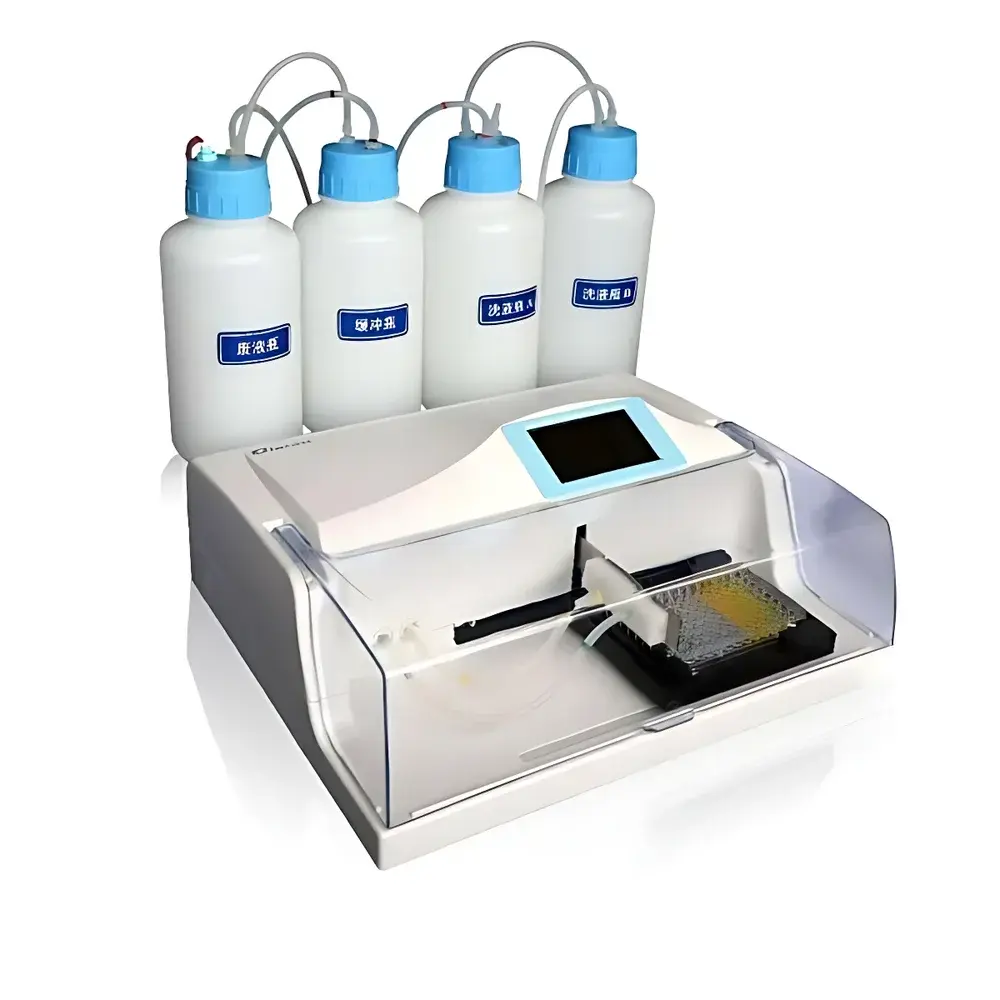
Keebio DKW330 Automated Microplate Washer
| Brand | Keebio |
|---|---|
| Model | DKW330 |
| Type | Multifunctional Plate Washer |
| Wash Head Configuration | 8- or 12-channel |
| Number of Wash Solution Channels | 1 (expandable to 3–4) |
| Soak Time Range | 0–24 h |
| Wash Cycles | 1–99 |
| Residual Volume per Well | ≤1 µL |
| Plate Agitation | Yes |
| Dimensions (W×D×H) | 446 × 368 × 164 mm |
| Weight | 12 kg |
| Liquid Dispense Volume | 50–3000 µL (10 µL increments) |
| Dispense Time | 0.1–9.9 s |
| Agitation Duration | 0–600 s |
| Programmable Protocols | >100 user-defined methods |
| Compatible Plate Formats | Flat-, U-, and V-bottom microplates |
Overview
The Keebio DKW330 Automated Microplate Washer is a precision-engineered instrument designed for high-fidelity washing of 96-well and 384-well microplates in enzyme-linked immunosorbent assay (ELISA), immunoassay, cell-based assay, and other ligand-binding workflows. It operates on the principle of controlled fluid displacement—using calibrated aspiration and dispensing cycles combined with programmable soak, agitation, and bottom-rinse sequences—to achieve consistent removal of unbound reagents while minimizing cross-contamination and well-to-well carryover. Its architecture supports reproducible plate preparation under regulated laboratory environments, making it suitable for research, quality control, and pre-clinical screening applications where wash stringency directly impacts assay sensitivity and signal-to-noise ratio.
Key Features
- Configurable wash head options: interchangeable 8-channel and 12-channel manifolds enable compatibility with standard strip-based and full-plate formats.
- Dual-point aspiration ensures uniform liquid removal across wells, reducing residual volume to ≤1 µL per well—a critical parameter for low-background ELISA and chemiluminescent assays.
- Bottom-rinse functionality delivers targeted wash solution directly beneath the well floor, dislodging adherent cellular debris or precipitated antigens that conventional top-down washing may miss.
- Adjustable wash solution pressure allows fine-tuned optimization for delicate coatings (e.g., fragile antibody layers) or viscous matrices (e.g., serum-containing samples).
- Programmable soak duration (0–24 hours) and agitation timing (0–600 seconds) support protocols requiring extended incubation or mechanical dissociation steps prior to final wash.
- Integrated tube-flushing routine activates automatically between cycles to prevent crystallization or protein buildup in fluidic pathways—enhancing long-term reliability and reducing maintenance frequency.
- Large backlit LCD touchscreen interface with intuitive icon-driven navigation simplifies protocol setup, execution monitoring, and error diagnostics without requiring external software.
Sample Compatibility & Compliance
The DKW330 accommodates flat-bottom, U-bottom, and V-bottom polystyrene and polypropylene microplates conforming to ANSI/SBS standards (e.g., ANSI SLAS-1–2017). Its fluid handling system is validated for use with common ELISA buffers (PBS, Tris-HCl), detergents (Tween-20, Triton X-100), blocking agents (BSA, casein), and enzymatic substrates. The instrument meets CE marking requirements for laboratory equipment and complies with IEC 61010-1 safety standards. While not FDA 510(k)-cleared, its operational parameters—including traceable residual volume performance and repeatable cycle timing—support alignment with GLP and GMP documentation practices when integrated into validated assay workflows.
Software & Data Management
All wash parameters—including dispense volume (50–3000 µL in 10 µL increments), dispense time (0.1–9.9 s), aspiration speed, soak duration, and rinse repetitions—are stored as editable, timestamped protocols. Over 100 user-defined methods can be saved onboard, each supporting conditional logic such as selective row/column washing or staggered cycle sequencing. The system logs operational events—including waste tank level status, residual overflow alerts, and error codes—with local non-volatile memory retention. No proprietary PC software is required; however, exportable CSV logs facilitate integration into LIMS or electronic lab notebook (ELN) platforms. Audit trail functionality satisfies basic 21 CFR Part 11 readiness when paired with institutional access controls and procedural SOPs.
Applications
- Primary and secondary antibody washing in sandwich and competitive ELISA formats.
- Cell culture plate washing prior to cytokine detection or viability staining.
- Preparation of microplates for fluorescence polarization (FP), time-resolved fluorescence (TRF), and AlphaScreen assays.
- Routine cleaning of plates used in high-throughput screening (HTS) campaigns involving recombinant proteins or small-molecule libraries.
- Removal of unincorporated nucleotides in post-PCR cleanup workflows prior to sequencing or hybridization.
- Environmental and food safety testing—including mycotoxin, pesticide residue, and pathogen antigen assays—where regulatory method validation requires strict wash consistency.
FAQ
Can the DKW330 handle both 96-well and 384-well plates?
Yes—the 8-channel head is optimized for 384-well plates (using two passes per row), while the 12-channel head supports standard 96-well configurations. Plate height adjustment is manual but covers standard ANSI-compliant plate dimensions.
Is calibration required before first use?
No factory calibration is shipped with the unit; however, users should perform volumetric verification using gravimetric or photometric methods per internal SOPs prior to assay deployment.
Does the instrument support remote monitoring or network connectivity?
The DKW330 operates as a standalone device with no built-in Ethernet or Wi-Fi interface. Protocol transfer is limited to onboard storage and touchscreen interaction.
What maintenance intervals are recommended?
Daily: Waste container emptying and tip/rinse port inspection. Quarterly: Fluidic line inspection and pressure regulator verification. Annually: Full fluid path decontamination and aspiration/dispense accuracy revalidation.
How does the bottom-rinse function improve assay performance?
By directing wash buffer upward from the well base, it disrupts surface-bound aggregates and improves removal efficiency in assays using high-protein matrices or low-binding plates—reducing false positives and inter-assay variability.




