
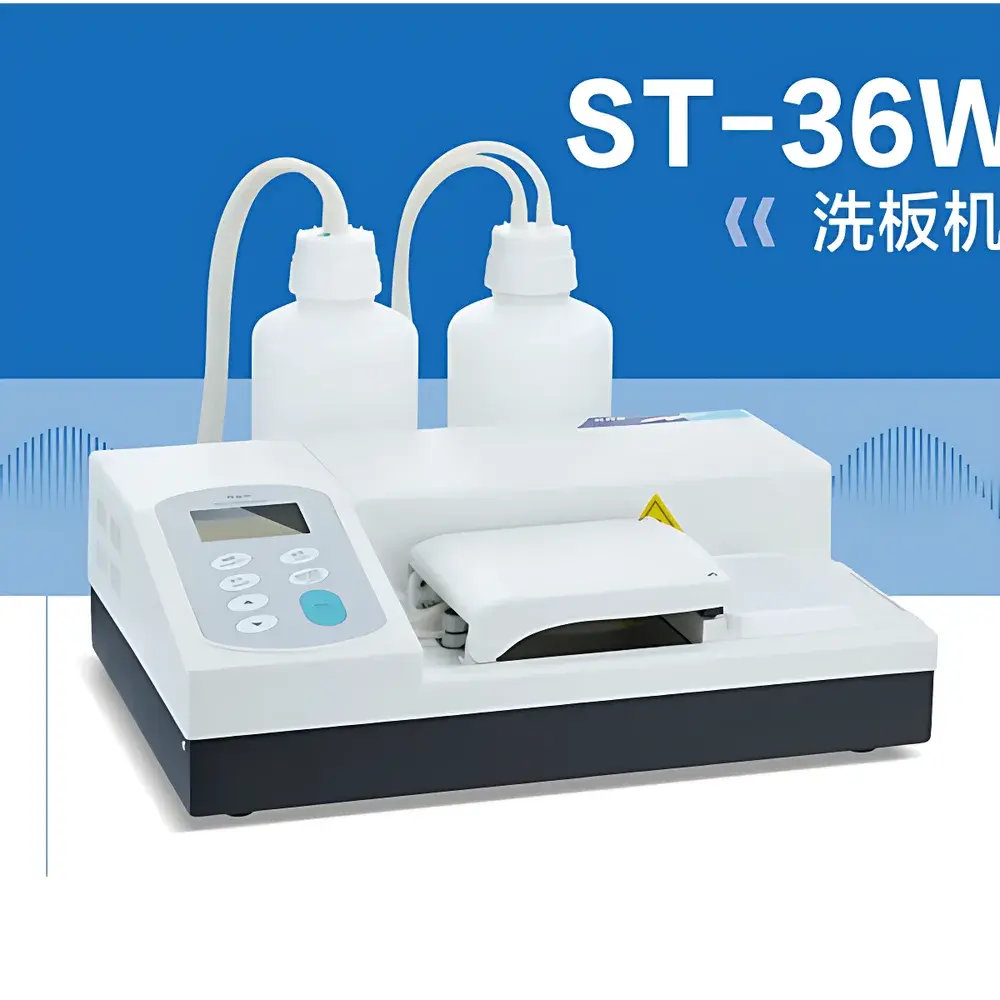
Kehua Biosciences ST-36W 96-Well Microplate Washer
| Brand | Kehua Biosciences (KHB) |
|---|---|
| Origin | Shanghai, China |
| Model | ST-36W |
| Instrument Type | Multifunctional Plate Washer |
| Wash Head Configuration | 8-channel or 12-channel |
| Wash Solution & Waste Reservoirs | 2 L each |
| Soaking Time | Programmable |
| Wash Cycles | Adjustable |
| Residual Volume per Well | ≤1 µL |
Overview
The Kehua Biosciences ST-36W is a benchtop, microprocessor-controlled 96-well plate washer engineered for reproducible, low-residual washing in ELISA, cell-based assays, and other high-throughput immunoassay workflows. It operates on a dual-pump aspiration/dispense architecture—separating wash fluid delivery and waste aspiration pathways—to minimize cross-contamination risk and prevent clogging during extended operation. The system employs positive-displacement peristaltic pumps for precise fluid handling and maintains consistent flow dynamics across all channels, ensuring uniform wash efficiency across the full plate. Designed for routine use in clinical laboratories, QC departments, and academic core facilities, the ST-36W supports U-, V-, and flat-bottom 96-well microplates without manual adapter changes, enabling rapid assay setup and walk-away operation.
Key Features
- Dual independent pump system: One dedicated peristaltic pump for wash solution delivery and another for waste aspiration—eliminating shared fluid paths and reducing carryover between cycles.
- Configurable wash head: Interchangeable 8-channel or 12-channel stainless-steel manifolds with precision-aligned nozzles ensure consistent liquid dispensing and aspiration across all wells.
- Adjustable mechanical parameters: Programmable soak time (0–10 min), wash cycle count (1–10), aspiration height (±5 mm fine adjustment), and dispense volume (50–400 µL/well in 10 µL increments).
- Intuitive local control interface: Backlit LCD display paired with tactile membrane keypad enables standalone method setup without external software or PC connection.
- Low residual volume performance: Optimized aspiration kinetics and nozzle geometry achieve ≤1 µL residual volume per well after final cycle—critical for minimizing background signal in sensitive immunoassays.
- Integrated reservoir monitoring: Visual level indicators on both 2 L wash solution and 2 L waste containers support uninterrupted operation during batch processing.
Sample Compatibility & Compliance
The ST-36W accommodates standard ANSI/SLAS-compliant 96-well microplates—including high-binding, low-binding, and streptavidin-coated formats—with automatic plate-height detection and motorized Z-axis positioning. Its fluidic design meets ISO 15197:2013 requirements for volumetric accuracy in diagnostic device support equipment. While not certified as an IVD device itself, the instrument is routinely deployed in GLP-compliant environments where traceability of wash parameters (cycle count, soak duration, dispense volume) is required for audit readiness. All wetted materials—including tubing, manifolds, and reservoir caps—are USP Class VI-certified and compatible with common ELISA wash buffers (e.g., PBS-T, Tris-Tween).
Software & Data Management
The ST-36W operates as a stand-alone instrument with onboard memory storing up to 20 preconfigured wash protocols. Each protocol retains full parameter sets—including dispense volume, soak time, cycle number, aspiration height, and wash mode (standard, gentle, or deep clean). No proprietary software is required for daily operation; however, optional RS-232 serial output allows integration into laboratory information management systems (LIMS) for timestamped log export of run metadata. Audit trail functionality is limited to on-device event logging (power-on, program execution, error codes), consistent with non-21 CFR Part 11 environments. For regulated settings requiring electronic records, users may pair the ST-36W with validated third-party data capture tools that meet ALCOA+ principles.
Applications
- ELISA and multiplex immunoassays requiring stringent removal of unbound conjugates and substrates.
- Cell-based assays involving adherent or suspension cultures where residual media components must be minimized prior to lysis or staining.
- High-throughput screening (HTS) workflows using 96-well plates for receptor binding or enzyme inhibition studies.
- Quality control testing of diagnostic reagents, including lot-to-lot verification of antibody conjugate wash stability.
- Academic research labs performing cost-sensitive, medium-volume assay development where reliability and ease of maintenance are prioritized over automated deck integration.
FAQ
Does the ST-36W support 384-well plates?
No—the ST-36W is designed exclusively for 96-well microplates conforming to ANSI/SLAS footprint standards.
Can wash parameters be exported or backed up externally?
Protocol parameters are stored only in internal non-volatile memory; no USB or network interface is provided for backup or transfer.
What maintenance is required for long-term reliability?
Monthly cleaning of wash heads and aspiration manifolds with 70% ethanol, biannual replacement of peristaltic pump tubing, and visual inspection of reservoir seals are recommended.
Is the instrument compatible with corrosive wash buffers such as acidic glycine-HCl?
Yes—wetted components are chemically resistant to pH 2–12 solutions; however, prolonged exposure to strong oxidizers (e.g., sodium hypochlorite) is not advised.
How is calibration verified?
Kehua Biosciences provides a factory-verified gravimetric test report for dispense accuracy (±3% CV at 200 µL/well) and residual volume (≤1 µL) upon shipment; no user-performed calibration is required under normal operating conditions.



