
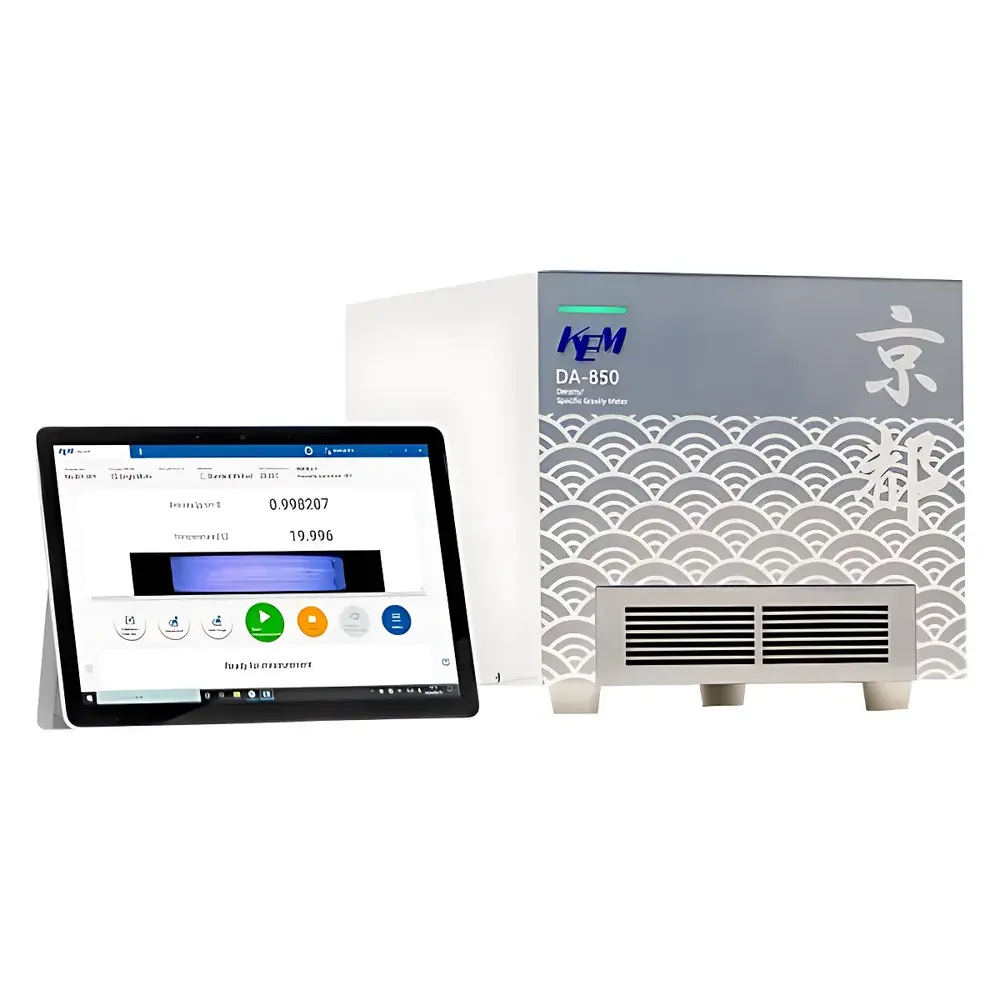
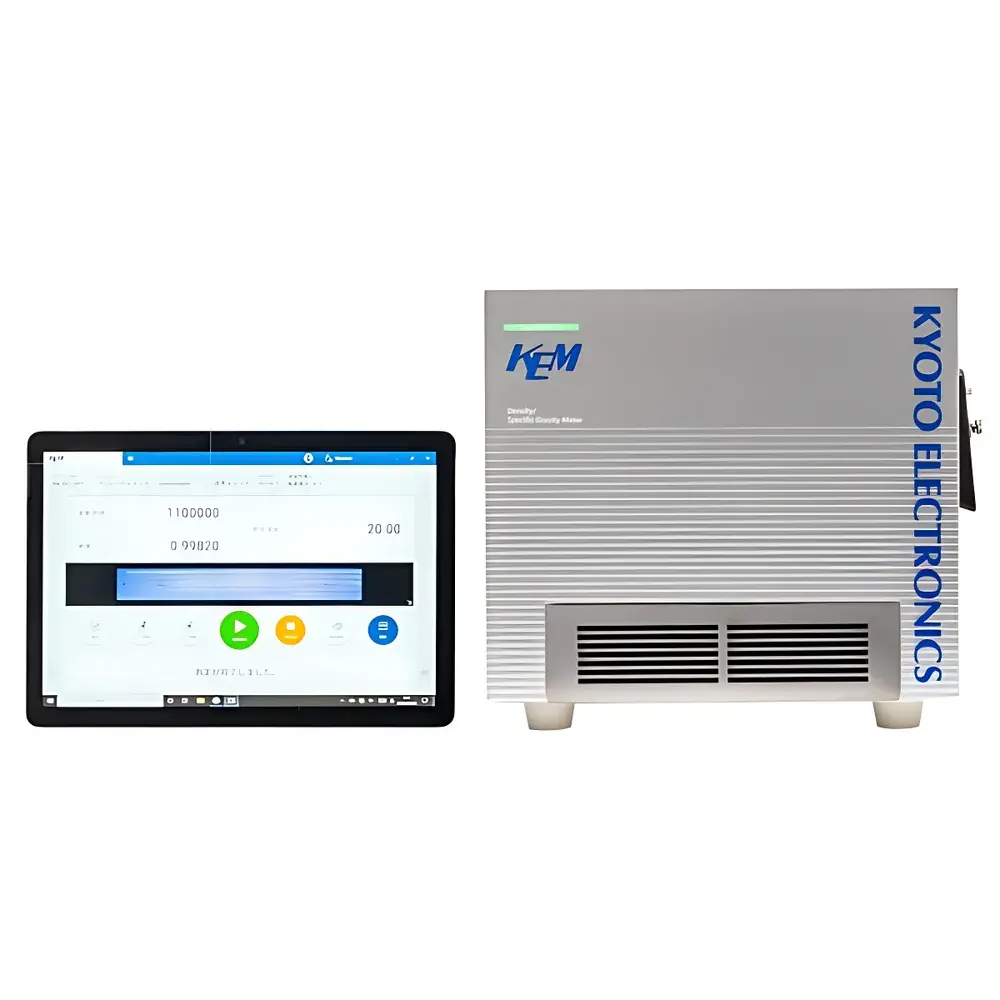
KEM DA-850 Benchtop Alcohol Meter (U-Tube Oscillating Density Meter Method)
| Brand | KEM (Kyoto Electronics Manufacturing) |
|---|---|
| Origin | Japan |
| Manufacturer | KEM |
| Product Type | Imported Instrument |
| Model | DA-850 |
| Measurement Time | 1–4 min |
| Alcohol Content Range | 0–100% v/v |
| pH Range | 0–14 |
| Dimensions (W×D×H) | 295 × 330 × 255 mm |
| Weight | 19 kg |
| Core Technology | U-Tube Oscillating Density Measurement |
| Density Accuracy | ±1 × 10⁻⁵ g/cm³ |
| Density Repeatability | ±5 × 10⁻⁶ g/cm³ |
| Temperature Control Accuracy | ±0.02 °C |
| Temperature Range | 0–100 °C (Peltier-controlled) |
| Sample Volume | ~1 mL (manual), ~2 mL (auto-pump) |
| Measurement Stabilization Time | ~10 s at target temperature |
| Compliance | GB 5009.225-2023, ISO 15212-1, OIML R 22 |
Overview
The KEM DA-850 Benchtop Alcohol Meter is a precision density-based analytical instrument engineered for the accurate and traceable determination of ethanol concentration (alcohol by volume, % v/v) in alcoholic beverages, food-grade ethanol, and fermentation broths. It operates on the internationally standardized U-tube oscillating density measurement principle—where a precisely machined borosilicate glass U-shaped resonator is filled with sample and excited into mechanical oscillation. The resonant frequency of the tube is inversely proportional to the square root of the sample’s density, enabling high-resolution density determination at user-defined temperatures (0–100 °C) with Peltier-based thermal regulation. Density values are then converted to ethanol concentration using built-in, standards-compliant calibration tables aligned with GB 5009.225-2023 (China’s national standard for ethanol determination in food) and ISO 15212-1 (determination of alcohol content in beverages). This method eliminates reliance on refractometry or distillation, delivering direct, operator-independent quantification without chemical reagents or consumables beyond standard cleaning solvents.
Key Features
- High-precision density measurement: ±1 × 10⁻⁵ g/cm³ accuracy and ±5 × 10⁻⁶ g/cm³ repeatability at 20 °C, validated against certified reference materials from NIST-traceable density standards.
- Integrated real-time imaging system: High-resolution camera mounted above the U-tube cell provides live visualization of sample injection, bubble formation, and cell filling status; images are timestamped and storable for audit trail compliance.
- Flexible control architecture: Supports operation via optional tablet interface or dedicated PC software (KEM WinCT-Density), enabling remote monitoring and integration into centralized lab informatics systems.
- Adaptive convergence algorithm: Achieves four-digit density stability within 10 seconds under thermally equilibrated conditions, significantly reducing per-sample analysis time versus conventional oscillating densitometers.
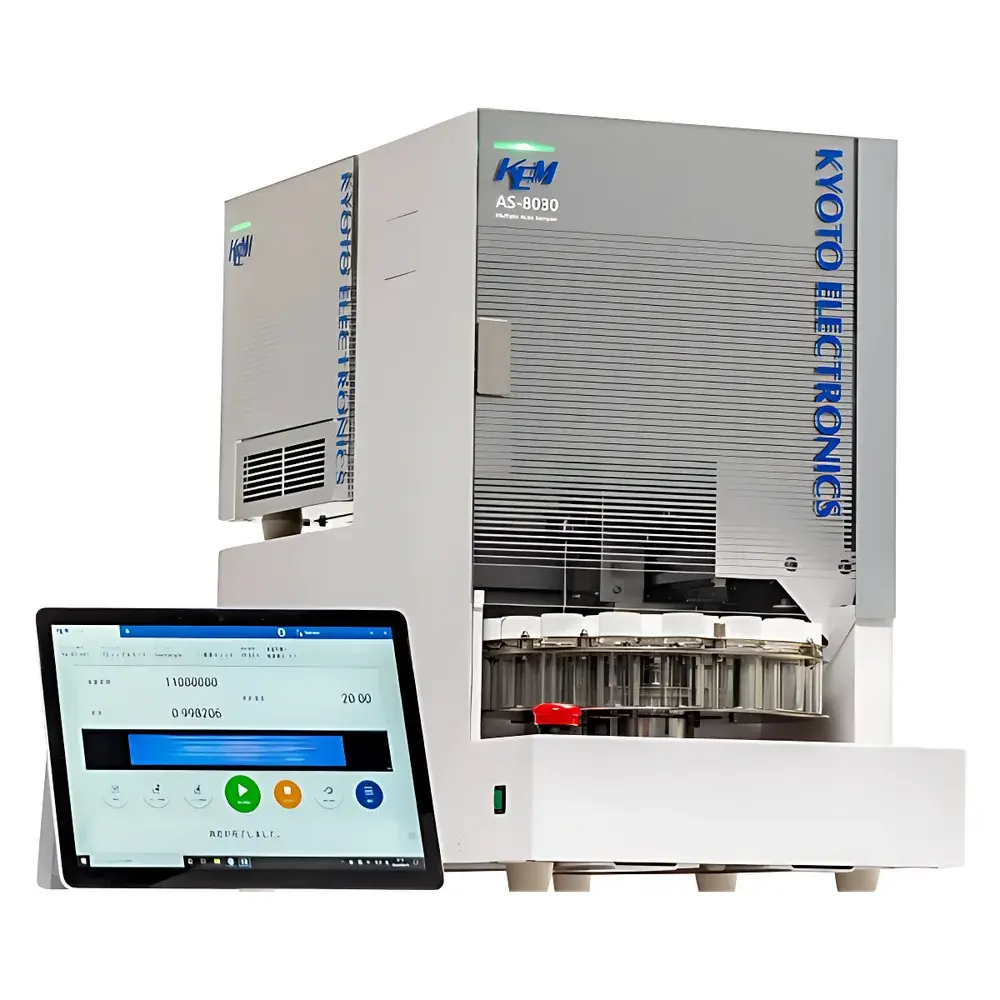
- Multi-unit network capability: A single control unit can manage up to four DA-850 measurement modules simultaneously, streamlining throughput in high-volume QC environments.
- Comprehensive fluidic automation: Fully programmable auto-sampling, measurement, waste evacuation, solvent rinsing (dual- or triple-rinse modes), and nitrogen-assisted drying—all initiated with one command.
- Intelligent diagnostics: Real-time bubble detection, automatic U-tube dryness verification, viscosity-corrected density calculation (based on dynamic viscosity input or empirical correction), and barometric pressure compensation ensure robustness across diverse matrix viscosities and ambient conditions.
Sample Compatibility & Compliance
The DA-850 is optimized for aqueous ethanol solutions but demonstrates reliable performance across a broad range of beverage matrices—including wine, beer, spirits, fortified wines, low-alcohol beverages, and non-distilled fermented products—without requiring pre-dilution or filtration in most cases. Its 0–3 g/cm³ density range accommodates high-sugar musts and viscous liqueurs when paired with optional viscosity correction protocols. Regulatory alignment includes full support for GB 5009.225-2023 (mandatory in Chinese food safety testing), ISO 15212-1:2021 (Alcoholic beverages — Determination of alcohol content — Part 1: Reference method using digital density meters), and OIML R 22 (International Recommendation for alcoholometers and hydrometers). Data integrity features—such as electronic signature-capable audit trails, user access levels, and 21 CFR Part 11–compliant software configuration options—facilitate GLP and GMP laboratory validation.
Software & Data Management
KEM WinCT-Density software provides a validated, Windows-based platform for instrument control, method definition, result calculation, and report generation. It supports customizable templates compliant with ISO/IEC 17025 documentation requirements, including automatic inclusion of instrument ID, operator ID, calibration history, environmental parameters (temperature, pressure), and raw oscillation frequency data. Statistical functions include automated mean, SD, RSD, and trend analysis across batches. Data export is available in CSV, PDF, and XML formats, with native compatibility for LIMS integration via ASTM E1384 or HL7 messaging protocols. All measurement events—including cleaning cycles, calibration checks, and error logs—are time-stamped and stored with immutable metadata for regulatory review.
Applications
- Quality control of distilled and fermented alcoholic beverages in production facilities and contract testing labs.
- Verification of alcohol labeling compliance per national and regional regulations (e.g., EU Regulation (EU) No 1308/2013, TTB standards in the US).
- Routine ethanol quantification in R&D settings for yeast strain evaluation, fermentation kinetics studies, and process optimization.
- Raw material screening of food-grade ethanol and neutral spirits prior to blending or formulation.
- Supporting AOAC Official Method 2016.02 (Ethanol in Alcoholic Beverages by Digital Density Meter) and equivalent pharmacopoeial assays (USP , Ph. Eur. 2.2.47).
FAQ
What standards does the DA-850 comply with for alcohol determination?
The instrument implements algorithms and reference tables aligned with GB 5009.225-2023, ISO 15212-1:2021, and OIML R 22. Optional software modules support 21 CFR Part 11 and ISO/IEC 17025 workflows.
Can the DA-850 measure samples with high sugar or glycerol content?
Yes—the built-in viscosity correction function compensates for damping effects in viscous matrices, maintaining accuracy across typical wine and liqueur densities when calibrated appropriately.
Is manual cleaning required between measurements?
No—fully automated rinse, purge, and dry sequences eliminate manual intervention. Three cleaning configurations (SA2, SA3, and AP+PU) accommodate varying contamination levels and residue types.
How is temperature control achieved and verified?
A dual-stage Peltier element maintains setpoint temperature within ±0.02 °C. Internal Pt100 sensor readings are continuously logged and cross-validated against external metrology-grade thermometers during IQ/OQ.
What sample volume is needed for reliable measurement?
Approximately 1 mL for manual injection; 2 mL when using the integrated peristaltic pump. The U-tube cell volume is 3.2 mL, ensuring complete fill and minimal air entrapment.






