
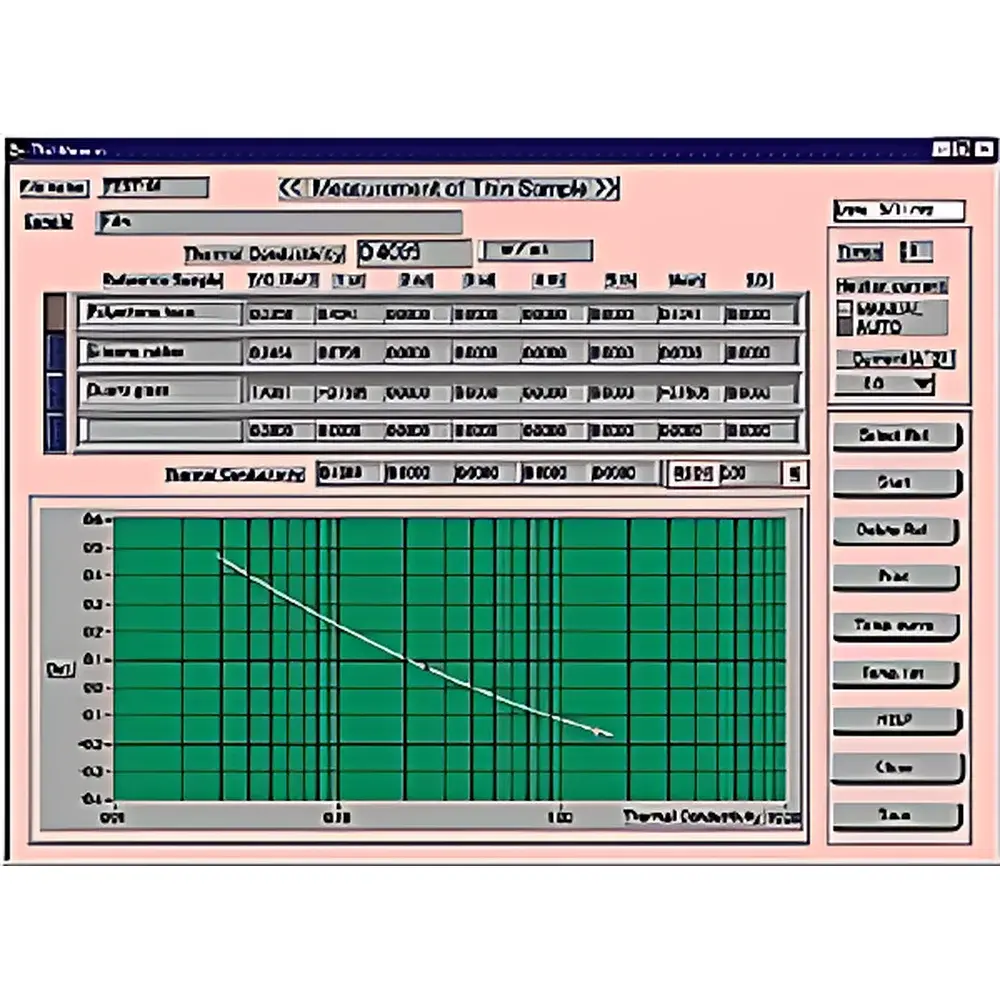
KEM SOFT-QTM Thin-Film Thermal Conductivity Measurement Software for QTM-500 Hot-Wire Analyzer
| Brand | Kyoto Electronics Manufacturing (KEM) |
|---|---|
| Origin | Japan |
| Manufacturer Type | Original Equipment Manufacturer (OEM) |
| Import Status | Imported Instrument |
| Model | SOFT-QTM |
| Measurement Principle | Transient Hot-Wire Method |
| Dimensions (L×W×H) | 300 × 475 × 175 mm |
| Accuracy | ±5% |
| Thermal Conductivity Range | 0.023–12 W/m·K |
| Repeatability | ±3% |
| Sample Thickness Compatibility | 30 µm – 10 mm |
| Supported Sample Thermal Conductivity Range (Software-Calibrated) | 0.035–5.0 W/m·K |
Overview
KEM SOFT-QTM is dedicated control and analysis software engineered exclusively for the QTM-500 Transient Hot-Wire Thermal Conductivity Analyzer. It enables precise, automated measurement of thermal conductivity in thin-sheet and low-thickness solid materials—ranging from flexible polymers and elastomers to porous ceramics, paperboard, textiles, and thin wood composites. The software implements the ASTM D5930 standard-compliant transient hot-wire method, wherein a fine platinum wire embedded between two sample layers serves as both heater and temperature sensor. A controlled current pulse induces a rapid, localized temperature rise; the resulting time-dependent voltage response is captured at microsecond resolution and converted into thermal conductivity using the fundamental relation k = (π·d²·ρ·V²·t)/(4·ln(t/t₀)), where k is thermal conductivity, d is wire diameter, ρ is wire resistivity, V is measured voltage, and t is elapsed time after pulse initiation. SOFT-QTM integrates real-time signal conditioning, automatic baseline correction, and multi-point calibration traceability—ensuring measurements meet ISO/IEC 17025 requirements for accredited laboratories.
Key Features
- Fully automated acquisition and calculation workflow optimized for thin-sheet geometry (30 µm to 10 mm thickness), minimizing edge-effect artifacts via dynamic contact-pressure compensation algorithms
- Multi-sample batch processing with configurable pass/fail criteria based on user-defined uncertainty thresholds (±3% repeatability verified per IEC 60584-2)
- Embedded calibration manager supporting NIST-traceable reference standards (e.g., Pyrex glass, sapphire, and certified polymer films)
- Real-time thermal diffusivity derivation alongside conductivity output—enabling simultaneous evaluation of thermal inertia and heat transfer kinetics
- Export-ready data formatting compliant with ASTM E1461 and ISO 22007-2 reporting structures, including raw voltage vs. time arrays, fitted slope coefficients, and expanded uncertainty budgets (k=2)
- Role-based access control with audit trail logging aligned with FDA 21 CFR Part 11 requirements for electronic records and signatures
Sample Compatibility & Compliance
SOFT-QTM supports non-destructive, contact-based thermal characterization of isotropic and semi-crystalline sheet materials with minimal preparation. Validated substrates include silicone rubber sheets (Shore A 30–80), polyethylene terephthalate (PET) films, alumina-coated paper, cotton-linen blends, medium-density fiberboard (MDF) laminates, and fired ceramic tiles (≤12 mm thickness). All measurements adhere to the boundary condition assumptions of the one-dimensional infinite-slab model under transient heating. The software enforces geometric validation checks—rejecting runs where sample thickness deviates >±2% from operator-entered values or where interfacial thermal resistance exceeds 0.5 m²·K/W (indicative of poor probe-sample contact). Regulatory alignment includes compliance with ISO 22007-2:2015 (Plastics — Determination of thermal conductivity and thermal diffusivity — Part 2: Transient plane source [hot disc] and hot-wire methods) and supports GLP/GMP documentation workflows required for QC release testing in medical device packaging and automotive interior material certification.
Software & Data Management
SOFT-QTM operates on Windows 10/11 (64-bit) and communicates with the QTM-500 hardware via USB 2.0 isolation interface, ensuring electromagnetic immunity in shared lab environments. Data storage follows a hierarchical project–sample–run structure, with each dataset archived as an encrypted .qtmx binary file containing raw ADC traces, metadata (operator ID, timestamp, environmental T/RH logs), and full calculation history. Export options include CSV (for LIMS integration), PDF analytical reports with embedded uncertainty propagation diagrams, and XML files formatted to ASTM E1382-22 schema for enterprise analytics platforms. Version-controlled software updates are delivered through KEM’s secure firmware portal, with change logs documenting all algorithmic modifications per ISO/IEC 17025 clause 7.7.2.
Applications
- Quality assurance of thermal barrier films in lithium-ion battery separators (e.g., PE/PP trilayer membranes)
- R&D screening of phase-change material (PCM)-impregnated textiles for smart apparel development
- Regulatory submission support for ASTM F1550-compliant fire-test documentation of insulation boards
- Process validation of roll-to-roll coated substrates in flexible electronics manufacturing
- Comparative aging studies of polymer film thermal degradation under accelerated UV/thermal cycling
- Material qualification for aerospace interior panels per FAR 25.853 Appendix F smoke density and heat release rate correlation
FAQ
Is SOFT-QTM compatible with third-party hot-wire analyzers?
No. SOFT-QTM is proprietary firmware and application software designed solely for bidirectional communication with KEM QTM-500 hardware. It does not support generic RS-232 or Modbus protocols.
Does the software support ISO 17025-compliant uncertainty budgeting?
Yes. The built-in uncertainty engine incorporates Type A (statistical repeatability) and Type B (calibration certificate, dimensional tolerances, ambient drift) components per GUM (JCGM 100:2008), generating expanded uncertainty reports (k=2) automatically with each measurement.
Can SOFT-QTM measure anisotropic materials such as unidirectional carbon-fiber composites?
Not without modification. The standard configuration assumes isotropic thermal behavior. Anisotropy assessment requires orthogonal sample orientation runs and post-processing using KEM’s optional QTM-Aniso module, which is separately validated per ISO 22007-4.
What is the minimum sample area required for reliable measurement?
The software enforces a minimum footprint of 25 mm × 25 mm to ensure lateral heat loss remains below 1.2% of total conduction—verified by finite-element modeling (ANSYS Thermal v23.2) across the full 0.023–12 W/m·K range.
How frequently must the QTM-500 sensor wire be recalibrated when used with SOFT-QTM?
KEM recommends annual recalibration using certified reference materials. SOFT-QTM logs all calibration events and alerts users 30 days prior to scheduled expiry, with automatic deactivation of measurement functions upon expiration unless extended via KEM-certified service contract.



