
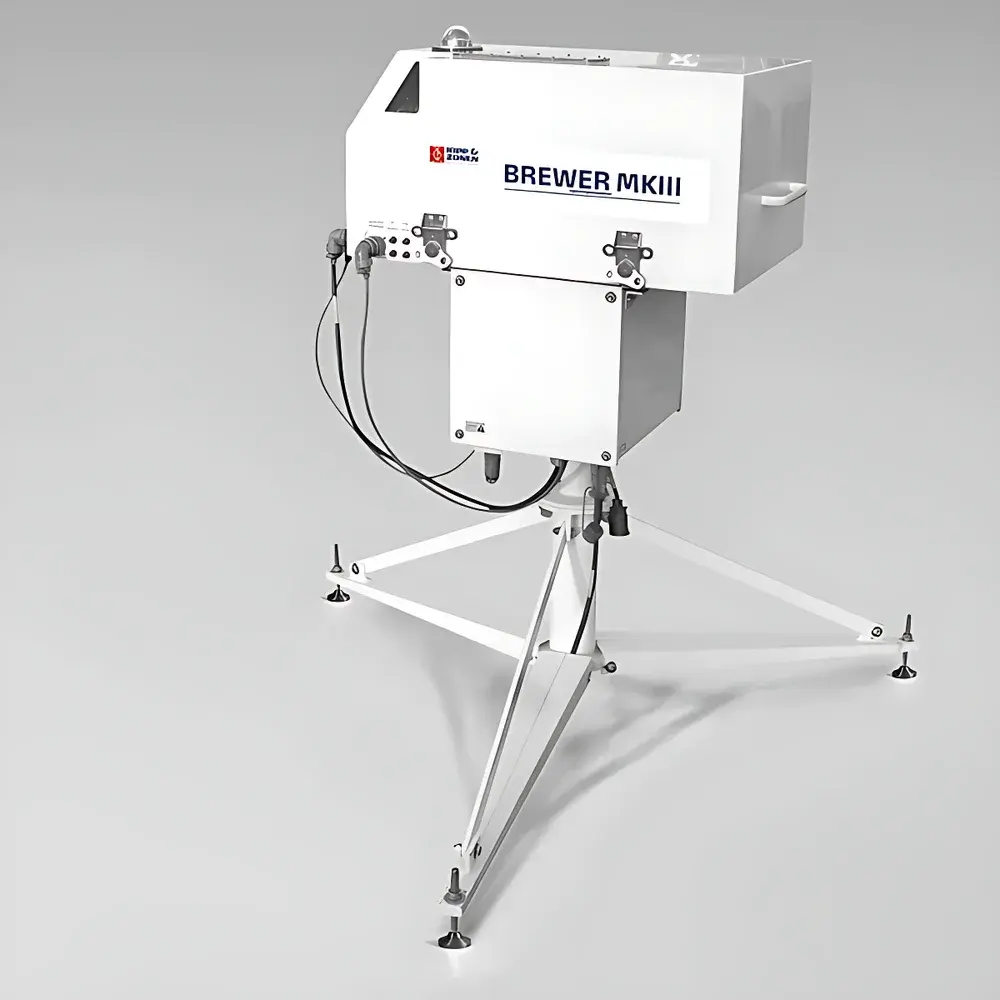
Kipp & Zonen Brewer MkIII Spectrophotometer
| Brand | Kipp & Zonen |
|---|---|
| Model | Brewer MkIII |
| Optical Design | Dual Monochromator |
| Wavelength Range | 286–363 nm (Ozone & SO₂ measurement bands) |
| Stray Light Rejection | <1×10⁻⁷ (typical) |
| Tracking System | Dual-axis solar tracker with azimuth/elevation control |
| Data Acquisition | PC-controlled via RS-232/USB, 24/7 unattended operation capable |
| Compliance | Meets WMO/GAW requirements for total ozone and UV spectral irradiance monitoring |
| Software | GW-Basic v3.75f (Kipp & Zonen validated, firmware-integrated) |
Overview
The Kipp & Zonen Brewer MkIII Spectrophotometer is a precision ground-based instrument engineered for long-term, high-accuracy monitoring of total column ozone (TCO), sulfur dioxide (SO₂), and spectral ultraviolet (UV) irradiance in the 286–363 nm range. It operates on the principle of differential optical absorption spectroscopy (DOAS), utilizing direct-sun and zenith-sky measurements to derive atmospheric trace gas concentrations and actinic UV flux. Unlike earlier MkII and MkIV variants, the MkIII employs a dual-monochromator optical architecture—comprising two cascaded Czerny-Turner monochromators with holographic gratings—which achieves stray light suppression below 1×10⁻⁷, a critical specification for reliable UV radiometric quantification under high solar zenith angles and variable atmospheric conditions. This design enhancement enables robust performance across diverse climatic zones—from polar observatories to tropical stations—and supports compliance with World Meteorological Organization (WMO) Global Atmosphere Watch (GAW) station-level requirements for ozone and UV data quality.
Key Features
- Dual-monochromator optical path optimized for ultra-low stray light (<1×10⁻⁷), ensuring high spectral fidelity in the biologically active UV-B (280–315 nm) and UV-A (315–400 nm) regions
- Automated dual-axis solar tracking system with real-time azimuth and elevation positioning, enabling continuous direct-sun observations with sub-arcminute pointing accuracy
- Integrated filter wheel with calibrated interference filters for ozone (306.3, 313.2, 316.8, 320.1, 323.1 nm), SO₂ (301.5, 310.2 nm), and reference wavelengths
- Onboard wavelength calibration using mercury and deuterium lamp references, traceable to NIST-certified standards
- Weatherproof enclosure rated IP65, designed for permanent outdoor deployment without auxiliary sheltering
- RS-232 and USB interfaces for local or remote host PC communication; compatible with Linux and Windows-based acquisition environments
Sample Compatibility & Compliance
The Brewer MkIII does not require sample preparation or consumables—it measures extraterrestrial solar irradiance attenuated by atmospheric constituents. Its operational protocol aligns with internationally recognized methodologies, including WMO GAW Photometry Guidelines (2020), ISO 17166:2019 (Erythema reference action spectrum), and ASTM E2792-22 (Standard Practice for Solar UV Spectral Irradiance Measurements). The instrument meets stringent criteria for network-level homogeneity in the Network for the Detection of Atmospheric Composition Change (NDACC) and is formally endorsed by Environment and Climate Change Canada (ECCC) as the reference standard for national ozone and UV monitoring—specifically citing its superior signal-to-noise ratio and long-term radiometric stability over legacy MkII/MkIV platforms. All firmware and calibration coefficients are maintained under controlled revision management per ISO/IEC 17025:2017 Annex A.3 requirements for measurement traceability.
Software & Data Management
The MkIII operates exclusively with Kipp & Zonen–validated GW-Basic software (v3.75f), a DOS-based, real-time acquisition and processing environment specifically architected for Brewer hardware. Version 3.75f introduces enhanced error logging, automated dark-current subtraction routines, and built-in validation checks against WMO-defined uncertainty thresholds for ozone Dobson Unit (DU) retrieval. Raw spectral scans, calibrated irradiance values, and derived geophysical products (e.g., TCO, SO₂ column density, UV index, erythemal dose rate) are stored in ASCII format compliant with GAW metadata conventions. The software supports scheduled autonomous operation—including sunrise/sunset detection, cloud-screening logic, and automatic recalibration cycles—and generates audit-ready log files required for GLP-compliant environmental monitoring programs. While no native GUI is provided, third-party Python and MATLAB toolboxes (e.g., PyBrewer, UVlib) enable post-processing interoperability with CF-netCDF and NetCDF-4 data archives.
Applications
- Long-term trend analysis of stratospheric ozone depletion and recovery in support of Montreal Protocol assessments
- Validation of satellite-derived ozone and UV products (e.g., OMI, TROPOMI, GOME-2)
- Ground-truthing of radiative transfer models (e.g., libRadtran, TUV) used in climate and health impact studies
- Quantification of UV-induced biological damage potential via spectral weighting with CIE erythema, DNA damage, and plant growth action spectra
- Volcanic SO₂ plume detection and quantification during eruptive events
- Calibration transfer between Brewer networks and reference triad instruments (e.g., Dobson, SAOZ, Pandora)
FAQ
Is the Brewer MkIII compliant with FDA 21 CFR Part 11 or similar regulatory frameworks for electronic records?
No—the Brewer MkIII is an environmental monitoring instrument intended for atmospheric research and operational meteorology, not clinical or pharmaceutical applications. Its data management architecture follows WMO GAW and ISO/IEC 17025 guidelines for environmental measurement integrity, including timestamped audit logs and firmware version tracking.
Can the MkIII operate without continuous PC connectivity?
Yes. While real-time control and data streaming require a host PC, the instrument’s internal controller maintains full autonomous operation—including solar tracking, filter selection, and spectral acquisition—for up to 72 hours on battery backup (with optional UPS integration).
Does Kipp & Zonen provide calibration services traceable to international standards?
Yes. Factory calibrations use NIST-traceable mercury and deuterium lamps, and field recalibrations are performed by Kipp & Zonen–authorized service centers following documented SOPs aligned with WMO GAW Calibration Reference Centre protocols.
What is the typical maintenance interval for the MkIII optical train?
Under standard deployment conditions, mirror reflectivity and grating efficiency are verified annually; full optical alignment is recommended every 5 years or after transport-related shock events, per Kipp & Zonen Technical Bulletin TB-MKIII-OP-02.
Related Products







