
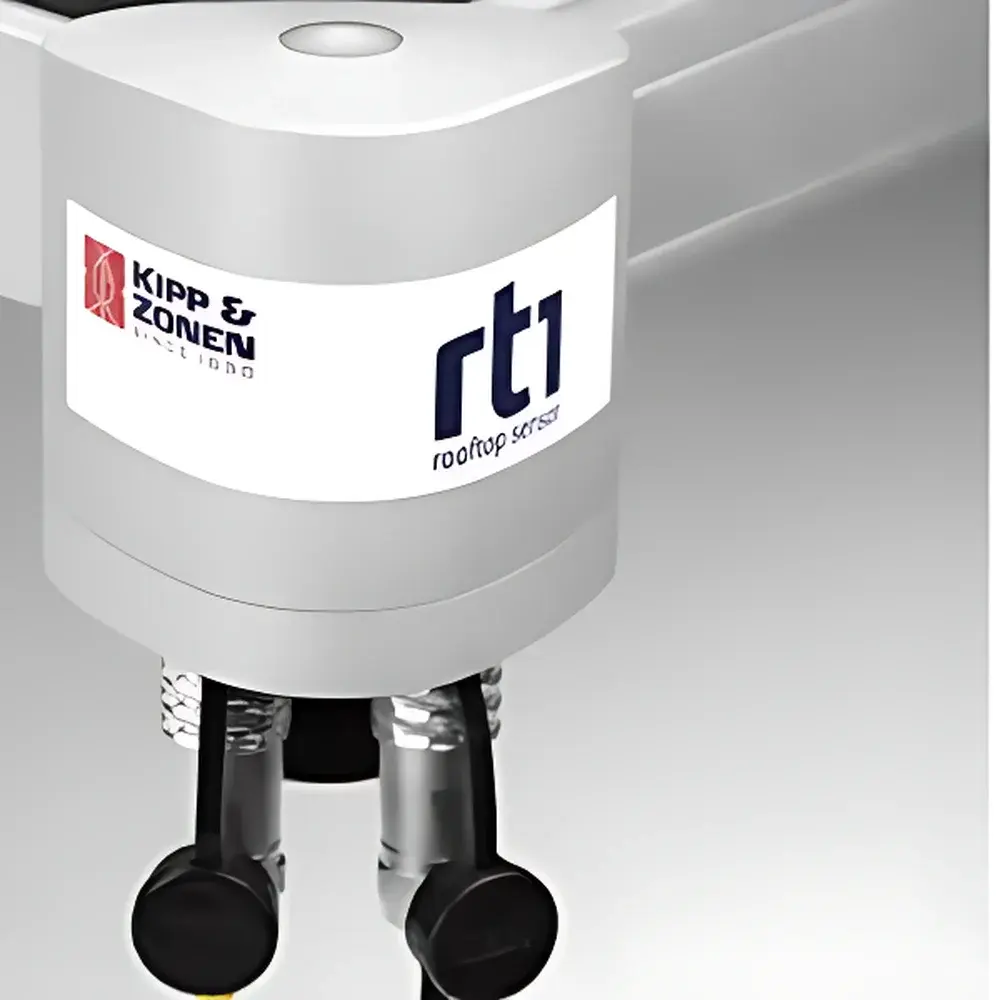
Kipp & Zonen RT1 Rooftop Photovoltaic Performance Monitor
| Brand | Kipp & Zonen |
|---|---|
| Origin | Netherlands |
| Model | RT1 |
| Sensor Type | Dual-channel digital pyranometer + backsheet temperature probe |
| Mounting | Corner-mount compatible with standard PV modules |
| Calibration Stability | ±2% uncertainty maintained for 5 years without recalibration |
| Output | RS-485 (Modbus RTU) or optional analog 4–20 mA |
| IP Rating | IP67 |
| Operating Temperature | −40 °C to +80 °C |
| Dimensions | 120 × 120 × 45 mm (L × W × H) |
| Weight | 320 g |
Overview
The Kipp & Zonen RT1 Rooftop Photovoltaic Performance Monitor is an integrated, field-deployable instrumentation system engineered specifically for real-time performance assessment of grid-connected commercial and industrial photovoltaic (PV) installations. Unlike generic irradiance meters, the RT1 implements a co-located, dual-sensor architecture: a thermopile-based pyranometer compliant with ISO 9060:2018 Class C specifications measures plane-of-array (POA) solar irradiance, while a precision NTC thermistor—mounted via plug-in cable to the rear surface of the PV module—simultaneously captures module backsheet temperature. This synchronized, spatially correlated measurement pair enables accurate calculation of performance ratio (PR), temperature-corrected yield, and degradation trend analysis per IEC 61724-1:2021 requirements. The RT1’s compact, low-profile housing is mechanically optimized for corner mounting on crystalline silicon (c-Si) and thin-film PV modules without interfering with cleaning cycles or structural loading profiles.
Key Features
- Integrated dual-sensor design: Class C pyranometer + calibrated NTC backsheet temperature probe in a single ruggedized enclosure
- Corner-mount form factor: 120 mm × 120 mm footprint aligns with standard PV module frame geometry; no drilling or adhesive required
- Digital output via RS-485 Modbus RTU (default) with configurable baud rates (9.6–115.2 kbps); optional 4–20 mA analog output for legacy SCADA integration
- Five-year calibration stability: Factory-calibrated traceability to World Radiometric Reference (WRR); drift ≤ ±2% over 60 months under typical rooftop exposure conditions
- IP67-rated enclosure with UV-stabilized polycarbonate housing and stainless-steel mounting hardware for long-term outdoor reliability
- Low thermal mass construction minimizes self-heating error during high-irradiance operation; spectral response matched to c-Si and CdTe PV spectral responsivity
Sample Compatibility & Compliance
The RT1 is validated for deployment across monofacial and bifacial crystalline silicon (c-Si), cadmium telluride (CdTe), and copper indium gallium selenide (CIGS) PV systems operating under IEC 61215, IEC 61730, and UL 1703 certification frameworks. Its POA irradiance measurement conforms to ISO 9060:2018 Class C classification, supporting data validity for bankable performance reporting under IEC 61724-1:2021 Tier B monitoring requirements. Backsheet temperature accuracy (±0.5 °C at 25 °C) meets the thermal input specification for PV system modeling tools including PVsyst v7.4+ and SAM (System Advisor Model). All firmware and configuration utilities comply with IEC 62443-3-3 cybersecurity baseline standards for industrial control systems.
Software & Data Management
Data from the RT1 integrates natively with Kipp & Zonen’s Solys 2 Cloud Gateway and third-party energy management platforms (e.g., Schneider Electric EcoStruxure, Siemens Desigo CC) via standard Modbus register mapping. Raw sensor outputs—including irradiance (W/m²), backsheet temperature (°C), internal sensor temperature (°C), and diagnostic flags—are timestamped with microsecond resolution using onboard real-time clock (RTC) synchronized via NTP when connected to networked gateways. Firmware updates are delivered over-the-air (OTA) with cryptographic signature verification. Audit logs record all configuration changes, calibration events, and communication errors in accordance with ISO/IEC 17025:2017 documentation requirements for accredited testing laboratories.
Applications
- Performance ratio (PR) monitoring for O&M contractors managing multi-MW commercial rooftop portfolios
- Temperature-corrected yield validation during commissioning and post-warranty performance guarantee assessments
- Long-term degradation rate analysis aligned with IEEE 1547-2018 and EN 50549-1 grid interconnection standards
- Input source for AI-driven soiling detection algorithms using irradiance–temperature–power residual modeling
- Reference sensor in comparative string-level monitoring deployments where cost-per-node constraints limit use of full IV curve tracers
FAQ
Is the RT1 suitable for bifacial PV arrays?
Yes—the RT1’s POA irradiance measurement remains valid for bifacial systems when mounted on the array plane; however, rear-side albedo contribution must be modeled separately using ground-reflected irradiance data from a second upward-facing sensor.
Does the RT1 require periodic field recalibration?
No. The unit is factory-calibrated with five-year stability assurance under normal exposure; recalibration is only recommended after physical damage, extreme thermal shock (>100 °C differential), or if audit trail review indicates out-of-spec deviation beyond ±2%.
Can the RT1 interface directly with inverters that lack Modbus capability?
Yes—via optional 4–20 mA analog output, enabling compatibility with inverters and PLCs supporting analog input channels for irradiance and temperature signals.
What mounting hardware is included?
The RT1 ships with stainless-steel L-bracket, M5 mounting screws, and silicone-based sealing gasket designed for direct attachment to aluminum PV module frames without penetrative fasteners.
Related Products







